

 Français
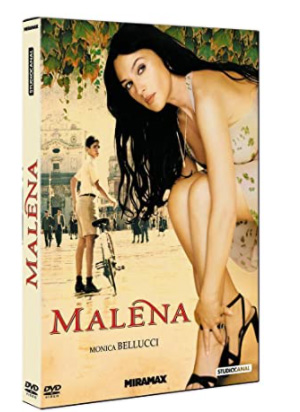
Malèna
Synopsis
In 1940, as Italy enters the Second World War, a teenage boy named Renato falls hopelessly in love with Malèna, the beautiful young wife of a soldier at the front. The whole Sicilian town watches her with desire, envy and suspicion, and Renato follows her in secret. When her husband is reported dead and she is left without protection or income, the rumours turn into cruelty. The boy, powerless but devoted, watches over her as the town gradually destroys her reputation.
The Making of the Film
Malèna was directed by Giuseppe Tornatore, the Sicilian filmmaker who won the Oscar for Best Foreign Language Film with Cinema Paradiso. Once again, he chose to set a story in the Sicily of his imagination, a world of small-town gossip, church bells and adolescent dreams. The film is a coming-of-age story told through the memories of the adult Renato, which allows Tornatore to blend nostalgia with irony. It was an Italian and American co-production linked to Miramax and was released in 2000. Tornatore wanted to explore how a community can turn a woman's beauty into a pretext for hatred. The Second World War provides a backdrop in which men leave and women are left to judge each other, with the absence of men intensifying the tension. The film was shot in Sicily, in the south-east of the island, among baroque streets and sunlit squares. It gave Tornatore the chance to work again with the composer Ennio Morricone and to build the film around the face and presence of Monica Bellucci.
Critical Reception
Critics were divided on Malèna. Many admired the film's visual beauty, with its warm cinematography and carefully composed street scenes, and praised Monica Bellucci's magnetic presence. Others found the story superficial and accused it of treating the heroine more as an object of desire than as a fully realised character. Comparisons with Cinema Paradiso were inevitable, and some felt that Malèna lacked the emotional warmth of Tornatore's earlier masterpiece, while others valued its darker view of small-town cruelty.
The film reached audiences in Italy and abroad and helped reinforce Monica Bellucci's international profile. Viewers often responded to its mixture of nostalgia, humour and brutality, and the film has remained one of the best-known recent works of Italian cinema. Its portrayal of the humiliation of Malèna in the town square remains one of the scenes people remember most strongly.
Malèna received two Academy Award nominations at the ceremony held in 2001, one for Best Original Score for Ennio Morricone and one for Best Cinematography for Lajos Koltai. It did not win in either category, since the prizes went to Tan Dun for Crouching Tiger, Hidden Dragon and to Peter Pau for the same film. The nominations nonetheless underlined the strength of the film's music and imagery. They also confirmed the Tornatore and Morricone partnership as one of the most admired in European cinema.
Filming anecdotes
The role of Malèna is built largely on silence, since Monica Bellucci speaks very few lines, and her character is defined by how the town sees her. The young Giuseppe Sulfaro, who plays Renato, was a newcomer chosen to carry the story's emotional weight as the film's point of view. Tornatore filmed Sicily as a place of memory, with streets and squares that seem to belong as much to the imagination as to geography. The film's most discussed scene, in which the women of the town turn on Malèna, was staged with a deliberate intensity that makes the audience feel complicit in the cruelty.
Themes explored
Malèna is first of all a portrait of adolescent desire and of the way a young boy builds a private religion around an unreachable woman. The film is equally a study of the gaze, since the whole town looks at Malèna and each person projects their own fantasies, resentments and fears onto her. Gossip is shown as a social weapon, capable of turning a lonely woman into a scapegoat. The story also explores the jealousy and hypocrisy of the women, who condemn her for the attention she receives rather than for anything she has done. The war and the fascist atmosphere form a darker backdrop, with patriotic speeches contrasting with the pettiness and violence of everyday life. Memory and nostalgia colour the narration, as the adult Renato looks back on a time when he did not understand everything he saw. The loss of innocence is central, as the boy discovers that adults can be cruel. Beneath its sensual surface, the film is a reflection on loneliness and on the human need to be seen, not merely looked at.
Ending explained
After the war, Malèna is publicly humiliated by the women of the town in a violent scene that marks the lowest point of her story. She leaves town, but her husband, who was believed dead, returns wounded and searches for her. When she comes back with him, the community that destroyed her slowly changes its attitude and accepts her. Renato, who has loved her silently from afar, watches the scene without being able to speak to her. The final images emphasise how small and ordinary a gesture of kindness can be after so much cruelty. The adult narration suggests that this was a love he never forgot, even though it was never returned in the way he hoped. The ending is both tender and bitter, because the town's change of heart cannot undo the harm already done. It leaves the audience with the idea that memory preserves some people forever, even when they have no idea how much they mattered to someone.
Meaning of the title
The title Malèna is simply the name of the heroine, but in this case the name is the whole film. It is the word that the boys of the town whisper, the name that men desire and women resent, and the name that Renato carries through his life. Malèna is a variant of Magdalena, which can evoke Mary Magdalene, the woman history has so often judged and misunderstood. By naming the film after her, Tornatore gives the central place to the person the town tries to reduce to a rumour. The title also reminds us that Malèna is seen mostly through the eyes of others, so her name becomes a screen on which people project their desires and prejudices. Its sound, soft and sensual, matches the way the film presents her. At the same time, the name carries a hint of tragedy, since the film shows how easily a person can be destroyed by a reputation. In that sense, the title is both an homage and an accusation.
Original Soundtrack
Ennio Morricone's score is one of the film's greatest strengths and earned him an Academy Award nomination for Best Original Score. It continues his long collaboration with Giuseppe Tornatore, which began with Cinema Paradiso and became one of the most celebrated director and composer partnerships in cinema. The music blends sensuality, nostalgia and melancholy, matching Renato's romantic memories and the sadness beneath the story. Morricone uses lyrical melodies to underline Malèna's loneliness, while lighter themes capture the boy's adolescent fantasies. The score also helps the film move between comedy and tragedy without ever losing its emotional thread. Many viewers remember the music as much as the images, and it remains one of the finest examples of Morricone's gift for turning a character's inner life into melody.
Similar Films
If you were moved by Malèna, start with Cinema Paradiso, Tornatore's most beloved film, which also looks back on a Sicilian childhood with nostalgia and tenderness. His later film The Legend of 1900 shares the same lyrical sensibility and the music of Morricone. Federico Fellini's Amarcord offers another comic and bittersweet portrait of adolescence under fascism, complete with an iconic desired woman. Summer of '42 tells the story of a teenage boy who falls in love with an older woman while her husband is away at war. Il Postino, with its gentle Italian setting and its theme of love and poetry, is another good companion. Life Is Beautiful, by Roberto Benigni, also mixes humour and tragedy against the backdrop of wartime Italy. Fans of Monica Bellucci might also look at her other European films from the same period. Together these films create a rich picture of how Italian cinema remembers its past.