

 Français
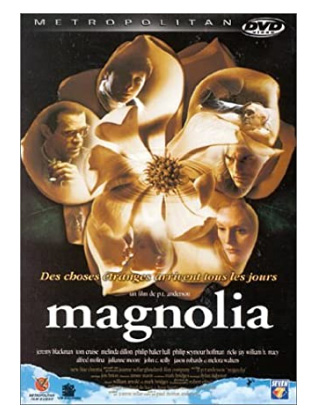
Magnolia
Synopsis
Over a single day in the San Fernando Valley, the lives of a group of strangers become entangled in unexpected ways. A dying television producer wants to see his estranged son, a charismatic self-help guru, one last time. A former quiz-show child prodigy, now a lonely adult, dreams of love, while a kind-hearted police officer tries to help those he meets. As the day goes on and the rain begins to fall, each of them faces the consequences of their past choices and searches for connection.
The Making of the Film
Magnolia was written and directed by Paul Thomas Anderson, who had made a name for himself with Hard Eight and Boogie Nights. After the success of the latter, he was given a great deal of creative freedom, and he used it to write an ambitious ensemble drama. Anderson has said that the project grew out of the music of Aimee Mann, whose songs had inspired him to write about lonely people trying to connect. The film's structure, which follows many characters through a single day, was influenced by the work of Robert Altman, particularly Short Cuts and Nashville. The opening sequence, which presents a series of improbable coincidences, sets out the film's theme that strange things happen all the time. Anderson wrote the film quickly, in a matter of months, and filled it with an extraordinary cast, including Tom Cruise, Julianne Moore, Philip Seymour Hoffman, William H. Macy, John C. Reilly and Jason Robards. The story is set in the San Fernando Valley, which Anderson knew well from his childhood. The film was released at the end of 1999 and, at over three hours, was one of the longest and most daring American films of its year.
Critical Reception
Critics were deeply divided but largely admiring. Many hailed Magnolia as a bold and emotionally rich film, praising its ambition, its ensemble acting and its willingness to take risks. Tom Cruise's turn as a vulgar self-help guru was singled out as a revelation. Others found the film overlong, melodramatic and self-indulgent, particularly in its famous and surreal climax. Over time its reputation has grown, and many now consider it one of the most important American films of its decade.
Audiences were more mixed, partly because of the film's length and unconventional structure. It made a modest amount at the box office, but it has since acquired a devoted following. Many viewers describe it as a film that they found overwhelming on first viewing and then rewarded with repeated viewings. The sequence in which the characters sing along to an Aimee Mann song is often cited as one of its most moving moments. It remains one of Anderson's most discussed and debated works.
Magnolia won the Golden Bear at the 2000 Berlin International Film Festival, the festival's top prize. Tom Cruise won the Golden Globe for Best Supporting Actor and received an Academy Award nomination in the same category. The film also received Oscar nominations for Best Original Screenplay and for Best Original Song, for Aimee Mann's Save Me. These recognitions confirmed Anderson's place as one of the most original voices in American cinema.
Filming anecdotes
The film's famous prologue, with its stories of improbable coincidences, sets the tone for a film in which fate and chance are central. Aimee Mann's songs run through the whole film, and in one memorable sequence the characters, each in their own place, sing along to a song as a way of sharing their pain. The rain of frogs that occurs near the end, which stunned many viewers, was based on a biblical reference to a plague, and the numbers 8 and 2 appear throughout the film as a quiet allusion to the passage in Exodus. Jason Robards, in one of his last major film roles, gave a moving performance as the dying Earl Partridge. Tom Cruise, who had been known for more conventional leading roles, surprised audiences with his intense and unexpected performance.
Themes explored
At its heart, Magnolia is a film about connection and loneliness, and about the way people hurt one another and try to heal. It examines the relationship between parents and children, showing how neglect and abuse can echo through generations. Forgiveness is a central theme, as several characters must decide whether they can forgive those who wronged them. The film also explores chance and coincidence, suggesting that what appears to be random may be part of a larger pattern. Regret and the need for redemption weigh on nearly every character, particularly in the final hours of the day. Success and failure, especially in the world of television, are shown to be fragile and often cruel. Love, however unlikely, appears as the force that can break through isolation. The story is held together by a sense of compassion, which allows even its most flawed characters to be treated with empathy.
Ending explained
The film reaches its climax when an extraordinary rain of frogs falls over the Valley, interrupting the tension and chaos of the evening. This surreal event, which seems to be the result of an outside force, shakes the characters out of their routines and brings the various storylines to a head. In the aftermath, several characters begin to open up, finding unexpected moments of tenderness and reconciliation. The police officer Jim Kurring helps a distressed Donnie, while the young Stanley finally tells his father what he needs to say. Frank, the self-help guru, comes to the bedside of his dying father and releases some of his anger. The last image of Claudia, who looks directly into the camera and smiles, offers a quiet note of hope. The ending suggests that, while we cannot control the strange events of life, we can still choose to forgive and to reach out. It leaves the audience with a feeling of grace after a day of pain.
Meaning of the title
Magnolia takes its name from Magnolia Boulevard, a long street that runs through the San Fernando Valley, where the film is set. Anderson grew up in the Valley and used the street as a symbol of the ordinary suburban setting where extraordinary things can happen. The magnolia is also a flower known for its beauty and its resilience, which can be seen as a metaphor for the characters who endure through hardship. The title is simple and poetic, which contrasts with the complexity of the film. It also suggests a certain Southern softness, even though the story is set in California. The name does not point to any one character, which fits the film's ensemble nature. It acts as a quiet unifying symbol for a group of people who are connected without knowing it. In this way, the title captures both the geography and the emotional tone of the story.
Original Soundtrack
Aimee Mann's songs are at the very heart of Magnolia, and the film is almost unthinkable without them. Anderson was so inspired by her music that he wrote much of the screenplay with her lyrics in mind, and several of her songs are used in the film. Her song Save Me, which she wrote for the film, received an Academy Award nomination for Best Original Song. The scene in which the characters sing along to Wise Up, each in their own place, is one of the most celebrated musical moments in recent American cinema. Jon Brion composed the film's orchestral score, which blends delicate melodies with moments of swelling emotion. Together, the songs and the score give the film a melancholic and tender atmosphere. Many viewers consider the soundtrack to be among the best of its decade.
Similar Films
If you enjoyed Magnolia, the first film to see is Paul Thomas Anderson's own Boogie Nights, which also follows an ensemble of characters in the San Fernando Valley. Short Cuts, by Robert Altman, interweaves many stories in Los Angeles in a similar fashion. Nashville, also by Altman, is a classic of the ensemble drama. Crash, from 2004, tells interlocking stories about race and connection in the same city. Babel offers another globe-spanning set of connected stories. Punch-Drunk Love, also by Anderson, shows a more intimate and quirky side of the director. There Will Be Blood, his later film, is a darker and more epic work. Together these films explore how individual lives intersect in unexpected ways.