

 Français
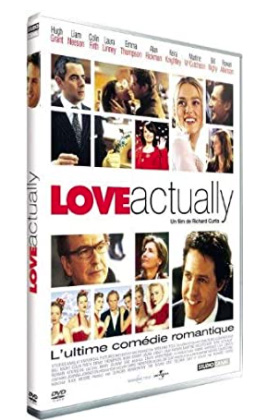
Love Actually
Synopsis
Set in the weeks leading up to Christmas, *Love Actually* follows a sprawling group of interconnected Londoners as they navigate romance, heartbreak and friendship. A new Prime Minister falls for a member of his staff, a widower tries to help his stepson, and a rock star releases a Christmas single. Across a dozen storylines, the film shows love in all its forms, from joyful to painful. It is a warm, funny and unashamedly sentimental holiday ensemble.
The Making of the Film
Love Actually was written and directed by Richard Curtis, the screenwriter behind Four Weddings and a Funeral, Notting Hill and Bridget Jones's Diary. It was his directorial debut, and he wanted to explore love in many different forms rather than focus on a single romance. Curtis had long dreamed of making a film that combined several stories in one narrative, inspired by the idea that love is all around us. The impressive cast included Hugh Grant, Emma Thompson, Colin Firth, Liam Neeson, Alan Rickman, Keira Knightley and Bill Nighy. The film was released in November 2003 and quickly became a seasonal favorite.
Reviews and Reception
Summary of Professional Reviews
Critics were divided. Some found the film charming, funny and heartwarming, praising its ensemble cast and witty script. Others thought it was overly sentimental and criticized the way some storylines were wrapped up too neatly.
Audience Reception
Audiences loved the film, which became a box-office success and, over the years, an annual Christmas tradition. Many viewers have their favorite storylines and scenes, from the cue-card confession to the prime minister's dance. It has also generated plenty of debate about which of its romantic gestures are sweet and which are questionable.
Awards Won
Bill Nighy won the BAFTA Award for Best Supporting Actor for his scene-stealing role as an aging rock star. The film also received Golden Globe nominations, and it won several audience-based awards in the United Kingdom.
Filming Anecdotes
Director's Inspirations
Richard Curtis wanted to capture the emotional highs and lows of the Christmas season, when feelings run strong. He believed that love exists in everyday gestures and not just in grand romantic moments.
Production Difficulties
Coordinating such a large ensemble cast with busy schedules was a challenge, and the film was shot in short bursts around London. The production also involved a large number of locations, from Downing Street to Heathrow Airport.
Anecdote About a Particular Scene
The scenes of joyful reunions at the arrivals gate of Heathrow Airport that open and close the film were filmed with real travelers, whose genuine emotions were captured on camera. They give the film an authentic emotional frame.
Themes Explored
Love Actually is a celebration of love in all its forms: romantic, familial, platonic and unrequited. It looks at the courage it takes to express feelings and the pain of loving someone who cannot love you back. The film also explores friendship, loyalty and betrayal, as characters wrestle with temptation and regret. The Christmas setting underscores themes of generosity, forgiveness and togetherness. Beneath its comedy lies a gentle claim that, in the end, love is everywhere.
Ending Explained
As the film draws to a close, several storylines reach resolutions of varying degrees of happiness, while others end in quiet bittersweetness. The final scenes return to the airport, where families and lovers greet each other with open arms. The narration reminds us that, even in a world full of hatred and greed, love is present in countless small ways. The ending is intended as a hopeful, uplifting statement rather than a literal wrap-up of every plot.
Meaning of the Title
The title plays on the phrase "love, actually", suggesting an answer to the question of what really matters in life. It reflects the film's optimistic belief that, when it comes down to it, love is the most important thing. The word "actually" gives it a typically British tone of understatement and quiet confidence.
Original Soundtrack
The soundtrack mixes pop hits and Christmas songs, including a fictional Christmas single performed in the film by Bill Nighy's character. Joni Mitchell's melancholy "Both Sides, Now" accompanies one of the film's most heartbreaking scenes. The music plays a major role in setting the mood, from joyful celebrations to private sorrow.
News
In 2017, the cast reunited for a short sequel called Red Nose Day Actually, made to raise money for charity. It checked in on many of the original characters fourteen years after the events of the film.
Similar Films
- Notting Hill: another romantic comedy by Richard Curtis.
- Valentine's Day: an ensemble romance modeled on a similar structure.
- The Holiday: a cozy Christmas romance.
- Bridget Jones's Diary: a witty British romantic comedy.