

 Français
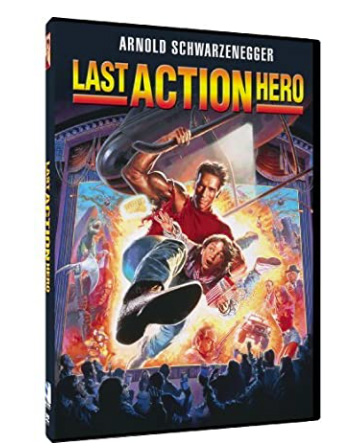
Last Action Hero
Synopsis
Danny Madigan, a young film fan, is given a magic ticket that transports him inside the latest adventure of his hero, the indestructible cop Jack Slater. Inside the movie world, everything follows the rules of an action film, with explosions, car chases and witty one-liners. When the villain Benedict discovers the ticket, he threatens to escape into the real world and take over. Danny and Slater must work together to stop him before reality becomes as dangerous as fiction.
The Making of the Film
The idea originated in a script by young writers Zak Penn and Adam Leff, who imagined a boy who enters the film world of his favourite action hero. Columbia Pictures bought the screenplay, and Arnold Schwarzenegger became attached as the star, bringing his fame as the biggest action hero of his time. The script was later reworked by Shane Black and David Arnott, who added sharper humour and a stronger satirical streak. John McTiernan, the director of Die Hard and Predator, was hired to direct, bringing his action credentials to the project. The film was designed as both a thrilling action movie and a loving parody of the genre. The story allowed Schwarzenegger to poke fun at his own screen persona. Its blend of action, comedy and fantasy was ambitious and difficult to balance. The studio pushed to release the film in the summer of 1993, a decision that would have a big impact on its fate.
Reviews and reception
Professional critics' summary
Critics were largely unkind, finding the film too messy and the tone uneven between satire and straightforward action. Some praised the inventive premise and the clever references to the action genre. Others found the humour too self-referential and the story overly complicated. Over the years, however, some critics have reassessed the film as an ahead-of-its-time deconstruction of Hollywood conventions.
Audience reception
The movie was released one week after Jurassic Park, which dominated the box office, and it quickly became a commercial disappointment. Its worldwide gross failed to cover its production and marketing costs. In the following decades, it has built a cult following among fans who appreciate its irreverence. It is now remembered as a daring and entertaining oddity in Schwarzenegger's filmography.
Awards
The film was not rewarded by the major awards ceremonies, and its poor reception at the time kept it away from the trophies. It did, however, find some recognition among fans of the genre. Over time, the film has been rediscovered, and its reputation has improved. Its true reward is the loyalty of the fans who defended it.
Filming anecdotes
Director's inspirations
John McTiernan drew on his own action classics to build a film that could both celebrate and mock them. He was inspired by the idea that cinema is a world of its own, with rules that characters can break. He included numerous references to other films, from Hamlet to Terminator 2. The film also contains a famous homage to Ingmar Bergman's The Seventh Seal, with Death stepping out of the screen.
Production difficulties
The production was rushed, with the studio demanding that the film be ready for the summer release date. Editing continued up until the last moment, and the film was reportedly not fully polished when it reached theatres. Test screenings were mixed, which led to last-minute changes. The huge scale of the action sequences also added to the difficulties and to the cost.
Anecdote about a particular scene
The film includes a scene in which Slater visits a video store and sees a poster for Terminator 2 starring Sylvester Stallone instead of Schwarzenegger. This running joke about alternate casting delighted audiences. Another highlight is the sequence where characters from different movies appear in a cameo, including Sharon Stone as Catherine Tramell. The film also features a spectacular final confrontation in the real world, where the fictional villains face real-life consequences.
Originally planned casting
Arnold Schwarzenegger was the studio's first and only choice for Jack Slater. Austin O'Brien, then a child actor, was chosen to play Danny after a wide casting search. Charles Dance, an acclaimed British actor, brought a cold elegance to the villain Benedict. Anthony Quinn, F. Murray Abraham and Ian McKellen also appear in supporting roles.
Themes explored
The film explores the relationship between fiction and reality, and what happens when the two collide. It questions the conventions of action cinema, in which heroes never die and justice is always served. Danny's journey shows how fans use movies to escape from real-life problems such as the loss of his father. The movie also reflects on the nature of heroes, asking whether they can exist outside of a script. Another theme is the cost of violence, since in the real world, bullets hurt and people die. It also plays with the idea of celebrity, when Schwarzenegger meets his fictional counterpart. The story suggests that fiction can inspire us, but cannot replace real life. At its heart is a love letter to cinema and to the people who watch it.
Ending explained
In the climax, the villain Benedict uses the magic ticket to escape into the real world, where he intends to bring other villains to life. Slater, now out of the film, discovers that he is vulnerable and that actions have consequences. With Danny's help, he faces Benedict during a premiere and defeats him. Benedict is killed, and the threat to reality disappears. Slater must return to his own world, as he does not belong in ours. Before leaving, he gives Danny some advice about how to handle his own life and grief. The film ends with a final scene in which Slater meets Schwarzenegger himself, who is both a star and a regular man. This closing moment emphasises the difference between a screen hero and a real person.
Meaning of the title
The title is a play on the idea of the ultimate action hero, the last of a dying breed. By the early 1990s, the type of muscular, invincible hero that Schwarzenegger incarnated was beginning to decline. The film uses this idea to comment on the end of an era in action cinema. It also refers to the fact that Jack Slater is a fictional character, living in a movie where he is the last guardian of justice. For Danny, the title carries emotional meaning, as Slater is his last source of hope. The phrase can also be read ironically, hinting at the end of the 1980s style of film. Whatever the interpretation, it perfectly conveys the film's mix of nostalgia and parody.
Original Soundtrack
Michael Kamen composed the score, which mixes orchestral action music with playful touches. The film also features a hard rock soundtrack, with songs by AC/DC, Megadeth, Alice in Chains and others. AC/DC's Big Gun, written for the film, became one of its most recognisable tracks.
Similar Films
True Lies, also starring Arnold Schwarzenegger, is a more traditional action comedy. The Purple Rose of Cairo by Woody Allen is another film in which a character steps out of the screen. Who Framed Roger Rabbit and Free Guy also mix fantasy worlds with real life. Hot Shots! and The Naked Gun are other parodies of the action genre.