

 Français
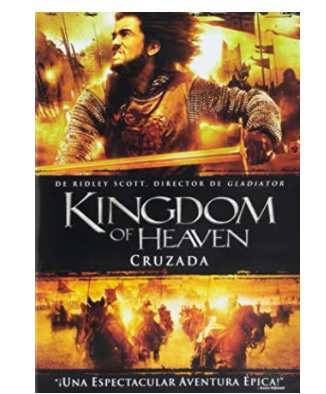
Kingdom of Heaven
Synopsis
In twelfth-century France, Balian is a blacksmith mourning the loss of his wife when a knight arrives and reveals that he is the man's father. Balian follows him to the Holy Land, where he inherits his father's title and finds himself caught up in the fragile peace between Christians and Muslims in Jerusalem. As tensions rise, he is forced to defend the city against the armies of Saladin. The film is a sweeping epic about faith, honor and the fight for a city sacred to many.
The Making of the Film
Kingdom of Heaven is a historical epic directed by Ridley Scott, who had previously made "Gladiator" and other large-scale adventures. The screenplay was written by William Monahan, who set the story in the years leading up to the fall of Jerusalem in 1187. Orlando Bloom plays Balian, supported by Eva Green, Liam Neeson, Jeremy Irons, Brendan Gleeson and Edward Norton. Ghassan Massoud plays Saladin, giving the Muslim leader a dignified and nuanced portrayal. The film was shot in Morocco and Spain, with enormous sets and thousands of extras. It was released in the spring of 2005.
Reviews and Reception
Summary of Professional Reviews
The theatrical version received mixed reviews, with critics praising its visuals and battle scenes but criticizing the story and character development. Many felt that the film was overly cut and that Balian's transformation was too rapid. When the longer Director's Cut was released in 2006, it received far more enthusiastic reviews, and many critics considered it a major improvement. The film has since been re-evaluated as one of Scott's underrated works.
Audience Reception
The film earned more than 200 million dollars worldwide, but was considered a disappointment in the United States. Viewers who discovered the Director's Cut often described it as a completely different and far more satisfying experience. Its portrayal of Muslims and Christians was praised by many for its relative balance. Over the years, it has gained a strong following among fans of historical epics.
Filming Anecdotes
Production Challenges
The production took place in challenging conditions, including the heat of the Moroccan desert. Massive sets, including a full-scale recreation of Jerusalem, had to be built and populated with thousands of extras. Scott later said that studio pressure to shorten the film harmed its story, which is why he released a longer cut.
Anecdote About a Particular Scene
The character of King Baldwin IV, who suffers from leprosy, is played by Edward Norton behind a silver mask. The actor's face is hidden throughout his scenes, so his performance relies almost entirely on his voice and posture. Many viewers consider the role one of the most memorable in the film.
Themes Explored
The film is a reflection on religious conflict and the possibility of coexistence. It contrasts the fanaticism of some characters with the tolerance of others, suggesting that peace depends on individual choices. Honor and duty are central to Balian's journey, as he learns what it means to protect the weak. Faith is treated in a complex way, as a source of both hope and violence. The story also explores identity, as a humble blacksmith becomes a leader of men. At its core, it asks whether a city can belong to everyone.
Ending Explained
After a brutal siege, Balian negotiates the surrender of Jerusalem to Saladin in exchange for the safety of its inhabitants. The film does not portray the conflict as a clear victory for either side, but as a human compromise that saves lives. Balian returns to France, where he meets King Richard, who is on his way to the Holy Land. The ending underlines that the cycle of conflict will continue, even if the characters have chosen mercy.
Meaning of the Title
"Kingdom of Heaven" refers to the spiritual ideal that the characters seek, which is not necessarily tied to a physical city. In the film, Balian is told that the kingdom is either in the conscience of every person or nowhere at all. The title therefore points to the idea that peace and goodness must be created by humans themselves.
Soundtrack
The score was composed by Harry Gregson-Williams, who blends orchestral grandeur with vocal and Middle Eastern influences. His music gives the film a sweeping, spiritual character that matches the epic scale of the story. It is widely admired as one of the highlights of the production.
News
Ridley Scott released a longer Director's Cut of the film in 2006, which is widely considered the definitive version and significantly changed its reputation.
Similar Films
- Gladiator (2000): Scott's earlier historical epic.
- Braveheart (1995): a sweeping tale of rebellion and honor.
- Robin Hood (2010): another Scott film set in the Middle Ages.
- Alexander (2004): a large-scale historical epic.