

 Français
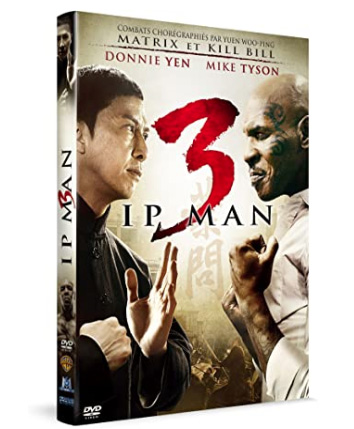
Ip Man 3
Synopsis
In 1959 Hong Kong, Ip Man is now a respected master who teaches Wing Chun at a local school. When a gang of thugs led by a ruthless property developer tries to seize the school's land, Ip Man steps in to protect the children. At the same time, a rival Wing Chun practitioner, Cheung Tin-chi, challenges his place as the grandmaster. As his wife's health begins to fail, Ip Man must decide how to balance his duties as a teacher, a protector and a husband.
The Making of the Film
After the success of the first two films, Wilson Yip and Donnie Yen decided to continue the story and to explore the later years of Ip Man's life. The third film moves the story to 1959, when Ip Man was already known as a master in Hong Kong, and it introduces a more personal dimension. The filmmakers wanted to show the toll of fame and responsibility on a family man. The script includes the conflict with real estate gangsters, a theme that resonates with the problems of urban development in Hong Kong. To make the film more spectacular, they hired Mike Tyson to play the villain Frank, a boxer-turned-gangster. Yuen Woo-ping, a legendary action choreographer known for The Matrix, was brought in to design the fights. The film was also shot with 3D cameras, which was a first for the series. It was conceived as an emotional chapter that would deepen the character.
Reviews and reception
Professional critics' summary
Critics were divided, with many praising the action and the emotional scenes, while others found the plot thinner than before. The fight between Ip Man and Mike Tyson was widely discussed, even though the boxer's role was relatively small. Donnie Yen was admired for his restrained and moving performance, particularly in scenes with his wife. Some reviewers found the story of the rival Wing Chun master more interesting than the main plot.
Audience reception
The film earned a large sum at the box office, particularly in China, where it surpassed the earlier films. Audiences enjoyed the new action choreography and the presence of a famous guest star. Fans of the series appreciated the more intimate portrait of Ip Man. It confirmed the franchise as a major success in Asian cinema.
Awards
The film earned nominations at the Hong Kong Film Awards and other Asian ceremonies. It was recognised for its action choreography and for the performance of Donnie Yen. Max Zhang's work as Cheung Tin-chi was also noticed by critics. It remains one of the highest-grossing films in the series.
Filming anecdotes
Director's inspirations
Wilson Yip wanted to show the human side of a legend, focusing on love and family rather than only on fighting. He drew on the traditions of melodrama and on stories of ageing masters facing a new generation. The film also aimed to pay homage to the real Ip Man's legacy, including his relationship with Bruce Lee. Yip wanted a balance between emotional drama and large-scale action.
Production difficulties
The production had to coordinate a large international cast, including Mike Tyson, who was unfamiliar with Hong Kong filmmaking. The fight choreography needed to adapt Tyson's boxing style to the more elegant Wing Chun moves. Working with 3D cameras also made the shoot more complicated. The cast and crew had to do many takes to capture the fight scenes safely.
Anecdote about a particular scene
The elevator fight, in which Ip Man faces several opponents in a very small space, is one of the most praised sequences. The scene shows how Wing Chun is effective in confined spaces. The face-off with Mike Tyson is another high point, with the boxer's power contrasting with Ip Man's speed. A touching scene between Ip Man and his wife in a tea house gives the film its emotional heart.
Originally planned casting
Donnie Yen returned as Ip Man, and Lynn Hung played his wife. Mike Tyson was chosen as Frank, the villain, bringing star power to the film. Max Zhang played Cheung Tin-chi, a rival Wing Chun master who becomes an ally. Danny Chan appeared as a young Bruce Lee.
Themes explored
The film is about the sacrifices that come with being a master and a husband. Ip Man must choose between his duty to the community and his love for his wife. It explores the idea of rivalry and respect between fighters, as Ip Man and Cheung Tin-chi measure themselves against each other. Another theme is the defence of the weak against corruption, represented by the gangster and his thugs. The film also touches on ageing and the passage of time. It shows the importance of legacy, as Ip Man teaches the next generation. Another subject is loyalty to one's principles, even when it costs something. Ultimately, it celebrates the quiet strength of love.
Ending explained
After defending the school, Ip Man agrees to a final duel with Cheung Tin-chi, who has challenged him for the title of grandmaster. The fight takes place in a crowded tram, where they fight with great skill and without causing damage. In the end, Ip Man wins, but he decides to spend his remaining time with his wife. She has been diagnosed with a serious illness, and he stays by her side until the end. The final scenes show Ip Man looking after her and enjoying their last moments together. A young Bruce Lee appears, hoping to learn from the master. The film ends on a bittersweet note, celebrating love and respect.
Meaning of the title
Ip Man 3 simply identifies the film as the third chapter in the story of the Wing Chun master. The number reflects the growth of the series and the loyalty of its audience. The title keeps the focus on the character, who remains the heart of the franchise. In this chapter, the name also carries a sense of legacy, as Ip Man becomes a symbol of a martial arts tradition. The simplicity of the title underlines the idea that the man himself matters more than any subtitle. It tells the audience that they can expect the same blend of action and emotion as before.
Original Soundtrack
Kenji Kawai once again composed the score, giving the film a mix of tender melodies and powerful themes for the fights. The music supports the emotional moments between Ip Man and his wife without becoming sentimental. It also adds suspense to the action sequences. The score maintains the elegant atmosphere that is a hallmark of the series.
News
The series concluded with Ip Man 4: The Finale, which takes Ip Man to the United States. Donnie Yen has said that he considers the saga complete. Spin-off projects, such as Master Z: Ip Man Legacy, have also explored the world of the films.
Similar Films
Ip Man and Ip Man 2 are the earlier chapters. Ip Man 4: The Finale concludes the story. The Grandmaster and Fearless offer other perspectives on martial arts legends. Tai Chi Master and Legend of the Fist are also worth watching.