

 Français
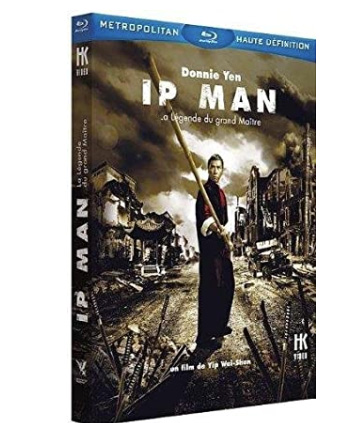
Ip Man
Synopsis
In the 1930s, Ip Man is the most respected Wing Chun master in the southern Chinese city of Foshan, living a quiet and comfortable life with his family. He refuses to open a school, preferring to test his skills in friendly duels with local masters. Everything changes in 1937 when the Japanese army invades, and Ip Man loses his home and his fortune. Forced to work as a labourer, he must decide whether to stay silent or to stand up against the occupiers.
The Making of the Film
Ip Man is a biographical martial arts film inspired by the life of Yip Man, the real Wing Chun grandmaster who later taught a young Bruce Lee in Hong Kong. At the end of the 2000s, several film projects about the legendary teacher were in competition, and the Wilson Yip version was the first to reach the screen. Producer Raymond Wong had long wanted to tell the story of Ip Man, and he brought in Donnie Yen, one of Hong Kong's biggest action stars, to play the lead. Writer Edmond Wong and director Wilson Yip chose to take liberties with history, building a dramatic story around the main events of Ip Man's life in Foshan. The film focuses on the period of the Japanese occupation, which gave the story strong emotional stakes. Sammo Hung was hired as action choreographer to give the fights a more realistic and grounded style. Yen studied Wing Chun intensively in order to portray the grandmaster with authenticity. The result was a film that combined historical drama with spectacular fight scenes.
Reviews and reception
Professional critics' summary
Critics greeted the film warmly, praising Donnie Yen's calm and dignified performance and the quality of the fight choreography. Many reviewers found it refreshing that the hero was a quiet and gentle man rather than a boastful warrior. The period atmosphere and the sense of national pride were also singled out. A few critics felt that the historical drama was a little simplistic and that the Japanese characters were painted in broad strokes.
Audience reception
The film was a major hit in Hong Kong and mainland China and went on to gain a large following abroad. Audiences were thrilled by the memorable fights, particularly the scene in which Ip Man faces ten opponents at once. It revived interest in Wing Chun around the world and turned Donnie Yen into an even bigger star. Its success led to several sequels and many rival productions.
Awards
The film won the Hong Kong Film Award for Best Film, as well as the award for Best Action Choreography for Sammo Hung. It also earned a number of nominations in other categories and prizes at Asian film festivals. Donnie Yen received praise from critics, who regarded the role as the highlight of his career. The film is generally considered one of the best martial arts movies of its decade.
Filming anecdotes
Director's inspirations
Wilson Yip wanted to portray Ip Man as a humble man whose strength lay in restraint, in contrast with the flamboyant heroes of earlier martial arts cinema. He was inspired by classic Hong Kong dramas and by Kung Fu films of the 1970s. The visual style, with its muted colours and elegant period details, was designed to reflect the dignity of the character. Yip also placed great importance on showing the real Wing Chun style, with its short, direct movements.
Production difficulties
The production recreated 1930s and 1940s Foshan in a studio in Shanghai, which required large and detailed sets. Donnie Yen trained for months to master Wing Chun, and he worked with Sammo Hung to adapt the style for the camera. The fight scenes were demanding, with actors often performing sequences with very little protection. Balancing historical accuracy with cinematic spectacle was a constant challenge.
Anecdote about a particular scene
The famous ten-man fight takes place in a Japanese-run dojo, where Ip Man faces ten karate experts in a row and defeats them with astonishing speed. The scene is a showcase of Wing Chun's rapid punches and was shot over several days. Another memorable moment is the earlier duel in the cotton mill, where Ip Man teaches an arrogant rival a lesson. The final scene, in which he fights the Japanese general, is also widely praised.
Originally planned casting
Donnie Yen was cast as Ip Man, bringing his own martial arts expertise to the role. Simon Yam played the police captain Zhou, and Lynn Hung was Ip Man's wife, Cheung Wing-sing. Fan Siu-wong and Hiroyuki Ikeuchi played rival fighters and the Japanese general, adding intensity to the fights.
Themes explored
The central theme of the film is dignity in the face of oppression. Ip Man is a man who seeks peace but is forced into conflict when his people are humiliated. The film also explores national pride and the importance of Chinese martial arts as a symbol of identity. Another theme is humility, since Ip Man refuses to boast of his talent or to teach for money. Family life is another important element, showing the toll that war takes on ordinary people. The story also reflects on the transformation of a man of leisure into a hero of the people. It looks at the meaning of strength, which can be moral as well as physical. In the end, it celebrates the idea that martial arts are about character as much as combat.
Ending explained
After being forced to fight in the Japanese general's dojo, Ip Man defeats Miura, a general who is also a karate master. The Japanese authorities refuse to accept the defeat and decide to execute him. The resistance tries to save him, and Ip Man escapes with his family. The end of the film shows him leaving Foshan for Hong Kong, where he will start a new life. A closing note tells the audience that he would later teach Bruce Lee, who became a martial arts icon. The ending links the story to the larger legend of Wing Chun. It leaves the viewer with a sense of pride and the promise of a sequel.
Meaning of the title
Ip Man is the Cantonese name of the real martial arts master, also spelled Yip Man. The title uses his name alone, as a sign of respect and of the legend that has grown around him. The word man simply means man, stressing that he is an ordinary person who became extraordinary. It also reflects the film's focus on the individual, rather than on the political or historical context. In French-speaking countries, the subtitle la legende du grand maitre was added to emphasise his status. The title is short and powerful, easy to remember and to use for a series. It sums up a film about the man behind the myth.
Original Soundtrack
Kenji Kawai, a Japanese composer known for his work on Ghost in the Shell, wrote the score. His music mixes traditional Chinese instruments with elegant orchestral writing, giving the film a refined and melancholy tone. The soundtrack underlines the dignity of the hero and the emotion of the historical moments. It has become one of the signature elements of the whole series.
News
The series continued with Ip Man 2, Ip Man 3 and Ip Man 4: The Finale, which wrapped up the story of the grandmaster. The success of the first film also inspired other productions about Ip Man. The original film is still seen as a key work in modern Hong Kong cinema.
Similar Films
Ip Man 2 and Ip Man 3 continue the story of the grandmaster. The Grandmaster by Wong Kar-wai offers a more poetic view of the same legend. Fearless with Jet Li and Once Upon a Time in China also deal with martial arts heroes in times of national crisis. Flash Point and SPL are other action films by Wilson Yip and Donnie Yen.