

 Français
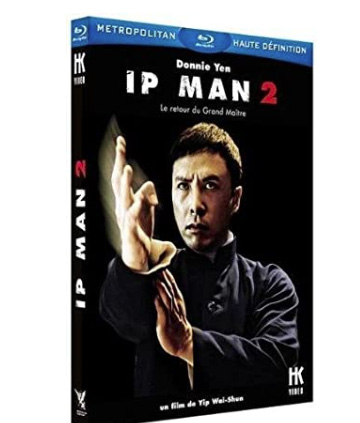
Ip Man 2
Synopsis
In 1949, Ip Man arrives in British-ruled Hong Kong, penniless, and begins to teach Wing Chun to a handful of students. His school struggles to survive, and the local martial arts masters, led by Hung Chun-nam, demand that he prove his skills in public. After a series of fights, the two masters learn to respect each other. But when a boastful British boxer humiliates the Chinese martial arts community, Ip Man must defend its honour in the ring.
The Making of the Film
After the success of the first Ip Man, a sequel was quickly put into production, with the same team led by Wilson Yip and Donnie Yen. The story picks up in 1949, when the real Ip Man moved to Hong Kong and began teaching Wing Chun to the public. The writers wanted to explore how a respected master from the mainland adapted to life as a refugee in a colonial city. They also decided to introduce a rival martial arts master played by Sammo Hung, who had worked as action choreographer on the first film. The film includes a final appearance by a young Bruce Lee, which pays tribute to Ip Man's most famous student. The creators also added a confrontation between Chinese martial arts and Western boxing, which gave the story a strong sporting dimension. Kenji Kawai returned to compose the music. The film became an even bigger production than the first.
Reviews and reception
Professional critics' summary
Critics gave the film positive reviews, with many considering it as entertaining as the original. They praised the intensity of the fights, especially the clash between Ip Man and Hung on a small round table. Donnie Yen's performance was admired, as was Sammo Hung's strong screen presence. Some reviewers felt that the boxer was a one-dimensional villain, and that the film became patriotic to the point of caricature.
Audience reception
The film was a major commercial success in Asia, outperforming the first film at the box office. Audiences loved the scene with the table fight and the final duel in the ring. It also found success abroad, with strong ticket sales in several countries. Fans consider it one of the best sequels in the martial arts genre.
Awards
The film earned a number of nominations at the Hong Kong Film Awards, including recognition for its action choreography. It also received awards and nominations at Asian film festivals. Donnie Yen and Sammo Hung were widely praised for their performances. The film strengthened the reputation of the series.
Filming anecdotes
Director's inspirations
Wilson Yip wanted to explore the idea of a man who has lost everything and must start again from scratch. He was inspired by the immigrant experience, as many people left mainland China for Hong Kong after 1949. The clash between martial arts and boxing was inspired by real matches that took place in the 1950s. Yip wanted the film to feel like a classic Hong Kong action movie, with a modern polish.
Production difficulties
The production built a large set to recreate the busy streets and buildings of 1950s Hong Kong. The fight scenes required long rehearsals, especially the round table fight and the final boxing match. Darren Shahlavi, who played the boxer, had to learn to fight in a Western boxing style while matching the choreography. The cast and crew worked intense hours to complete the film on a tight schedule.
Anecdote about a particular scene
The famous table fight, in which Ip Man and Hung Chun-nam battle on a small round table, is considered one of the best fight scenes in the series. The scene demanded careful choreography, as the fighters had to avoid falling off. The final match against the boxer Twister is another highlight, with its mixture of brutality and honour. The closing scene with a young Bruce Lee is a nod to the legend.
Originally planned casting
Donnie Yen returned as Ip Man, and Lynn Hung played his wife. Sammo Hung, who had directed the action in the first film, appeared as the rival master Hung Chun-nam. Huang Xiaoming and Simon Yam also joined the cast. Darren Shahlavi was chosen for the role of Twister, a boxer who is both arrogant and skilled.
Themes explored
The film is about starting over and finding a new place in the world. Ip Man faces poverty and discrimination as a refugee in a foreign environment. It explores the clash of cultures, particularly between Chinese martial arts and Western boxing. Another theme is respect among rivals, as Ip Man and Hung come to admire each other. The story also emphasises patriotism and the idea of defending national honour. It looks at the responsibility of a teacher toward his students and his community. Family also plays a role, since Ip Man struggles to balance his work with his duties as a father. Ultimately, it suggests that true greatness lies in humility and integrity.
Ending explained
In the finale, Hung is killed during a match with the arrogant boxer Twister, who refuses to stop fighting. Ip Man steps into the ring to avenge him and to defend the honour of the Chinese martial arts. After a brutal fight, Ip Man defeats Twister but chooses to show mercy. He then gives a speech about respect and mutual understanding between cultures. The film ends with a young boy, Bruce Lee, who asks to become Ip Man's student. This scene links the story to the future and sets up the next chapter in the series. The ending leaves audiences with a sense of pride and hope.
Meaning of the title
Ip Man 2 is a straightforward title that presents the film as the second chapter of Ip Man's story. The number signals continuity and promises a new set of challenges for the hero. In French, the subtitle le retour du grand maitre underlines that the master is back. The title also suggests that the legend continues to grow, as Ip Man spreads Wing Chun beyond his hometown. The original Chinese title reflects the idea of a legend or a chronicle. The simple name Ip Man keeps the focus on the central figure. It is a title that is clear and effective for fans of the series.
Original Soundtrack
Kenji Kawai returned to compose the music, building on his themes from the first film. His score blends traditional instruments with orchestral passages, giving the fights a sense of grace and weight. The music underlines both the cultural clash and the emotional moments of the story. It helps to give the sequel its epic atmosphere.
Similar Films
Ip Man is the essential companion to this film. Ip Man 3 and Ip Man 4: The Finale continue the story. Fist of Legend and Fearless are other martial arts films about national pride. Rocky IV and Bloodsport also feature confrontations between fighters from different traditions.