

 Français
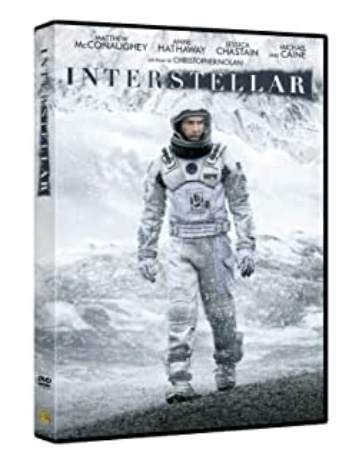
Interstellar
Synopsis
In a dystopian future where Earth is becoming uninhabitable due to crop blight, a former NASA pilot named Joseph Cooper is recruited for a desperate mission. He must lead a team of explorers through a newly discovered wormhole near Saturn to find a habitable new home for humanity. As he navigates space-time relativity and distant star systems, the bond with his children on Earth remains his guiding light. This epic science fiction masterpiece explores love, gravity, and the survival of the human race.
The Making of the Film
Director Christopher Nolan developed the script alongside his brother Jonathan Nolan, initially inspired by theoretical physicist Kip Thorne's groundbreaking gravitational physics research. The project originally began development under Steven Spielberg before Christopher Nolan took over directorial duties. The vision was to create a scientifically grounded science fiction epic that explored deep human emotions alongside complex cosmic concepts. The production set out to push the boundaries of practical special effects and IMAX cinematography.
Critical Reception
Professional critics praised the film for its stunning visual scope, ambitious scientific concepts, emotional resonance, and Hans Zimmer's breathtaking musical score. Reviewers highlighted Matthew McConaughey and Anne Hathaway for their grounded, powerful performances amidst the cosmic spectacle. While some debated the complexity of the scientific theories, the sheer cinematic ambition was universally admired.
Public reception was immense, turning the movie into a global blockbuster and a modern sci-fi classic. Audiences were mesmerized by the depiction of black holes, time dilation, and the profound father-daughter emotional core. It sparked widespread public interest in astrophysics and space exploration.
Awards and recognition included an Academy Award for Best Visual Effects, alongside multiple nominations for its score, sound mixing, and production design. It received numerous accolades from international film critics associations and science fiction bodies. The film is widely regarded as one of the defining cinematic achievements of the 2010s.
Filming Anecdotes
The director drew heavy inspiration from classic cinematic epics like '2001: A Space Odyssey' and real-world space exploration history. Christopher Nolan preferred practical effects and built full-scale spacecraft interiors on gimbals rather than relying entirely on green screens. This allowed the actors to experience realistic physical motion during space travel sequences.
Production challenges included working closely with physicist Kip Thorne to ensure that visual representations of black holes and wormholes were mathematically accurate. The visual effects team had to write entirely new rendering software to simulate how light bends around massive gravitational fields. Filming in remote locations like Iceland also tested the endurance of the cast and crew.
A memorable anecdote involves the cornfield scenes, where Christopher Nolan deliberately planted hundreds of acres of corn without telling the studio, intending to burn part of it for the story. The harvest was ultimately sold at a profit, showcasing the production's resourceful approach. Matthew McConaughey also brought raw emotional depth inspired by his own experiences as a father.
The casting process brought together top-tier talent, with Matthew McConaughey chosen to anchor the emotional heart of the story as Cooper. Anne Hathaway and Jessica Chastain delivered powerful supporting performances that anchored the scientific and personal stakes. Michael Caine returned as a frequent collaborator to lend gravitas to the scientific leadership.
Themes Explored
The themes explored include the survival of humanity, the enduring power of love across space and time, parental sacrifice, and scientific curiosity. The narrative examines how human connection transcends the laws of physics. It also touches upon ecological collapse and stewardship of planet Earth.
Explanation of the Ending
The ending reveals that Cooper navigates the interior of a tesseract inside a supermassive black hole, communicating with his daughter Murphy across different moments in time through gravity. Having provided the crucial quantum data needed for humanity's escape from Earth, he wakes up in a futuristic space station. He reunites briefly with his elderly daughter before setting off on a new journey to find the pioneering astronaut Dr. Brand.
Title Significance
The title 'Interstellar' refers to travel or communication taking place among the stars and across vast galactic distances. It encapsulates the massive scope of the human journey beyond our solar system. The name highlights the central premise of humanity searching for a new home in deep space.
Original Soundtrack
The film features a legendary, monumental musical score composed by Hans Zimmer, utilizing massive pipe organs and orchestral swells that evoke the infinite mystery and emotional weight of the cosmos.
The film remains a frequent subject of scientific lectures, anniversary cinematic screenings, and pop culture discussions regarding space exploration.
2001: A Space Odyssey, Arrival, Gravity, The Martian