

 Français
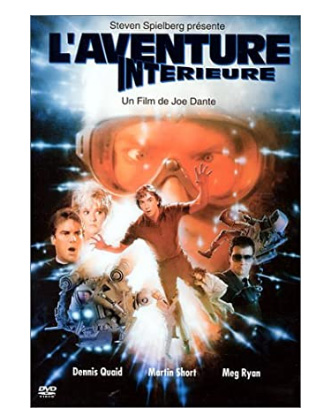
Innerspace
Synopsis
Lieutenant Tuck Pendleton is a daring, reckless Navy pilot who volunteers for a top-secret miniaturization experiment involving a microscopic pod. When industrial saboteurs attack the laboratory, the scientist leading the project manages to inject the microscopic pod containing Tuck into the body of an anxious, hypochondriac supermarket clerk named Jack Putter. Trapped inside a human body, Tuck must communicate with Jack through his auditory nerve to stop the villains and save the technology. Together, this unlikely duo embarks on a wildly hilarious and perilous microscopic adventure across human anatomy.
The Making of the Film
Executive producer Steven Spielberg conceived the sci-fi comedy adventure as a playful, high-tech spin on Richard Fleischer classic 1966 film Fantastic Voyage. Director Joe Dante joined the project to infuse the narrative with his signature cartoonish humor, inventive special effects, and pop-culture energy. Warner Bros. financed the high-concept science-fiction comedy.
Critical Reception
Critics gave the film positive reviews upon its release, praising its dazzling visual effects, breakneck comedic pacing, and stellar chemistry between Martin Short and Dennis Quaid. Reviewers noted that Joe Dantes imaginative direction successfully balanced high-tech science fiction with slapstick physical comedy. Audiences embraced the inventive adventure warmly.
Public reception was solid, turning the sci-fi comedy into a beloved fan favorite of 1980s cinema. Viewers fell in love with the witty dialogue, ground-breaking optical effects, and lovable character dynamics. It remains an all-time classic sci-fi comedy.
The film won the Academy Award for Best Visual Effects, recognizing its groundbreaking miniature and optical compositing achievements. It also received Saturn Award nominations for Best Science Fiction Film. Its technical accomplishments are widely celebrated by genre fans.
Filming Anecdotes
Director Joe Dante drew inspiration from classic 1950s science fiction B-movies, Chuck Jones cartoons, and Fantastic Voyage. He chose elaborate soundstage laboratory and internal organ sets to recreate the microscopic human anatomy. His direction encouraged Martin Short and Dennis Quaid to improvise comedic banter while recording separate dialogue tracks.
Production faced heavy technical challenges coordinating complex optical special effects, laser animation, and miniature creature puppets. Dennis Quaid spent weeks filming inside a cramped, cylindrical pod prop on hydraulic gimbals. Martin Short brought his trademark hyper-energetic physical comedy to the hypochondriac clerk role.
A memorable sequence involves Tuck manipulating Jacks facial muscles from inside his bloodstream to help him evade mobsters in a restaurant. The scene highlights the hilarious physical comedy of remote-controlling a human body. Short execution of the erratic facial twitches delighted audiences.
The casting process brought together top-tier comedic and action talent. Dennis Quaid was cast as the daring pilot Tuck Pendleton, bringing roguish charm. Martin Short was chosen for Jack Putter, showcasing his unmatched physical comedy genius.
Themes Explored
The film explores miniaturization science, unlikely friendship, overcoming hypochondriasis and fear, corporate espionage, and heroism. It highlights how ordinary people can rise to extraordinary challenges. Humor conquers physical peril.
NULL
Title Significance
The title refers directly to the uncharted inner space of the human body explored by the microscopic pod. It highlights the clever comedic twist on traditional outer space exploration themes.
NULL
NULL
Similar Films
Other similar films include Fantastic Voyage, Honey, I Shrunk the Kids, and The Nutty Professor.