

 Français
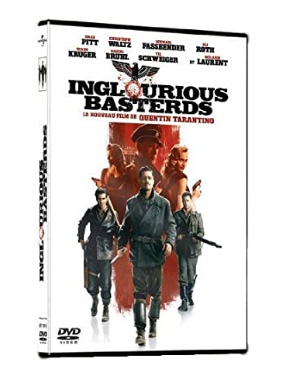
Inglourious Basterds
Synopsis
In Nazi-occupied France during World War II, a plan to assassinate Nazi leaders by a group of Jewish-American guerrilla soldiers coincides with a theater owner's vengeful plot. Led by the ruthless Lt. Aldo Raine, the squad known as "The Basterds" strikes fear into the hearts of the German high command. Meanwhile, Shosanna Dreyfus prepares her own cinema-based inferno to wipe out the Reich's elite. The explosive paths of these two forces ultimately collide in a fiery climax.
The Making of the Film
Quentin Tarantino spent over a decade writing the script for Inglourious Basterds, considering it his masterpiece and a long-standing passion project. The initial inspiration came from classic war movies of the 1960s and 1970s, as well as spaghetti westerns and men-on-a-mission films like The Dirty Dozen. Tarantino originally envisioned it as a multi-part miniseries before condensing it into a feature-length cinematic experience. He intentionally blended historical fact with sheer cinematic fantasy to give the oppressed victims of World War II a satisfying, fictional revenge.
Critical Reception
Professional critics praised the film for its razor-sharp dialogue, tense suspense sequences, and brilliant performances, particularly Christoph Waltz's iconic portrayal of Hans Landa. Reviewers lauded Tarantino's bold revisionist history and his ability to subvert traditional war movie tropes into a thrilling homage to cinema itself. The pacing and structure were highlighted as masterclasses in building unbearable cinematic tension.
Audience reception was overwhelmingly enthusiastic worldwide, with viewers captivated by the stylish violence, unforgettable characters, and witty banter. The movie became a massive commercial success at the box office, appealing to both longtime Tarantino fans and general audiences alike.
The film received numerous prestigious accolades, including eight Academy Award nominations, with Christoph Waltz winning the Oscar for Best Supporting Actor. It also earned multiple Golden Globe, BAFTA, and Screen Actors Guild awards, cementing its status as a modern cinematic classic.
Filming Anecdotes
Quentin Tarantino drew heavy inspiration from classic European cinema, French New Wave aesthetics, and Sergio Leone's spaghetti western framing styles. His direction focused heavily on long, unbroken dialogue sequences that allowed actors to build intense psychological pressure before any physical action occurred.
Production faced unique hurdles, including finding authentic European locations that could authentically replicate 1940s France and Germany. The meticulous set design and historical wardrobe required extensive coordination among international crews working across Germany and France.
During the famous tavern shootout scene, Diane Kruger accidentally injured her leg when Christoph Waltz accidentally applied too much physical force during a strangulation take. Tarantino himself had to physically choke Kruger in a later pickup shot to achieve the desired cinematic realism.
Adam Sandler was initially the top choice to play the role of Donny Donowitz, known as "The Bear Jew," but he turned it down due to scheduling conflicts with the comedy film Funny People, leading to Eli Roth taking on the iconic part.
Major Themes
Exploring the power of cinema as a weapon of mass catharsis, the illusion of justice through historical revisionism, identity deception, and the psychological impact of war and vengeance.
Explanation of the Ending
The explosive finale destroys the entire Nazi high command, including Adolf Hitler, trapped inside Shosanna's burning cinema. It serves as a symbolic victory where cinema rewrites tragic history to deliver ultimate poetic justice to the victims of the Holocaust.
Title Significance
The title is a deliberate, stylized misspelling of Enzo G. Castellari's 1978 Italian war film The Inglorious Bastards, paying direct homage to the gritty exploitation and grindhouse cinema that inspired Tarantino.
Ennio Morricone was originally approached to compose the score, but due to scheduling conflicts, Tarantino curated a legendary soundtrack using preexisting spaghetti western tracks, Ennio Morricone cues from other films, and vintage pop records.
The film continues to be celebrated in retrospectives, with frequent discussions regarding Tarantino's planned tenth and final film.
Django Unchained, Once Upon a Time in Hollywood, The Dirty Dozen, Saving Private Ryan