

 Français
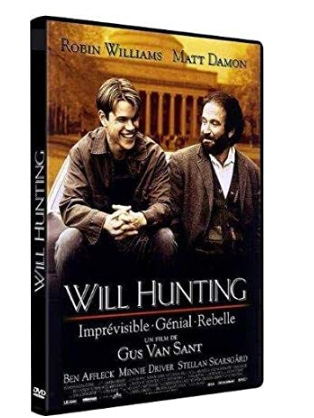
Good Will Hunting
Synopsis
Will Hunting is a gifted young man from a working-class neighbourhood in Boston who works as a cleaner at the Massachusetts Institute of Technology. Although he has an extraordinary talent for mathematics, he avoids using his abilities and repeatedly gets into trouble. After solving a difficult mathematical problem left on a university blackboard, he attracts the attention of Professor Gerald Lambeau. Will is offered an opportunity to develop his potential, but his personal difficulties make progress complicated. With the help of therapist Sean Maguire, he begins to confront the painful experiences that have prevented him from trusting others and imagining a different future.
The Making of the Film
Good Will Hunting was written by Matt Damon and Ben Affleck and directed by Gus Van Sant. The screenplay began as a project developed by Damon while studying at Harvard University, where he explored the idea of a young man with exceptional mathematical abilities. Ben Affleck became involved in the writing process and helped transform the concept into a story about friendship, class, trauma and personal development. The writers wanted to create a protagonist whose intellectual brilliance contrasted with his emotional vulnerability. Gus Van Sant was attracted to the screenplay because of its strong characters and its authentic portrayal of working-class Boston. Matt Damon was cast as Will Hunting, while Robin Williams played the therapist Sean Maguire. Ben Affleck portrayed Chuckie, Will's loyal friend, and Stellan Skarsgård played Professor Lambeau. The production used real Boston locations to create a convincing sense of place and social background. The dialogue was particularly important, allowing the characters to reveal their personalities through humour, confrontation and emotional honesty. The film became a major success and launched Damon and Affleck into international prominence as screenwriters and actors.
Critical Reception
Professional critical response: Good Will Hunting received widespread critical acclaim. Reviewers praised its intelligent screenplay, natural dialogue and sensitive treatment of emotional vulnerability. Robin Williams' performance was especially celebrated for its warmth, humour and dramatic depth. Matt Damon and Ben Affleck were also recognised for creating a protagonist whose intelligence does not protect him from emotional pain. Gus Van Sant's direction was appreciated for allowing the characters and their relationships to remain at the centre of the story. Some critics considered the narrative familiar, but the quality of the performances and writing made it particularly compelling.
Audience reception: The film became a major commercial success and connected strongly with audiences around the world. Viewers responded to its themes of friendship, self-worth and the difficulty of accepting help. Its dialogue and emotional scenes became widely quoted and discussed. Robin Williams' portrayal of Sean Maguire was particularly moving for many spectators. The film has continued to attract audiences interested in stories about education, personal growth and the importance of human relationships.
Awards and recognition: Good Will Hunting won two Academy Awards: Best Supporting Actor for Robin Williams and Best Original Screenplay for Matt Damon and Ben Affleck. It also received nominations for Best Picture, Best Director, Best Actor for Matt Damon, Best Supporting Actress for Minnie Driver and Best Film Editing. The film won Golden Globe recognition for its screenplay and received numerous other awards from critics' organisations. Its success established Damon and Affleck as major creative talents. Robin Williams' performance remains one of the most celebrated roles of his career.
Behind-the-Scenes Stories
Director's inspirations: Gus Van Sant was drawn to the screenplay's combination of intellectual ambition and emotional vulnerability. He wanted to portray Boston as a genuine social environment rather than a generic cinematic city. The director also focused on the contrast between Will's extraordinary mathematical abilities and his difficulty dealing with ordinary emotional relationships. The story's central idea is that intelligence alone cannot resolve the wounds created by childhood experiences.
Production challenges: The production had to present complex mathematical ideas in a way that remained understandable and dramatically engaging. The filmmakers also needed to create a believable relationship between Will and Sean, which required subtle performances and carefully paced dialogue. Shooting in real Boston locations helped establish authenticity but involved practical restrictions. The actors were encouraged to develop natural interactions, allowing humour and emotional intensity to emerge from the scenes.
A memorable scene: The repeated exchange in which Sean tells Will that his childhood abuse was not his fault is one of the film's most powerful moments. At first, Will resists the therapist's words and tries to maintain emotional distance through humour and defensiveness. Sean patiently repeats the message until Will finally breaks down. The scene marks a turning point because Will begins to accept that his past does not define his worth. Robin Williams and Matt Damon deliver a restrained but deeply affecting performance that has become central to the film's reputation.
Originally considered casting: Matt Damon and Ben Affleck developed the screenplay with the intention of playing central roles themselves. Robin Williams was cast as Sean Maguire, bringing considerable emotional depth to the character. Minnie Driver portrayed Skylar, while Stellan Skarsgård played Professor Lambeau. The casting brought together established actors and emerging talents, helping the film balance emotional credibility with the energy of its younger characters.
Themes Explored
Good Will Hunting explores intelligence, class, friendship, trauma and the difficulty of accepting love and personal responsibility. Will's extraordinary intellectual abilities do not prevent him from feeling isolated or afraid of emotional intimacy. His friends offer loyalty and a sense of belonging, but they also challenge him to recognise that he may be wasting his potential. The relationship with Sean reveals how trust and empathy can help someone confront painful memories. The film also questions the idea that academic success alone determines a person's value. Ultimately, it presents personal growth as a process that requires courage, honesty and the willingness to accept help from others.
Explaining the Ending
Will finally decides to leave Boston and pursue a relationship with Skylar rather than remain trapped by the expectations of his friends and academic mentors. His decision follows a long process of confronting his childhood trauma and recognising that he deserves a future beyond the familiar streets of his neighbourhood. Chuckie has already encouraged him to leave, explaining that his greatest hope is to discover that his friend has finally chosen a better life. Sean also begins a new chapter after resolving some of his own emotional difficulties. Will's departure is not presented as a rejection of his friends but as an act of independence and personal courage. The final scene shows that he has accepted the possibility of love and a future he cannot completely control. The ending is deliberately hopeful, suggesting that healing does not erase the past but can make a different future possible.
The Meaning of the Title
The title Good Will Hunting plays on the protagonist's name, Will Hunting, while also suggesting the idea of seeking goodwill. The word good refers to the character's underlying moral worth, which remains present despite his anger and defensive behaviour. Hunting suggests both his surname and the search for something valuable that defines the story. The title therefore reflects the film's central journey: discovering the good within a gifted but emotionally wounded young man and helping him find a meaningful direction in life.
The original score was composed by Danny Elfman, whose restrained music supports the film's emotional atmosphere. The soundtrack also features songs by Elliott Smith, whose music became closely associated with the film. Miss Misery received an Academy Award nomination for Best Original Song. Smith's intimate and melancholic style complements the story's exploration of loneliness, vulnerability and the desire for connection. The combination of original scoring and carefully selected songs is an important part of the film's emotional identity.
Similar films include A Beautiful Mind, directed by Ron Howard, which explores exceptional mathematical intelligence and personal struggle; Finding Forrester, directed by Gus Van Sant, which examines talent and mentorship; The Dead Poets Society, directed by Peter Weir, which celebrates intellectual independence; and The Theory of Everything, directed by James Marsh, which portrays the relationship between scientific achievement and personal life.