

 Français
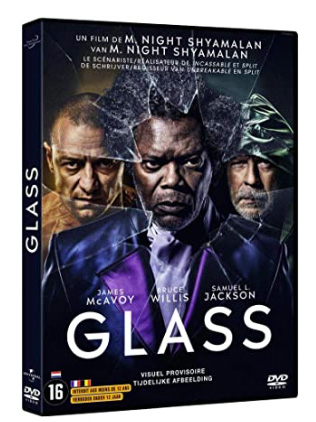
Glass
Synopsis
Glass brings together the characters introduced in Unbreakable and Split. David Dunn, a man with extraordinary strength and an ability to sense criminal intentions, is searching for Kevin Wendell Crumb, whose personality disorder includes a dangerous identity known as the Beast. Their confrontation leads both men to a psychiatric institution where they meet Elijah Price, also known as Mr. Glass. A psychiatrist attempts to convince them that their extraordinary abilities are delusions rather than evidence of something supernatural. As the three men are brought together, a larger plan begins to emerge. The film explores the boundary between reality, belief and the idea of the superhero.
The Making of the Film
Glass was conceived by M. Night Shyamalan as the concluding chapter of a story that began with Unbreakable in 2000 and continued with Split in 2016. The connection between the two films was revealed at the end of Split, when David Dunn appeared in the final scene. This unexpected link confirmed that both stories belonged to the same fictional universe. Shyamalan had considered developing a direct sequel to Unbreakable for many years, but he eventually decided that a third film could bring together the characters and ideas introduced across both productions. The screenplay explores the relationship between David Dunn, Kevin Wendell Crumb and Elijah Price, three individuals whose lives are shaped by unusual abilities and beliefs. The director was interested in examining superhero mythology through a more psychological and grounded perspective. Bruce Willis, James McAvoy and Samuel L. Jackson returned to their respective roles. The production also brought back Sarah Paulson, Anya Taylor-Joy and other performers from the earlier films. Shyamalan designed the story as a confrontation between different interpretations of extraordinary human potential. The result is a psychological thriller that questions the origins and social meaning of superhero identities.
Critical Reception
Professional Reviews
Glass received mixed reviews from professional critics. Many appreciated the performances of James McAvoy, Bruce Willis and Samuel L. Jackson, particularly the way the three characters embody different approaches to the superhero concept. McAvoy's ability to portray multiple personalities was frequently highlighted as one of the film's strongest elements. Some critics also praised Shyamalan's visual style and his interest in questioning the conventions of comic-book storytelling. However, others found the screenplay overly explanatory and considered the final revelations disappointing. The pacing and the use of the psychiatric institution as the main setting were also criticised by some reviewers. Overall, the film was regarded as an ambitious but uneven conclusion to the trilogy.
Audience Reception
Audience reactions were divided, particularly among viewers who had strong expectations after the ending of Split. Fans of Unbreakable appreciated the return of David Dunn and Elijah Price, while others expected a more conventional superhero confrontation. James McAvoy's performance attracted considerable attention and was often considered the film's most entertaining element. Some viewers enjoyed the philosophical approach to superhero mythology, while others felt that the story lacked the intensity of the earlier films. The film performed reasonably well commercially but did not reach the same level of enthusiasm as Split. Its reputation remains closely linked to the reception of the trilogy as a whole.
Awards
Glass received limited recognition from major film awards organisations. James McAvoy's performance attracted attention from genre critics and specialist awards groups, but the film did not become a major awards-season contender. Its technical and visual elements received some recognition, particularly within horror and thriller categories. The film's principal achievement was bringing together the stories of Unbreakable and Split into a single conclusion. Its reception among critics and audiences remained more divided than that of the earlier films.
Behind the Scenes
Director Inspirations
M. Night Shyamalan wanted to explore superhero mythology through a psychological thriller rather than a conventional comic-book adventure. He was interested in the idea that people with extraordinary abilities might be interpreted as dangerous, mentally ill or even mythical figures. The film also reflects his longstanding fascination with perception, belief and the hidden structures behind apparently ordinary events. By bringing together three characters with very different abilities, Shyamalan created a story about competing explanations of human potential. The director deliberately retained a restrained visual approach instead of relying on the spectacle typical of large superhero productions.
Production Challenges
The production required the return of characters and visual elements from two earlier films released many years apart. The filmmakers needed to maintain continuity in the appearance, behaviour and relationships of the protagonists. James McAvoy faced the particular challenge of portraying several distinct personalities within the same character, often changing rapidly between them. The psychiatric institution also had to function as a believable setting while supporting the film's psychological and supernatural ambiguity. The production relied on carefully controlled lighting, framing and performance to create tension without extensive action sequences.
A Particular Scene
The confrontation between David Dunn and the Beast is one of the film's central sequences. It brings together two characters whose abilities and moral outlooks are fundamentally different. Their physical encounter takes place in a public environment, creating a contrast between extraordinary strength and the ordinary world around them. The scene also illustrates the film's interest in how people interpret unusual events. Rather than presenting the confrontation as a straightforward superhero battle, Shyamalan uses it to develop the psychological and philosophical conflict at the heart of the story.
Casting
Bruce Willis and Samuel L. Jackson returned as David Dunn and Elijah Price, continuing the story established in Unbreakable. James McAvoy reprised his role as Kevin Wendell Crumb, bringing back the multiple personalities introduced in Split. Sarah Paulson joined the cast as Dr. Ellie Staple, the psychiatrist responsible for examining the three men. Anya Taylor-Joy also returned as Casey Cooke. The combination of returning actors and new characters was essential to connecting the three films.
Themes
Belief and the interpretation of reality are the central themes of Glass. The film asks whether extraordinary abilities should be understood as supernatural gifts, psychological conditions or phenomena that society refuses to accept. David Dunn, Kevin Wendell Crumb and Elijah Price represent three different responses to this question. Identity is another major theme, particularly through Kevin's multiple personalities and Elijah's conviction that he has a special purpose. The story also examines the relationship between weakness and strength, suggesting that physical limitations do not necessarily determine a person's potential. Society's fear of the unusual becomes a recurring concern, especially through the attempts to explain away extraordinary events. Comic books function as a cultural language through which people interpret experiences that seem impossible. The film questions whether myths are created by individuals or by the institutions that control public understanding. Manipulation and secrecy also play important roles in the narrative. Ultimately, Glass explores the power of belief and the consequences of accepting or rejecting an extraordinary identity.
Ending Explained
The final revelation exposes the psychiatrist's organisation as a secret group dedicated to preventing people with extraordinary abilities from becoming public symbols. Elijah has manipulated events in order to reveal the existence of individuals like David and Kevin to the world. His plan involves recording their confrontation and distributing the footage. Although the organisation attempts to suppress the evidence, Elijah's recordings are eventually shared with people who can make the truth public. David and Kevin die during the final confrontation, while Elijah is also killed. Their deaths do not completely defeat Elijah's plan because the information has already escaped the organisation's control. The final images suggest that the world may begin to recognise the existence of extraordinary individuals. The film therefore ends with a victory of information over secrecy, even though the principal characters do not survive. The conclusion reframes their lives as the beginning of a larger change in public understanding. It also completes Elijah's long effort to prove that people with extraordinary abilities exist.
Meaning of the Title
The title Glass refers to Elijah Price, whose bones are extremely fragile because of a rare medical condition. His physical vulnerability contrasts with his intelligence, determination and ability to manipulate events. The name is also associated with fragility, transparency and the possibility of breaking under pressure. Elijah's nickname, Mr. Glass, reflects both his physical condition and the symbolic role he plays in the story. He is the character who connects the different protagonists and attempts to reveal the hidden structure of their world. The title therefore identifies the film with the most physically fragile of its three central figures, whose influence is nevertheless enormous.
Original Soundtrack
West Dylan Thordson composed the original score for Glass, continuing his collaboration with M. Night Shyamalan after Split. The music combines restrained orchestral passages with electronic textures to create an atmosphere of psychological tension. The score also uses musical references connected to the earlier films, helping establish continuity across the trilogy. Its sound is deliberately controlled, reflecting the characters' uncertainty about their identities and abilities. Music supports the film's gradual movement from psychological drama towards a larger confrontation.
Similar Films
- Unbreakable (2000), the first film in M. Night Shyamalan's trilogy.
- Split (2016), the second film introducing Kevin Wendell Crumb and his different personalities.
- Chronicle (2012), a psychological superhero story about ordinary people developing extraordinary abilities.
- The Sixth Sense (1999), another M. Night Shyamalan thriller about perception and hidden realities.
- The Batman (2022), a darker interpretation of superhero mythology and psychological identity.