

 Français
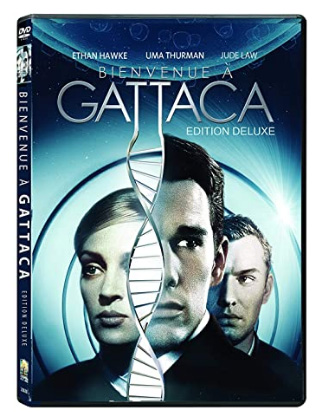
Gattaca
Synopsis
In a near future where children are genetically engineered to be perfect, Vincent Freeman was conceived naturally and is considered inferior. Despite his genetic "flaws", he dreams of becoming an astronaut and joining a prestigious space program. To pursue his goal, he assumes the identity of Jerome Morrow, a genetically superior athlete paralyzed in an accident. As Vincent gets closer to his dream, a murder investigation threatens to expose his deception.
The Making of the Film
Gattaca is a science-fiction drama written and directed by Andrew Niccol, in his directorial debut. Niccol imagined a society in which genetic discrimination replaces traditional prejudice, a concept that felt prophetic as genetic research advanced. Ethan Hawke plays Vincent, Jude Law plays Jerome and Uma Thurman plays his colleague Irene. The film's sleek, retro-futuristic look was achieved partly by using real mid-century modernist architecture as sets. It was released in late 1997 in the United States and reached France in early 1998.
Reviews and Reception
Summary of Professional Reviews
Critics praised the film for its intelligent ideas, elegant look and quiet emotional force. Many highlighted the performances of Hawke and Law, whose relationship is the heart of the story. A few reviewers found the pacing slow and the thriller elements underdeveloped. Overall, it was seen as a thoughtful and stylish piece of science fiction.
Audience Reception
The film was a box-office disappointment, earning only a modest amount at release. Over the years, however, it has become a cult classic and a frequent reference in debates about genetics and ethics. Many viewers cite it as one of the most moving and underrated science-fiction films of its era. It is regularly used in classrooms to discuss bioethics.
Awards Received
The film received an Academy Award nomination for Best Art Direction. Michael Nyman's score also received a Golden Globe nomination. These nominations recognized the film's distinctive visual and musical identity.
Themes Explored
The film is a meditation on genetic determinism and the human capacity to overcome it. It asks whether a person is defined by their DNA or by their will. Discrimination, here based on genetic makeup, is shown as a subtle and insidious form of control. The friendship between Vincent and Jerome explores sacrifice and shared dreams. The story also examines identity and the lengths one will go to in order to achieve a goal. Above all, it celebrates the idea that determination can defy the odds.
Ending Explained
In the final scenes, Vincent boards the rocket to Titan, having succeeded in fulfilling his dream. Jerome, who has helped him throughout, chooses to end his own life in an incinerator, leaving Vincent a stock of his genetic samples. The farewell is deeply emotional, as Jerome acknowledges that he only lent Vincent his body while Vincent gave him a dream. The ending suggests that both men have achieved a form of fulfillment, in different ways.
Meaning of the Title
The letters of "Gattaca" are made up only of the four DNA bases: guanine, adenine, thymine and cytosine. The title is therefore a subtle reference to genetics and to the film's central theme. It is also the name of the space program where Vincent hopes to work.
Soundtrack
The score was composed by Michael Nyman, whose minimalist, melancholic music perfectly matches the film's cool, precise world. His themes add emotional weight to the quiet scenes between the characters. The score received a Golden Globe nomination and is widely admired.
Similar Films
- Blade Runner (1982): a classic about identity in a high-tech future.
- Minority Report (2002): a futuristic thriller about fate and control.
- The Truman Show (1998): a story of a man trapped in a controlled world.
- Never Let Me Go (2010): a drama about engineered lives.