

 Français
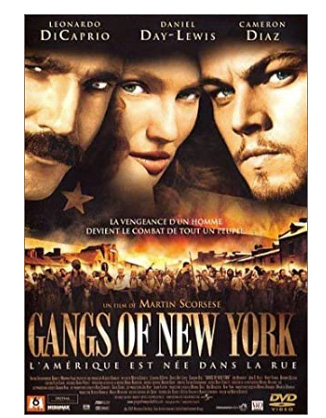
Gangs of New York
Synopsis
In 1863, New York City is dominated by violent rival gangs competing for territory, influence, and political power. As a young boy, Amsterdam Vallon witnesses the murder of his father at the hands of Bill the Butcher, a ruthless gang leader. Years later, Amsterdam returns to the Five Points neighborhood under a false identity, determined to avenge his father's death. He gradually gains Bill's trust while becoming involved in the criminal and political struggles surrounding the neighborhood. His relationship with pickpocket Jenny Everdeane complicates his plans and forces him to question his desire for revenge. As the city approaches a period of widespread unrest, the conflict between the gangs reaches a devastating climax.
The Film's Origins
Gangs of New York is inspired by Herbert Asbury's 1927 historical book The Gangs of New York: An Informal History of the Underworld. The book documents the violent criminal organizations, political corruption, and social tensions that shaped nineteenth-century New York. Martin Scorsese had been interested in adapting the material for many years because of its connection to the history of the city where he grew up. The project offered an opportunity to explore the origins of modern New York through the experiences of immigrants and working-class communities. Screenwriter Jay Cocks collaborated with Scorsese and Steven Zaillian to develop a dramatic narrative based on historical events and figures. Leonardo DiCaprio became involved as Amsterdam Vallon, while Daniel Day-Lewis was selected to portray Bill the Butcher. The production required the construction of an enormous historical recreation of nineteenth-century Manhattan. Filming took place primarily at Cinecittà Studios in Rome, where elaborate sets recreated the Five Points neighborhood. Released in 2002, the film became one of Scorsese's most ambitious historical productions.
Critical Reception
Professional Reviews: Gangs of New York received generally positive reviews, with particular praise for Daniel Day-Lewis's performance as Bill the Butcher. Critics admired the film's elaborate production design, historical atmosphere, and ambitious reconstruction of nineteenth-century New York. Martin Scorsese's direction was widely recognized for its energy and visual complexity. Some reviewers considered the screenplay uneven and felt that the central revenge story did not fully exploit the historical setting. The film's length and violent sequences also generated mixed reactions. Nevertheless, its artistic ambition and remarkable performances established it as a significant historical drama.
Audience Reception: The film attracted substantial international audiences and became a commercial success. Viewers were particularly impressed by the scale of the production and the intensity of Daniel Day-Lewis's performance. Its portrayal of gang violence and immigrant tensions offered an unusual perspective on American history. The production also attracted attention because of the collaboration between Scorsese and DiCaprio. Over time, it has remained an important entry in the director's filmography, particularly for its ambitious historical reconstruction.
Awards and Recognition: Gangs of New York received ten Academy Award nominations, including Best Picture, Best Director, and Best Actor for Daniel Day-Lewis. It also received nominations for Best Original Screenplay, Best Cinematography, Best Art Direction, Best Costume Design, Best Film Editing, Best Sound, and Best Original Song. The film received recognition from several international awards organizations. Although it did not win an Academy Award, its nominations confirmed the scale of its technical and artistic achievement. Daniel Day-Lewis's portrayal of Bill the Butcher became one of the most celebrated performances of his career.
Behind-the-Scenes Stories
Director's Inspirations: Martin Scorsese was fascinated by the violent history of New York and the social conflicts that accompanied mass immigration during the nineteenth century. He wanted to portray the city as a place shaped by competing communities, political corruption, and struggles for survival. The director also drew inspiration from historical accounts of the Five Points neighborhood and its notorious gangs. His approach emphasized the connection between individual violence and the development of larger political institutions. He considered the project a deeply personal exploration of the city's origins.
Production Challenges: The reconstruction of nineteenth-century New York required an enormous production effort. The filmmakers built detailed streets, buildings, shops, and public spaces at Cinecittà Studios in Rome. The costumes, weapons, and everyday objects also needed to reflect the historical period. The large-scale battle sequences required extensive coordination between extras, stunt performers, and technical departments. Maintaining historical authenticity while creating an accessible dramatic narrative was another major challenge. The production became one of the most elaborate historical recreations of its time.
Memorable Scene: The opening battle between the Dead Rabbits and the Nativists is one of the film's most powerful sequences. It introduces the violent world of the Five Points and establishes the historical conflict that shapes Amsterdam's life. The confrontation also reveals the importance of Bill the Butcher as a figure of authority and fear. Scorsese uses the sequence to create a theatrical and almost mythological representation of gang warfare. Its intensity establishes the tone for the entire film.
Originally Considered Casting: Leonardo DiCaprio was selected as Amsterdam Vallon, while Daniel Day-Lewis became Bill the Butcher. Cameron Diaz was cast as Jenny Everdeane, and Liam Neeson portrayed Amsterdam's father, Priest Vallon. The project went through a long development process, during which several possible casting arrangements were discussed. The final ensemble also included Jim Broadbent, John C. Reilly, Brendan Gleeson, and Henry Thomas. Daniel Day-Lewis's participation was particularly important because of the extensive character preparation he undertook for the role.
Themes Explored
Gangs of New York explores immigration, identity, revenge, political corruption, social inequality, and the violent formation of national identity. The conflict between native-born Americans and newly arrived immigrants reflects the tensions surrounding the transformation of nineteenth-century New York. Bill the Butcher represents an aggressive form of nationalism built on exclusion and intimidation. Amsterdam's personal revenge gradually becomes connected to a larger struggle over the future of the neighborhood. The film also examines the relationship between criminal organizations and political institutions. Its depiction of the Civil War draft riots reveals the anger and desperation of working-class communities. The characters frequently confuse loyalty with obedience and justice with personal vengeance. Ultimately, the story presents American history as a process shaped by conflict, exploitation, and the struggle for recognition.
Ending Explained
The final confrontation takes place against the background of the New York Draft Riots of 1863. Amsterdam finally challenges Bill the Butcher, bringing their long-standing personal conflict to its conclusion. Although Bill is defeated, his influence and the violent world he represents cannot simply disappear. The riots overwhelm the neighborhood, revealing that the social tensions behind the gang conflict are much larger than any individual rivalry. Amsterdam survives and eventually leaves the past behind, while the city continues to grow and transform. The final cemetery sequence shows the graves of Amsterdam's father and Bill, gradually disappearing beneath the changing New York skyline. This image suggests that history moves forward, often burying the violence and suffering that helped create it. The ending also emphasizes that personal revenge cannot undo the wider consequences of historical conflict. New York emerges as a different city, but its foundations remain marked by the struggles of its past.
Meaning of the Title
The title Gangs of New York refers to the numerous criminal organizations that controlled different neighborhoods of nineteenth-century New York. These groups competed for territory, political influence, and economic opportunities. The title also emphasizes that the city was not governed exclusively through formal institutions, since street gangs often exercised considerable social and political power. The word gangs reflects the violent divisions that shaped the lives of immigrants and working-class residents. It therefore presents the film as a portrait of a city whose identity emerged through conflict between rival communities.
Original Soundtrack
Howard Shore composed the original score, creating a dramatic musical atmosphere that reflects the film's historical setting and violent conflicts. The soundtrack combines orchestral passages with traditional musical influences associated with nineteenth-century America and Irish immigrant culture. Its compositions help establish the emotional tension surrounding Amsterdam and Bill. The music also reinforces the film's epic scale and the tragic dimension of its historical narrative. The soundtrack received attention for its contribution to the film's distinctive atmosphere.
Similar Movies
Films exploring comparable historical conflicts include The Age of Innocence, another Martin Scorsese film examining New York society and social conventions in the nineteenth century. There Will Be Blood explores ambition, power, and violence in the development of American society. Once Upon a Time in America examines organized crime and the transformation of urban communities. The Godfather presents another portrait of criminal organizations and family loyalty. The Untouchables explores the relationship between organized crime and political institutions. These productions share Gangs of New York's interest in violence, power, and the historical development of American cities.