

 Français
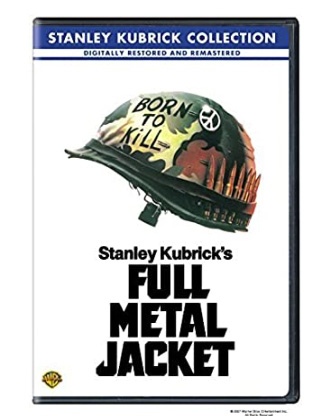
Full Metal Jacket
Synopsis
During the Vietnam War, a group of young American recruits undergoes an extremely harsh Marine Corps training program under the control of the brutal Gunnery Sergeant Hartman. Among them are the intelligent but increasingly disillusioned Joker and the vulnerable Leonard Lawrence, nicknamed Gomer Pyle. The psychological pressure of training eventually leads to a devastating act of violence. The story then moves to Vietnam, where Joker works as a military journalist before becoming involved in combat operations. As the soldiers confront the realities of war, the film examines the dehumanizing effects of military discipline and the psychological destruction caused by violence.
The Making of the Film
Full Metal Jacket is based primarily on The Short-Timers, a 1979 novel by former Marine Gustav Hasford. Stanley Kubrick became interested in adapting the book because of its unusual portrayal of military training and the psychological experience of soldiers during the Vietnam War. He collaborated with Hasford and journalist Michael Herr, who had written extensively about the conflict. The screenplay combines the novel's fictional narrative with elements inspired by the experiences of actual American soldiers. Kubrick was particularly interested in examining how military institutions transform individuals into instruments of war. Matthew Modine was selected to play Joker, while Vincent D'Onofrio took on the demanding role of Leonard Lawrence. Former Marine instructor R. Lee Ermey was cast as Gunnery Sergeant Hartman after initially becoming involved as a technical adviser. The production took place primarily in England rather than Vietnam, requiring the filmmakers to recreate the country's landscapes and urban environments through carefully designed sets.
Reviews and Reception
Professional reviews: Critics generally praised the film for its powerful direction, visual composition and disturbing portrayal of military training. R. Lee Ermey received particular recognition for his intense performance as Sergeant Hartman. The film's two-part structure was sometimes criticized for creating an abrupt narrative transition. Nevertheless, many reviewers considered it one of the most significant cinematic examinations of the Vietnam War.
Audience reception: Full Metal Jacket attracted considerable attention and became a major reference point in war cinema. Its training sequences and memorable dialogue have remained particularly influential. Audiences appreciated its uncompromising portrayal of military violence and the psychological consequences of combat. The film has maintained a strong reputation among viewers interested in serious war dramas.
Awards: The film received an Academy Award nomination for Best Adapted Screenplay. It also earned nominations at the BAFTA Awards and other international ceremonies. R. Lee Ermey received significant recognition for his performance as Hartman. The American Film Institute later included the film among its list of the greatest cinematic thrillers.
Behind-the-Scenes Stories
Director's inspirations: Stanley Kubrick was fascinated by the psychological transformation that military training imposes on young recruits. He wanted to examine how language, humiliation and repetitive discipline can gradually destroy individual identity. The novel by Gustav Hasford provided a strong narrative foundation, while Michael Herr contributed his knowledge of the Vietnam War. Kubrick also sought to create a visual contrast between the controlled environment of military training and the chaotic destruction of combat.
Production challenges: Although the story takes place in Vietnam, most of the film was shot in England, particularly at Pinewood Studios and other locations. The production transformed industrial and military landscapes into convincing representations of Vietnam. The shoot lasted more than a year and involved extensive construction work. Recreating the atmosphere of a war zone without filming in the actual country required considerable imagination and technical coordination.
Notable scene: The confrontation between Joker and Sergeant Hartman during the training sequences is one of the film's most memorable passages. Hartman's relentless verbal abuse establishes the psychological environment in which the recruits are expected to survive. The scene involving Leonard Lawrence illustrates how humiliation and isolation can become destructive forces. Its devastating conclusion marks a turning point in the narrative.
Original casting: R. Lee Ermey originally approached the production as a military technical adviser. His experience as a former Marine drill instructor impressed Kubrick, who eventually cast him as Sergeant Hartman. Matthew Modine was selected for the central role of Joker, while Vincent D'Onofrio underwent a remarkable physical transformation to portray Leonard Lawrence. The supporting cast includes Arliss Howard, Adam Baldwin and Dorian Harewood.
Themes Explored
Full Metal Jacket examines the dehumanizing effects of military institutions and the psychological consequences of war. The training sequences show how recruits are stripped of their individuality through humiliation, obedience and relentless discipline. Violence becomes a learned behavior that gradually replaces ordinary human compassion. The film also explores the contradiction between military professionalism and the brutality of combat. Joker represents the struggle to preserve personal identity while participating in an environment that demands emotional detachment. The contrast between his role as a journalist and his experience as a soldier highlights the difficulty of remaining an objective observer. The relationship between language and violence is another important theme, as insults and military slogans become tools of psychological conditioning. Ultimately, the film questions whether military training prepares individuals for war or simply teaches them to reproduce its violence.
Ending Explained
The final sequence follows the soldiers after their confrontation with a young Vietnamese sniper. Several members of their group have been killed, and the wounded sniper is left unable to escape. Joker faces a difficult moral decision when he is asked to end her suffering. His choice represents the conflict between the military identity he has acquired and the human values he has not entirely lost. After the confrontation, the surviving soldiers move through a devastated landscape while singing the Mickey Mouse Club theme. This strange contrast between childhood innocence and the destruction surrounding them is deliberately disturbing. The song suggests that the soldiers have become trapped in a world where innocence and brutality coexist. Joker's final narration reflects his awareness that he has survived but has also been profoundly changed. The ending therefore offers no conventional victory, only the recognition that war leaves lasting psychological scars.
Meaning of the Title
The title Full Metal Jacket refers to the full-metal-jacketed ammunition used by military forces. This type of bullet is designed with a metal covering around its core, making it suitable for standard military applications. The expression therefore connects directly to the weapons and military environment depicted in the film. However, the title also carries a symbolic meaning. The recruits are gradually covered by an emotional and psychological armor designed to suppress fear, sensitivity and individuality. This transformation mirrors the hard exterior of the ammunition itself. The title also reflects the film's interest in the relationship between military technology and human destruction. Its technical and impersonal sound reinforces the atmosphere of institutional violence. Ultimately, it summarizes the process through which human beings are transformed into instruments of war.
The film uses an unusual combination of original electronic music and popular songs from the 1960s. The original score was composed by Vivian Kubrick, who worked under the pseudonym Abigail Mead. She used electronic instruments and synthesizers to create an unsettling musical atmosphere. The soundtrack also features memorable songs such as These Boots Are Made for Walkin' by Nancy Sinatra and Paint It, Black by The Rolling Stones. The mixture of period music and electronic sound reinforces the contrast between the soldiers' everyday lives and the violence of combat. The soundtrack is particularly important to the film's distinctive atmosphere.
Similar Films
Platoon offers another powerful examination of the psychological and moral consequences of the Vietnam War. Apocalypse Now explores the madness of warfare and the collapse of conventional morality. The Deer Hunter examines the devastating effects of combat on soldiers and their relationships. Born on the Fourth of July portrays the lasting consequences of military service and the struggle to rebuild a civilian identity. Jarhead explores the psychological experience of modern soldiers and the absurdity of military life. Paths of Glory examines the destructive relationship between military authority and individual human beings. Come and See presents an exceptionally disturbing portrait of war and the destruction of innocence. These films share Full Metal Jacket's interest in military conditioning, violence, psychological trauma and the human cost of armed conflict.