

 Français
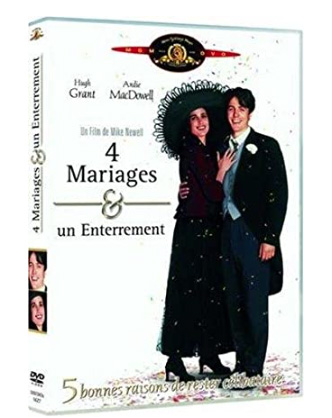
Four Weddings and a Funeral
Synopsis
Charles is a charming but commitment-averse Englishman who regularly attends weddings with his close group of friends. At one particular wedding, he meets Carrie, an American woman with whom he immediately develops a connection. Their relationship unfolds through several weddings and one funeral, while misunderstandings and romantic complications repeatedly interfere with their happiness. As the group experiences love, loss and personal change, Charles must finally confront his fear of commitment.
The Film's Origins
Four Weddings and a Funeral originated from a screenplay written by Richard Curtis, who wanted to create a romantic comedy centred on friendship and the social rituals surrounding marriage. Curtis drew inspiration from his observations of British social life and the conversations that take place among groups of friends at important events. Rather than adapting a novel or a true story, he developed an original narrative based on recurring characters and interconnected romantic situations. Producer Duncan Kenworthy and Working Title Films recognised the commercial potential of the screenplay. Mike Newell was selected to direct, bringing a naturalistic approach to the film's humour and emotional moments. The filmmakers deliberately avoided the exaggerated romantic conventions of some Hollywood comedies. Hugh Grant was cast as Charles, whose awkward charm became a central element of the production's identity. Andie MacDowell was selected to play Carrie, providing an international dimension to the central romance. The film ultimately became one of the most successful British romantic comedies of the 1990s.
Critical Reception
Professional reviews: Critics generally praised the screenplay for its witty dialogue and believable portrayal of friendship. Hugh Grant's performance was widely admired for its charm and comic timing. Mike Newell's direction was appreciated for balancing romantic situations with moments of genuine emotional sadness. Kristin Scott Thomas and the supporting cast also received positive attention. Some reviewers considered the central romance conventional, but the film's humour and character development were widely recognised.
Audience reception: The film became an international commercial success and attracted a particularly strong audience for British romantic comedy. Its memorable dialogue and recurring wedding situations made it popular with viewers across different countries. Hugh Grant's performance helped establish his reputation as a leading romantic-comedy actor. The film also demonstrated that a relatively modest British production could achieve major international success.
Awards: Four Weddings and a Funeral received two Academy Award nominations, including Best Picture and Best Original Screenplay. It won several BAFTA Awards, including Best Film, Best Actor for Hugh Grant and Best Supporting Actress for Kristin Scott Thomas. Mike Newell also received recognition for his direction. The film received further nominations at the Golden Globes and other international awards ceremonies. Its success helped establish Richard Curtis as one of the most influential British screenwriters of romantic comedy.
Behind-the-Scenes Stories
Director's inspirations: Mike Newell wanted to create a romantic comedy that felt natural and recognisable rather than overly polished. The film's structure was inspired by the social importance of weddings and funerals within British friendship groups. Richard Curtis also drew upon his own observations of awkward conversations, romantic uncertainty and the complicated relationships between friends. The director encouraged the cast to develop a convincing sense of familiarity and shared history.
Production difficulties: The production involved several elaborate social gatherings, each requiring large groups of extras and carefully coordinated filming schedules. Wedding scenes had to look convincing while allowing the central characters to remain the focus of the narrative. The filmmakers also faced the challenge of maintaining continuity across events that take place over an extended period. The production's modest budget required efficient planning and careful use of locations. Despite these constraints, the finished film achieved a polished and naturalistic appearance.
A memorable scene: The funeral sequence featuring John Hannah's character delivering a poem in sign language is among the film's most emotional moments. The scene creates a striking contrast with the surrounding romantic comedy. It demonstrates that the story is concerned not only with marriage and happiness but also with loss and friendship. Another memorable moment occurs when Charles repeatedly struggles to express his feelings towards Carrie. These scenes help balance the film's humour with genuine emotional depth.
Original casting choices: Hugh Grant was cast as Charles and delivered the performance that helped establish his international career. Andie MacDowell was selected as Carrie, bringing an American perspective to the central romance. Kristin Scott Thomas played Fiona, while John Hannah portrayed Matthew. Charlotte Coleman, James Fleet and Simon Callow completed the central group of friends. Rowan Atkinson also appeared in a memorable supporting role as an inexperienced priest.
Themes Explored
Four Weddings and a Funeral explores love, commitment and the importance of friendship during major life events. Charles represents individuals who desire romantic relationships but fear the responsibilities associated with marriage. The film examines the pressure created by social expectations and the belief that happiness should follow a conventional path. Friendship provides emotional support while also exposing the characters' insecurities and contradictions. The repeated weddings highlight the different ways people understand love and commitment. The funeral introduces mortality and reminds the group that relationships are also defined by loss. The story explores the difficulty of communicating genuine feelings, particularly when fear and uncertainty interfere. It also contrasts romantic idealism with the practical realities of long-term relationships. Ultimately, the film suggests that love requires honesty, courage and the willingness to accept emotional vulnerability.
Ending Explained
After several missed opportunities and complicated romantic encounters, Charles finally confronts his feelings for Carrie. Although he has previously been reluctant to marry, he begins to understand that his fear of commitment has prevented him from pursuing genuine happiness. At the final wedding, he decides that he wants to be with Carrie but is uncertain whether he can offer the traditional marriage she expects. He eventually asks whether she would consider being with him without marrying him. Carrie accepts this alternative, recognising that their relationship matters more than the formal ceremony. The conclusion challenges the assumption that marriage is the only valid expression of romantic commitment. It also reflects the film's central idea that people must find their own way towards happiness. The final sequence brings together the main characters and shows how their relationships have evolved. Charles's emotional transformation is ultimately more important than the wedding itself.
Meaning of the Title
The title Four Weddings and a Funeral describes the five major social events that structure the film's narrative. Each wedding introduces a different stage in the characters' romantic and personal development. The funeral provides a necessary emotional contrast, reminding viewers that life includes loss as well as celebration. The title also suggests the importance of rituals in organising social relationships. By counting these events, it gives the story a simple and memorable structure while reflecting the British social environment in which the characters move. Its apparent lightness conceals the film's deeper exploration of love, friendship and mortality.
The film is particularly associated with Wet Wet Wet's version of Love Is All Around, which became an enormous international hit following its release. The song appears prominently in the film and reinforces its romantic atmosphere. The soundtrack also includes music that supports the different weddings and social gatherings. Its success helped make the film's musical identity an important part of its cultural impact. The association between the film and its main song remains one of the most recognisable examples of a successful romantic-comedy soundtrack.
Fans of Four Weddings and a Funeral may enjoy Notting Hill, another Richard Curtis romantic comedy featuring Hugh Grant. Love Actually explores several interconnected relationships through an ensemble narrative. Bridget Jones's Diary combines British humour with romantic uncertainty and social awkwardness. About Time offers another emotionally engaging exploration of love, family and the passage of time.