

 Français
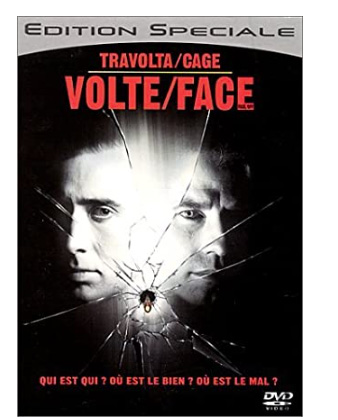
Face/Off
Synopsis
FBI agent Sean Archer has spent years pursuing Castor Troy, a ruthless terrorist responsible for the death of his son. When Troy is seriously injured and falls into a coma, Archer undergoes an experimental surgical procedure that transfers the criminal's face onto his own. His mission is to infiltrate Troy's criminal organization and discover the location of a devastating bomb. However, the operation takes an unexpected turn when Troy awakens, steals Archer's identity and assumes his position within the FBI. The two enemies are consequently forced to live each other's lives, creating a dangerous psychological and physical confrontation.
The film's origins
The concept for Face/Off was developed by screenwriters Mike Werb and Michael Colleary, who imagined an action thriller built around the extraordinary possibility of two enemies exchanging identities. The original screenplay explored the psychological consequences of becoming someone else and the difficulty of distinguishing physical appearance from personal identity. The project attracted the attention of director John Woo, whose experience with stylized action cinema made him particularly suited to the material. Woo was interested in combining the high-concept science-fiction premise with his recurring themes of revenge, family and moral duality. The screenplay underwent several revisions before becoming the spectacular Hollywood production audiences eventually discovered. The filmmakers also wanted to create a situation in which both leading actors could explore contrasting aspects of their characters. The unusual premise offered an opportunity for John Travolta and Nicolas Cage to portray not only their original roles but also convincing versions of each other. The film became an important milestone in Woo's American filmmaking career.
Critical reception and audience response
Professional reviews: Critics widely praised the extraordinary performances of John Travolta and Nicolas Cage. Their ability to imitate each other's mannerisms and personalities became one of the film's most celebrated achievements. John Woo received recognition for his spectacular direction, elaborate action sequences and distinctive visual composition. The film's extravagant violence, dramatic slow-motion scenes and operatic atmosphere were also frequently highlighted. Some critics considered the scientific premise implausible, but many appreciated the film's willingness to embrace its outrageous concept without hesitation.
Audience reception: The film became a major commercial success and was one of the most popular action productions of 1997. Audiences were particularly enthusiastic about the confrontation between Travolta and Cage and the increasingly absurd situations created by their exchanged identities. Its mixture of science fiction, crime thriller and spectacular action attracted a broad international audience. Over time, the film acquired cult status and became one of John Woo's most recognizable Hollywood productions.
Awards: The film received an Academy Award nomination for Best Sound Effects Editing. It also attracted recognition for its technical achievements, particularly its sound design and elaborate action production. Its performances and visual style received considerable attention from critics and audiences. Although it did not win major acting awards, it remains one of the most celebrated action thrillers of its period.
Behind-the-scenes stories
Director's inspirations: John Woo was fascinated by the philosophical idea that a person's identity could be separated from their physical appearance. He used the premise to explore the relationship between good and evil, particularly the possibility that two apparently opposite individuals might share unexpected psychological characteristics. His characteristic visual motifs, including doves, slow motion and highly choreographed gunfights, were integrated into the Hollywood production.
Production challenges: The main challenge was ensuring that the identity exchange remained convincing throughout the film. John Travolta and Nicolas Cage had to study each other's acting styles, gestures, vocal rhythms and body language. They needed to reproduce recognizable elements of their colleague's performance while maintaining the emotional characteristics of their own original characters. The action sequences also required extensive choreography and coordination between stunt performers, special effects teams and cinematographers. The production combined practical effects with sophisticated visual techniques to create the film's elaborate confrontations.
Memorable scene: The church confrontation is among the film's most iconic sequences. The combination of religious imagery, doves, orchestral music and spectacular gunplay perfectly illustrates John Woo's distinctive filmmaking style. The setting reinforces the contrast between spiritual symbolism and extreme violence. The sequence has become one of the defining examples of Woo's operatic approach to action cinema.
Original casting: John Travolta was cast as FBI agent Sean Archer, while Nicolas Cage took the role of terrorist Castor Troy. The two actors were selected partly because their contrasting screen personalities made the identity exchange particularly interesting. Joan Allen portrays Archer's wife, Eve, while Alessandro Nivola plays Pollux Troy. Gina Gershon and Dominique Swain also contribute important performances.
Themes explored
The film examines identity and the relationship between physical appearance and personal character. The exchange of faces forces both protagonists to confront the possibility of becoming the very person they hate. The distinction between good and evil becomes increasingly complicated as Archer experiences life from his enemy's perspective. Family and fatherhood provide the emotional foundation of the narrative, particularly through Archer's grief over the loss of his son. Revenge is another central theme, showing how obsession can gradually consume an individual. The film also explores deception, trust and the fragility of social identity. The two characters become trapped in a situation where their appearance contradicts their memories and moral convictions. Ultimately, the story asks whether identity is determined by our bodies, our actions or the choices we make.
Ending explained
The final confrontation brings Archer and Troy face to face after their identities have been exchanged and their respective families have been placed in danger. Archer must defeat the man who has stolen his appearance, career and family life. The struggle becomes both physical and psychological, as each character represents a distorted reflection of the other. Archer eventually succeeds in killing Troy and recovering his original identity. He returns to his wife and daughter, bringing the terrifying deception to an end. The family eventually welcomes a young boy who has been connected to the story's tragic events, suggesting that Archer is beginning a new chapter in his life. This decision reflects the character's transformation from a man consumed by revenge into someone capable of embracing compassion. The ending restores the distinction between the two identities while suggesting that personal growth can emerge from even the most extraordinary experiences.
Meaning of the title
The title Face/Off refers directly to the surgical exchange that allows the two main characters to assume each other's physical appearance. The expression also suggests a confrontation between two opposing personalities who are forced to confront themselves through the other person. The wordplay evokes both the removal of a face and the intense showdown between the protagonists. Their exchanged appearances create a situation in which identity becomes a dangerous illusion. The title captures the film's central idea that appearance and character are not necessarily the same thing. It also reflects the spectacular and confrontational nature of John Woo's action cinema.
The original score was composed by John Powell, with Hans Zimmer serving as score producer. The music combines powerful orchestral passages, dramatic percussion and suspenseful arrangements. Powell creates an energetic sound that reinforces the psychological tension and spectacular action sequences. The score also incorporates the classical religious composition Since by Man Came Death from Handel's Messiah, which contributes to the film's distinctive church sequence. The musical atmosphere alternates between intense action and more emotional passages associated with the characters' families. The soundtrack is an important part of the film's extravagant cinematic identity.
Similar films
The Killer by John Woo shares the film's stylized action, moral conflicts and recurring exploration of identity. A Better Tomorrow also combines spectacular violence with themes of loyalty and redemption. Mission: Impossible explores deception, impersonation and dangerous undercover operations. The Bourne Identity examines the relationship between identity, memory and personal transformation. Total Recall raises similar questions about the nature of identity and the reliability of personal memories. Face/Off can also be compared with Point of No Return, which explores the transformation of an individual through an elaborate secret operation. Enemy offers a more psychological approach to the disturbing discovery of a physical double. These films share an interest in deception, identity and the uncertainty of appearances.