

 Français
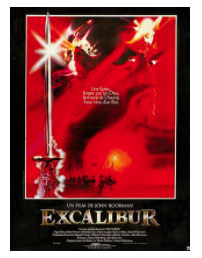
Excalibur
Synopsis
Set in a mythical, mist-shrouded medieval Britain where lords battle endlessly for fractured territory, the wizard Merlin guides the young, pure-hearted warrior Arthur as he pulls the legendary sword Excalibur from the stone to unite the warring kingdoms. Crowned king, Arthur establishes the utopian Camelot and the Knights of the Round Table, marries the beautiful Guinevere, and fosters an era of chivalric peace. However, betrayal strikes when Queen Guinevere falls in love with Arthur's greatest knight, Lancelot, while Arthur's manipulative half-sister Morgana uses dark sorcery to conceive a treacherous incestuous heir named Mordred. Ultimately, this epic fantasy masterpiece explores Arthurian romance, chivalry, tragedy, and the magical twilight of the old gods.
The Making of the Film
Director and co-producer John Boorman fulfilled a lifelong dream by adapting Sir Thomas Malory's fifteenth-century Arthurian romance Le Morte d'Arthur into a massive, visionary cinematic epic. The project was conceived as a grand mythological fantasy exploring the birth and collapse of civilization, pagan mysticism, and chivalric honor. Boorman drew inspiration from Arthurian folklore, Celtic mythology, and Carl Jung's theories of the collective unconscious. The production prioritized breathtaking Irish location shooting, stunning mirrored armor design, and an elite British ensemble cast.
Critical Reception
Critics offered generally favorable reviews upon release, praising its stunning visual opulence, operatic tone, Trevor Jones's majestic musical score, and bold mythological scope. Reviewers noted that John Boorman successfully crafted the definitive cinematic version of the Arthurian legend by embracing both its brutal medieval reality and its surreal pagan magic. Some film critics, however, initially criticized its dense narrative pacing and melodramatic performances. Despite mixed initial reviews, fantasy enthusiasts and cinephiles embraced its visionary brilliance over time.
Audiences were completely spellbound by the dark, magnificent fantasy epic, turning it into a massive box-office success and an immortal cult classic. Viewers worldwide praised the striking chrome armor, lush Irish forests, and the powerful performances of Nicol Williamson as Merlin and Nigel Terry as King Arthur. It found a devoted, passionate fanbase who celebrated its unmatched operatic grandeur and poetic dialogue. Many hailed it as the greatest fantasy film ever made.
Excalibur earned prestigious acclaim, including an Academy Award nomination for Best Costume Design for Bob Ringwood. It also competed for the prestigious Palme d'Or at the 1981 Cannes Film Festival, where John Boorman won the award for Best Artistic Contribution. The film's stunning cinematography and soundtrack received universal praise from critics guilds. These prestigious accolades cemented its legacy as a towering masterpiece of fantasy cinema.
Behind-the-Scenes Stories
John Boorman was heavily inspired by the primal myths of Celtic paganism and Arthurian legend, wanting to create a hallucinatory, blood-soaked fairy tale rather than a clean historical drama. He wanted to anchor the magical elements in deep psychological symbolism, where the land and the king are inextricably linked as one. The visual style utilized expressionistic green-filtered forests, gleaming mirrored chrome suits of armor designed to reflect nature, and Wagnerian opera music. The director also worked closely with production designers to build authentic castles in Ireland.
Shooting on location across misty bogs, ancient forests, and rugged mountains in County Wicklow and County Tipperary, Ireland, presented authentic Celtic atmosphere and rainy weather challenges for the production crew. Nigel Terry performed grueling sword fights in heavy steel armor, while Nicol Williamson brought eccentric, theatrical genius to his iconic portrayal of Merlin. A young Helen Mirren and Liam Neeson—in his breakout feature film debut as Sir Gawain—brought intense dramatic gravitas to the supporting cast. Despite grueling physical production conditions, the technical crew successfully delivered a breathtaking visual masterpiece.
During the filming of the epic final battle sequences in the mud and mist, the actors and stunt teams brought fierce, brutal energy to their medieval combat choreography. Director John Boorman encouraged a visceral, unpolished realism in every sword clash and pagan ritual. Crew members reported feeling spellbound on set watching the glittering chrome armor gleaming against the dark Irish foliage. The profound dedication of the cast gave the fantasy epic its immortal soul.
Casting directors secured an extraordinary ensemble of legendary British theatrical actors. Nigel Terry was secured for the lead role of King Arthur, tracing his journey from naive youth to weary monarch. Nicol Williamson delivered a legendary performance as the enigmatic wizard Merlin. The supporting cast featuring Helen Mirren, Liam Neeson, Gabriel Byrne, and Patrick Stewart added stellar dramatic weight.
Themes Explored
The film heavily explores Arthurian chivalry, the quest for the Holy Grail, and the eternal struggle between Christianity and ancient pagan magic. It examines kingship, betrayal, incestuous tragedy, and the mystical bond between the king and the land (The Wasteland). Another core motif is honor, fate, and the twilight of mythical ages. It also touches upon romance, sorcery, and destiny.
Ending Explained
The film concludes with a mortally wounded King Arthur engaging in a devastating final duel against his traitorous son Mordred, ultimately slaying Mordred while receiving a fatal blow himself. As Arthur lies dying, he commands the surviving knight Sir Lancelot (or Bedivere in various versions) to cast the magical sword Excalibur back into the mystical lake, where the Lady of the Lake's arm rises to catch it before disappearing beneath the waves. Arthur is then ferried away on a mystical barge toward Avalon by three mysterious queens. This transcendent finish marks the magical twilight of the old world.
Meaning of the Title
The title refers directly to the legendary magical sword Excalibur wielded by King Arthur, which serves as the physical and mystical symbol of royal sovereignty, divine right, and unity. It highlights the central artifact driving the entire Arthurian quest for Camelot. The single-word phrasing sets an epic, iconic tone for the fantasy masterpiece. It encapsulates the legendary blade that birthed and ended an age of chivalry.
Similar films include The Lord of the Rings, Conan the Barbarian, Camelot, and Jason and the Argonauts, which feature epic fantasy, medieval legends, and heroic quests.