

 Français
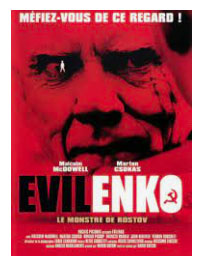
Evilenko
Synopsis
Set in the Soviet Union during the turbulent decades leading up to its collapse, a mild-mannered, politically loyal schoolteacher and former party official named Andrei Romanovich Evilenko leads a horrifying double life as a sadistic serial killer who preys on vulnerable children. As dozens of young victims go missing across various regions, a brilliant and intuitive Rostov police detective named Abel Azarov struggles against bureaucratic Soviet denial to connect the gruesome murders. While state officials stubbornly insist that violent crime does not exist in a socialist utopia, Azarov builds a psychological profile of the elusive monster. Ultimately, this dark crime thriller explores state corruption, serial murder, and psychological investigation.
The Making of the Film
Writer and director David Grieco crafted the gripping crime thriller based loosely on the horrifying real-life crimes of Soviet serial killer Andrei Chikatilo (the Butcher of Rostov). The project was conceived as a dark psychological procedural examining the intersection of political corruption, bureaucratic denial, and heinous criminal depravity. Grieco drew inspiration from true-crime archives, Soviet history, and Malcolm McDowell's intense acting pedigree. The production prioritized authentic Eastern European locations, moody neo-noir lighting, and an international cast.
Critical Reception
Critics offered mixed reviews upon release, praising Malcolm McDowell's terrifying, powerhouse lead performance and its gloomy, authentic Soviet atmosphere. Reviewers noted that David Grieco successfully directed a chilling true-crime drama that exposed the dark bureaucratic failures of the collapsing Soviet regime. Some film critics, however, condemned its graphic depiction of violence against children and somewhat disjointed narrative pacing. Despite polarizing critical reactions, crime thriller enthusiasts embraced its dark psychological intensity.
Audiences found the grim crime thriller deeply disturbing yet compelling, praising Malcolm McDowell's chilling portrayal of one of history's most notorious monsters. Viewers on home video platforms commended Marton Csokas for his grounded performance as the relentless detective tracking the killer. It found a niche audience among fans of true-crime dramas, psychological thrillers, and dark neo-noir cinema. Many praised its unflinching look at how political denial enabled a monster to operate unchecked.
Although major mainstream cinematic awards bypassed the dark crime release, it earned recognition among European film festivals and crime genre showcases. Malcolm McDowell's terrifying performance received universal praise from horror and thriller fans. The film's moody musical score by Angelo Badalamenti was also celebrated by reviewers. These milestones helped cement its reputation as a chilling, uncompromising true-crime thriller.
Behind-the-Scenes Stories
David Grieco was heavily inspired by years of investigative research into the real-life capture of Andrei Chikatilo, wanting to explore how the ideological blindness of the Soviet state inadvertently protected a serial killer. He wanted to anchor the horror in the chilling psychological contrast between a polite schoolteacher and a sadistic predator. The visual style utilized desaturated Soviet-era color palettes, bleak gray concrete architecture, and haunting neo-noir shadow work. The director also worked closely with criminologists to ensure procedural accuracy.
Shooting on location across historic cities and brutalist architecture in Ukraine and Italy presented authentic Eastern European textures for the international production crew. Malcolm McDowell immersed himself completely in the dark psychology of the killer, delivering a performance that terrified the cast and crew on set. Marton Csokas brought quiet determination to his role as the detective refusing to give up the hunt. Despite the heavy, draining emotional weight of the true-crime subject matter, the technical crew successfully delivered a polished thriller aesthetic.
During the filming of the intense interrogation and apprehension sequences, Malcolm McDowell brought chilling, bone-chilling gravity to his character's quiet menace. The supporting cast of Soviet bureaucrats delivered rigid, realistic performances that highlighted the systemic political denial. Crew members reported feeling profoundly unsettled behind the monitors during the darkest crime scenes. The profound dedication of the lead actor gave the true-crime drama its terrifying pulse.
Casting directors secured an acclaimed international ensemble to anchor the dark thriller. Malcolm McDowell was secured for the lead role of Andrei Evilenko, delivering a masterclass in cinematic villainy. Marton Csokas was cast as the determined detective Abel Azarov. The supporting cast featuring Ronald Pickup and Frances Barber added stellar dramatic weight.
Themes Explored
The film heavily explores serial murder, true-crime psychopathology, and the horrifying double life of a predator hiding in plain sight. It examines Soviet political corruption, bureaucratic denial, and ideological blindness. Another core motif is the relentless pursuit of justice by dedicated detectives against systemic odds. It also touches upon trauma, isolation, and evil.
Ending Explained
The film concludes with Detective Abel Azarov finally cornering and arresting Andrei Evilenko following a breakthrough psychological profiling breakthrough, bringing an end to his decades-long reign of terror as the Soviet Union collapses around them. During a tense prison interrogation, Evilenko displays no remorse, chillingly analyzing his own monstrous psychology before facing trial and execution. The final haunting shots show documentary-style text outlining the true-crime legacy of the Rostov Ripper. This sobering finish offers grim justice for the victims.
Meaning of the Title
The title refers directly to the surname of the central character, Andrei Evilenko, cleverly echoing the English word "evil" embedded within his name to signify his monstrous true nature. It highlights the biographical true-crime focus of the narrative. The straightforward phrasing sets a dark, ominous tone for the crime thriller. It encapsulates the chilling identity of the predator at the center of the story.
Similar films include Citizen X, Monster, The House That Jack Built, and Zodiac, which feature true-crime serial killer investigations, psychological thrillers, and historical murder cases.