

 Français
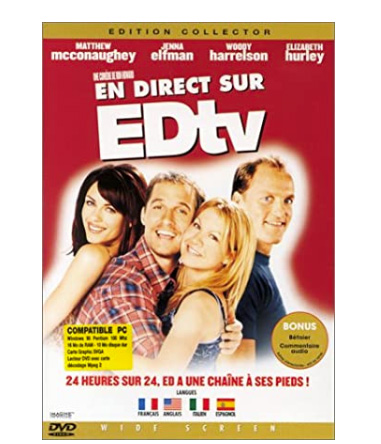
EDtv
Synopsis
Ed Pekurny is an ordinary, easygoing San Francisco videorecorded clerk whose life takes a bizarre turn when he agrees to participate in a revolutionary 24-hour reality television experiment. Created by a struggling television network looking for ratings, Ed's entire life is broadcast live to the world without interruption or censorship. Initially enjoying his sudden fame, perks, and romantic attention, Ed soon discovers that constant surveillance destroys his privacy and strains his relationships. When he attempts to cancel the show, the network and public refuse to let him go, turning his life into a chaotic media circus.
The Making of the Film
Based on the 1994 Canadian satirical film Louis 19, King of the Airwaves, the Hollywood adaptation was developed as television reality shows began gaining mainstream traction. Director Ron Howard sought to satirize media voyeurism and society's growing obsession with televised surveillance years before reality television dominated modern broadcasting. The production aimed to blend romantic comedy with sharp social commentary on fame. Matthew McConaughey was cast for his charismatic, everyman appeal.
Critical Reception
Critical reception for the film was generally mixed, with reviewers praising its prescient satire of reality television culture and Matthew McConaughey's charming lead performance. However, some critics felt the film played its satirical concepts too safely compared to similar contemporary releases like The Truman Show. Audiences stayed away in theaters, resulting in a disappointing box office run. Despite its commercial failure, the film is frequently revisited today for its astonishingly accurate prediction of modern influencer culture.
Filming Anecdotes
Director Ron Howard incorporated real television personalities and talk show hosts into cameo roles to enhance the authentic media atmosphere. The production built elaborate sets representing Ed's apartment surrounded by hidden broadcast cameras and observation control rooms. Matthew McConaughey and Woody Harrelson maintained their natural off-screen camaraderie while playing feuding brothers on screen. The crew utilized simulated live-broadcast camera angles throughout the film to mimic documentary television aesthetics.
Themes Explored
The film explores the perils of constant surveillance, media voyeurism, and the loss of personal privacy in pursuit of fame. It satirizes how modern media corporations exploit ordinary individuals for commercial entertainment and ratings. The value of genuine human connection over artificial celebrity adoration is a central pillar of the narrative. It also examines sibling rivalry and media ethics.
Explanation of the Ending
Ed deliberately sabotages the broadcast by orchestrating humiliating public stunts and intentionally alienating viewers to force the network to cancel his contract. When the network refuses and tries to trap him legally, the public finally sympathizes with his plight and boycotts the show. Ed regains his freedom, privacy, and the love of Shari, walking away from the cameras for good. The conclusion delivers a cautionary yet optimistic message about reclaiming one's life from media exploitation.
Meaning of the Title
The title is a playful combination of the protagonist's name, Ed, and "TV," representing the 24-hour television channel dedicated entirely to broadcasting his life. It highlights the commodification of an ordinary person for mass media consumption. The catchy name signals a satirical comedy centered around television culture.
Randy Edelman composed an upbeat, jazzy orchestral score that captures the energetic and chaotic atmosphere of broadcast television.
The Truman Show, Network, Pleasantville, Quiz Show