

 Français
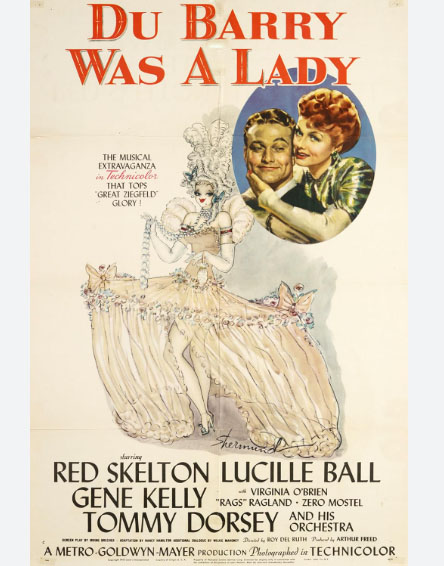
Du Barry Was a Lady
Synopsis
Louis Blore is a humble, lovesick New York nightclub washroom attendant who is hopelessly infatuated with the glamorous club singer May Daly. May, however, only has eyes for handsome professional entertainer Alex Bard. When Louis wins a massive sweepstakes jackpot, he tries to buy Mays affection with expensive gifts, but she rejects him. After accidentally drinking a drugged wine cocktail spiked by a stage hypnotist, Louis falls into a deep slumber. In his elaborate dream, he imagines himself as King Louis XV of France, with May as Madame Du Barry and Alex as his romantic rival in an extravagant 18th-century royal court.
The Making of the Film
Director Roy Del Ruth adapted the film from the hit 1939 Broadway musical written by Herbert Fields and B. DeSylva, featuring timeless songs by Cole Porter. Metro-Goldwyn-Mayer purchased the screen rights as a lavish Technicolor star vehicle for legendary comedy duo Red Skelton and Lucille Ball. The production aimed to translate the raucous Broadway stage success into a visually stunning cinematic musical extravaganza.
Critical Reception
Critics gave the film mixed reviews upon release, praising its glorious Technicolor visual design, lavish costumes, and the comedic talents of Red Skelton and Lucille Ball. However, many reviewers felt that Cole Porters brilliant Broadway score was largely gutted or altered, and that the musical numbers lacked energy compared to the stage version. Audiences nonetheless enjoyed the bright Technicolor escapism.
Public reception was solid, turning the musical comedy into a respectable box-office success for MGM during wartime Hollywood. Families and fans of Red Skelton and Lucille Ball flocked to theaters to enjoy the colorful royal court fantasy sequences. It remains a fascinating historical artifact of 1940s studio musicals.
The film earned Academy Award nominations for Best Art Direction (Color) and Best Scoring of a Musical Picture. Its dazzling Technicolor cinematography was praised by industry peers. Its preservation of Lucille Balls early comedic stardom is historically significant.
Filming Anecdotes
Director Roy Del Ruth drew inspiration from classic MGM musical extravaganzas and Busby Berkeley theatrical staging traditions. He chose to shoot entirely in vibrant Technicolor, utilizing massive soundstage sets representing 18th-century French royal palaces. His direction encouraged Red Skelton to unleash his trademark physical slapstick comedy.
Production faced studio adjustments as censors forced MGM to tone down some of Cole Porters famously risqué Broadway lyrical double entendres. Lucille Ball wore stunning period royal gowns and red wigs that defined the films glamorous visual aesthetic. Gene Kelly was originally considered for the supporting role before Tommy Dorsey and his orchestra joined.
A memorable sequence involves Lucille Ball performing a lavish musical number dressed as Madame Du Barry in a grand French ballroom. The scene showcases MGM legendary costume and set design budgets in full Technicolor splendor. Balls charismatic performance anchored the fantasy.
The casting process brought together top MGM comedy and musical talent. Red Skelton was cast as the lovesick attendant, bringing effortless vaudeville slapstick. Lucille Ball was chosen for her dazzling beauty and sharp comedic timing as the glamorous star.
Themes Explored
The film explores unrequited love, class aspiration, dreams versus reality, and royal court intrigue. It satirizes historical pomposity through modern comedic sensibilities. Imagination offers escape from heartbreak.
NULL
Title Significance
The title refers directly to the historical French royal figure Madame Du Barry, who serves as the central fantasy persona dreamed up by the protagonist. It highlights the lavish 18th-century royal setting.
NULL
NULL
Similar Films
Other similar films include Cabin in the Sky, The Pirate, and Ziegfeld Follies.