

 Français
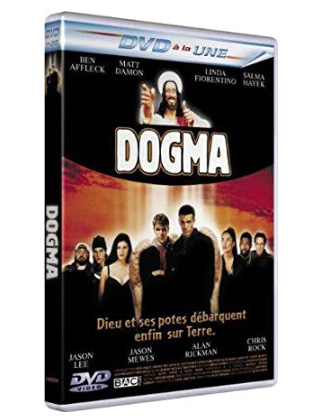
Dogma
Synopsis
Two fallen angels named Loki and Bartleby discover a loophole that could allow them to return to Heaven. Their return would paradoxically prove that God can be contradicted and could therefore destroy existence. Bethany Sloane is chosen for a divine mission to stop them, accompanied by an unlikely group of allies. Their journey becomes a provocative and irreverent exploration of faith, institutional religion, doubt and the nature of God.
The Making of the Film
Kevin Smith conceived Dogma as a religious satire built around questions that had interested him since childhood. The story combines Catholic imagery, biblical concepts and the irreverent humor characteristic of Smith early work. Smith wanted to explore the difference between organized religion and personal faith rather than simply attack belief itself. He wrote the screenplay before production and assembled many recurring collaborators from his previous films. The project attracted a remarkably large cast including Ben Affleck, Matt Damon, Linda Fiorentino, Alan Rickman and Salma Hayek. Alanis Morissette was selected to portray God, while George Carlin played Cardinal Ignatius. The film was produced as an ambitious independent-style religious comedy with a larger budget than Smith earlier projects. Its subject matter generated controversy before release, making the production unusually sensitive for a mainstream comedy.
Reviews and reception
Professional reception was mixed but often recognized the ambition of the screenplay. Critics praised Kevin Smith dialogue, the ensemble cast and the films willingness to address serious theological questions through comedy. Others criticized the uneven tone and the large amount of irreverent humor. The film attracted substantial controversy from religious groups before and after its release. Its appearance at the Cannes Film Festival outside competition gave it additional international visibility. Audiences developed a strong cult following for the film over time. The performances of Alan Rickman, Matt Damon, Ben Affleck and Alanis Morissette became especially memorable to fans. Although it did not become a major mainstream awards success, its cultural impact remained significant.
Filming anecdotes
The production had to coordinate a large ensemble cast containing several major stars. Kevin Smith deliberately mixed serious religious imagery with absurd comic situations. Alan Rickman played Metatron with a restrained and authoritative style that contrasted sharply with the surrounding comedy. Alanis Morissette appearance as God was deliberately brief and largely silent, making the casting itself part of the joke. Ben Affleck and Matt Damon were reunited as the fallen angels Bartleby and Loki. The production design created a visual world combining ordinary American locations with exaggerated religious elements. The controversy surrounding the subject matter created additional pressure around the marketing and release of the film. Smith later continued to discuss the religious questions that inspired the screenplay, emphasizing that his intention was to explore faith rather than simply mock believers.
Themes addressed
The film examines faith, organized religion, free will, doubt, redemption and the relationship between humanity and God. It questions whether religious institutions can become separated from the spiritual ideas they are supposed to represent. The story also explores the possibility that doubt and faith can coexist. Bethany journey is fundamentally about discovering her own relationship with belief. Humor allows the film to approach theological subjects that would otherwise be difficult to dramatize in a conventional comedy.
Explanation of the ending
Bethany and her companions eventually prevent Loki and Bartleby from exploiting the loophole that would allow them to return to Heaven. The conflict reaches a supernatural climax in which the consequences of their actions become clear. Bethany discovers that her role is connected to a larger divine plan than she initially understood. The angels actions are ultimately stopped before their return can destroy existence. Bethany survives and gains a renewed understanding of faith and responsibility. The ending reinforces the idea that belief is not simply obedience to rules but a personal relationship with meaning and purpose.
Meaning of the title
The title Dogma refers to an established religious belief or doctrine regarded as authoritative. The word is particularly appropriate because the film constantly questions the relationship between official doctrine and individual faith. The characters debate rules, traditions and interpretations while trying to understand the intentions behind them. The title therefore has both a theological meaning and an ironic function. It highlights the films central question about what happens when rigid rules become separated from the deeper purpose of belief.
Original soundtrack
Howard Shore composed the original score, providing the film with a musical identity that balances supernatural drama and comedy. The soundtrack also includes songs by various artists, reinforcing the irreverent and contemporary tone. The music helps connect the ordinary New Jersey setting with the supernatural events taking place within it. Shore score contributes a sense of grandeur that deliberately contrasts with Kevin Smith unconventional humor.
News
There has been continuing interest in the possibility of a return to the world of Dogma, particularly because of Kevin Smith discussions about his earlier films. The movie remains a cult favorite and is frequently revisited in discussions of controversial religious comedies. Its unusual combination of theological debate, fantasy and irreverent humor continues to distinguish it from conventional studio comedies.
Similar films
Viewers interested in Dogma may enjoy Clerks, Chasing Amy and Jay and Silent Bob Strike Back, which share Kevin Smith characters and comedic style. The Last Temptation of Christ offers a much more serious examination of religious questions. Life of Brian similarly uses comedy to explore religion and social institutions. Constantine combines supernatural mythology with questions about faith and redemption. The Prophecy also explores angels, Heaven and theological conflict through a darker tone.