

 Français
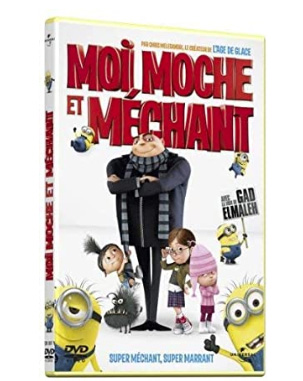
Despicable Me
Synopsis
Gru is a grumpy villain who lives in a gloomy house and is proud of his evil schemes. When a younger rival, Vector, steals the Pyramid of Giza, Gru decides to carry out the most outrageous crime ever: stealing the Moon. To do so, he needs a shrink ray, which Vector keeps in his fortress. Gru adopts three orphan girls to help him sneak into Vector's lair, but he soon finds that the girls, with their love and curiosity, are changing his heart.
The Making of the Film
Despicable Me was the first feature film produced by Illumination Entertainment, a studio created by producer Chris Meledandri. Meledandri, who had previously run Fox Animation and produced the Ice Age series, wanted to make animated films at a lower cost and with a distinctive tone. The idea of a film with a villain as the hero came from the desire to subvert the usual formula of family films. The script was written by Cinco Paul and Ken Daurio, who imagined a character with a gloomy exterior and a hidden capacity for love. Illumination partnered with the French animation studio Mac Guff in Paris, which was responsible for much of the film's animation. Pierre Coffin, who co-directed with Chris Renaud, created the Minions and voiced them himself. The design of Gru was inspired by classic villains, with a long nose and an Eastern European accent. The film was released in 2010 and quickly became a major success.
Reviews and reception
Professional critics' summary
Critics gave the film generally positive reviews, praising its humour, its imagination and its heart. Many noted that the Minions stole the show with their slapstick comedy. Steve Carell's voice performance was admired for its blend of menace and warmth. Some reviewers felt that the story was fairly predictable, but they enjoyed its energy and charm.
Audience reception
The film earned more than 540 million dollars worldwide on a modest budget, which was a spectacular result for a new studio. Families flocked to see it, and children especially loved the Minions and the three girls. It became a favourite on home video and television and led to a major franchise. The film also launched Illumination as a serious competitor in the animation market.
Awards
The film earned a nomination for the Annie Awards and was recognised by several children's choice and animation ceremonies. It was praised for its character design and for the music by Pharrell Williams and Heitor Pereira. While it did not win the Oscar, it had a large cultural impact. Its true reward was the creation of one of the most successful animated franchises of the century.
Filming anecdotes
Director's inspirations
The directors took inspiration from classic villains, such as those in James Bond films, and from the dark humour of Roald Dahl and Charles Addams. The Minions were inspired by silent film comedians, with their expressive movements and simple gags. The idea of a villain who is softened by children echoes stories like The Grinch. Chris Renaud and Pierre Coffin also wanted the film to be visually distinctive, with bold shapes and colours.
Production difficulties
The film was produced at a lower budget than most big animated features, so the team had to be resourceful. Animating Gru's long, thin body and large nose required the development of special rigs. The Minions, with their huge numbers and distinctive movements, were a challenge to animate in large groups. Despite these constraints, the film achieved a polished and inventive look.
Anecdote about a particular scene
The scene in which Gru reads bedtime stories to the girls is among the most touching in the film. It shows how the tough villain slowly becomes a loving father. Another memorable moment is the sequence in which Gru steals the shrink ray from Vector's fortress. The scenes with the Minions, such as their antics in the laboratory, have become iconic.
Originally planned casting
Steve Carell was cast as Gru, giving him a distinctive accent and a mix of gruffness and vulnerability. Jason Segel played Vector, the nerdy and pompous rival, while Russell Brand voiced Dr. Nefario. Julie Andrews, Will Arnett and Kristen Wiig appeared in supporting roles. Miranda Cosgrove, Dana Gaier and Elsie Fisher voiced the three girls.
Themes explored
The film is about the power of love to change people. Gru begins as a cold and selfish man, but the affection of three little girls gradually softens him. It also explores the theme of family, showing that families can be formed by choice. Another theme is the desire for approval, as Gru longs for recognition from his mother and his peers. The story pokes fun at the idea of villainy and the competitiveness among supervillains. It also looks at loneliness and the need for human connection. The film shows that people are more complicated than the labels attached to them. At heart, it is a story of redemption and unconditional love.
Ending explained
Gru manages to steal the Moon, but Vector kidnaps the girls and holds them hostage. To save them, Gru gives up the Moon and rescues them in a daring flight. The Moon returns to its place in the sky, and Gru confesses his love for the girls. He officially adopts them and decides to leave his life of crime behind. The Minions, loyal as ever, join in the celebration. The film ends with a school show in which the girls perform, and Gru proudly watches. The ending shows that he has found a new kind of happiness.
Meaning of the title
The title Despicable Me refers to the way Gru sees himself, as a villain who is proud to be hated. The word despicable means deserving contempt, and Gru uses it as a badge of honour at the start of the film. Throughout the story, the meaning of the title changes, as he learns that he is capable of love and kindness. The word Me shows that the story is told from his point of view, with his flaws and his growth. The title is playful and memorable and tells the audience that the main character is not a conventional hero. In French, the film was titled Moi, moche et mechant, which preserves the same tone.
Original Soundtrack
Heitor Pereira composed the score, and Pharrell Williams wrote and produced several original songs. The music mixes funk, pop and orchestral elements, giving the film a playful and energetic sound. The song Despicable Me, performed by Pharrell, plays during the Minions' scenes and has become a fan favourite. The soundtrack was a key element in the film's success and set the tone for the sequels.
News
The franchise includes two sequels, the spin-offs Minions and Minions: The Rise of Gru, and Despicable Me 4. The Minions have become global icons, appearing in advertising, merchandise and theme park attractions. The original film remains a fan favourite and is regularly shown on television.
Similar Films
Despicable Me 2 and Despicable Me 3 continue the story of Gru. Megamind and Monsters vs. Aliens are other animated films about unusual villains and heroes. The Incredibles and Hotel Transylvania also feature super-powered families. Cloudy with a Chance of Meatballs is another fun animated comedy.