

 Français
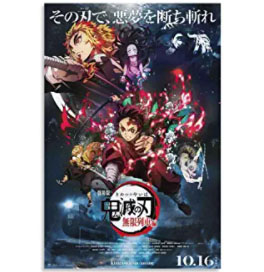
Demon Slayer: Kimetsu no Yaiba – The Movie: Mugen Train
Synopsis
After a harrowing mission, young demon slayer Tanjiro and his companions board the mysterious Mugen Train. They are soon joined by Kyojuro Rengoku, the fiery Flame Hashira, who is investigating a series of disappearances. It becomes clear that a powerful demon is hiding on board, trapping the passengers in an endless dream. As the stakes rise, Tanjiro must face his inner demons while fighting to save everyone on the train.
The Making of the Film
The film is based on the manga Demon Slayer: Kimetsu no Yaiba by Koyoharu Gotouge, which became a massive success in Japan. It adapts the Mugen Train arc, which follows directly after the first season of the anime. The director Haruo Sotozaki and the studio Ufotable were already known for the visual quality of the television series. For the film, they combined traditional hand-drawn animation with digital effects to bring the train and its dreamlike sequences to life. The story was chosen because of its emotional intensity and its focus on the character of Rengoku. Composers Yuki Kajiura and Go Shiina returned to provide the music, along with the singer LiSA. The film was released in Japan in October 2020 and became a national phenomenon. It reached international audiences in 2021.
Critical Reception
Critics praised the film's stunning animation, particularly the fluid fight scenes and the imaginative depiction of the dream world. Many noted that the emotional climax was handled with great sensitivity. Some felt that viewers unfamiliar with the series might struggle to follow the story. Still, most agreed that it stood as a spectacular and touching continuation of the anime.
Audiences in Japan embraced the film with extraordinary enthusiasm. It overtook Spirited Away to become the highest-grossing film in Japanese history, and it earned more than 500 million dollars worldwide. Fans were moved by Rengoku's story and by the film's message about duty and sacrifice. Many viewers returned several times to the cinema.
The film won the Japan Academy Prize for Animation of the Year, among numerous other honours. These awards confirmed its status as a landmark in modern anime.
Behind-the-Scenes Stories
Sotozaki said he wanted to give Rengoku the farewell that the character deserved. The team therefore spent a great deal of time shaping the emotional rhythm of the film. The visuals were designed to switch smoothly between the realistic and the surreal.
The train itself was a major technical challenge, as it had to feel both physical and alive. Ufotable's artists used 3D models for parts of the train and combined them with hand-drawn characters. The result is a seamless blend that still feels consistent with the look of the series.
One of the most memorable sequences shows Tanjiro in a dream world filled with memories of his family. The scene is full of warmth and sorrow, and it sets up the emotional stakes for the rest of the film.
Themes Explored
The film deals with duty, sacrifice and the strength to keep going despite loss. It contrasts the comfort of dreams with the harsh reality of the world. Rengoku's credo of using one's strength to protect the weak becomes a moral compass for the heroes. Grief and family bonds are present throughout, especially in Tanjiro's sequences. Ultimately, the film is about finding courage in the face of overwhelming darkness.
Ending Explained
After defeating the demon on the train, the group believes the danger has passed. Then a more powerful demon appears and attacks Rengoku. Despite his injuries, Rengoku fights until the end, and he dies after protecting everyone aboard. His final words encourage Tanjiro and the others to continue their mission. The ending is heartbreaking, but it also gives the heroes a renewed sense of purpose.
Meaning of the Title
The word mugen in the original Japanese title means infinite or endless. The Mugen Train is therefore the endless train, a place where the demon traps people in an unending dream. The title evokes both the supernatural setting and the idea of being caught in a loop. It also hints at the characters' struggle to escape their past.
Original Soundtrack
The soundtrack, composed by Yuki Kajiura and Go Shiina, is one of the film's greatest strengths. LiSA's theme song Homura became an enormous hit in Japan, and it perfectly captures the emotion of the final act. The music accompanies the fights and quieter moments with equal power. Many fans consider it among the best anime scores of recent years.
Latest News
The story continued with Demon Slayer: Kimetsu no Yaiba – Infinity Castle, the first part of a film trilogy adapting the final arc of the manga. Released in 2025, it became another huge success for the franchise and drew large audiences around the world.
Similar Films
If you enjoyed Mugen Train, watch the first season of the Demon Slayer anime to explore the story from the beginning. Jujutsu Kaisen 0 offers similar action and emotional depth. Spirited Away, which Mugen Train surpassed at the box office, remains a classic. Your Name is another global anime hit with strong emotional appeal. For more supernatural fights, you could also try Bleach or Fullmetal Alchemist.