

 Français
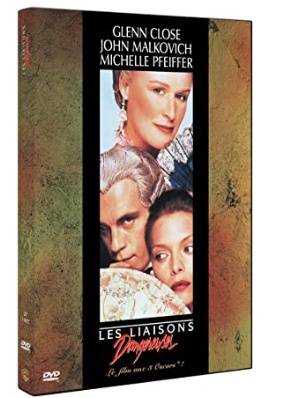
Dangerous Liaisons
Synopsis
In pre-revolutionary France, the Marquise de Merteuil and the Vicomte de Valmont, former lovers turned partners in intrigue, amuse themselves by manipulating the hearts of others. She asks him to seduce and ruin an innocent young girl, while he sets his sights on the virtuous and married Madame de Tourvel. What begins as a refined game of seduction and revenge slowly turns into a dangerous contest of pride. As real feelings creep in, the two schemers discover that their weapons can also destroy them.
The Making of the Film
Dangerous Liaisons is based on the 1782 epistolary novel Les Liaisons dangereuses by Pierre Choderlos de Laclos, a scandalous portrait of the French aristocracy on the eve of the Revolution. The screenplay was written by Christopher Hampton, who had first adapted the book for the stage in a play that opened at the Royal Shakespeare Company in 1985. That production, which later transferred to the West End and to Broadway, had already proved how well the story of seduction and betrayal could work in the theatre. For the film, Hampton reworked his own text to give it more movement and space, while keeping the sharp, cruel dialogue. Stephen Frears, who had become known for My Beautiful Laundrette and Prick Up Your Ears, was chosen to direct, which gave the project a lively and unstuffy sensibility. The cast brought together Glenn Close, John Malkovich and Michelle Pfeiffer, with Uma Thurman and Keanu Reeves in early roles. The production aimed to recreate the sumptuous world of eighteenth-century aristocracy, from its costumes to its candlelit interiors. The film came out at the end of 1988 in the United States, and it was soon followed by a rival adaptation, Milos Forman's Valmont.
Critical Reception
Critics were enthusiastic about Dangerous Liaisons. They praised the elegance of the staging, the wit of Hampton's screenplay and above all the performances of Glenn Close and John Malkovich, who play two of cinema's most memorable manipulators. Michelle Pfeiffer's moving portrayal of the virtuous Madame de Tourvel was also widely admired. A few reviewers found the film somewhat theatrical and cold, but most agreed that this chilliness suited the subject. It is now regarded as one of the finest literary adaptations of its era.
The film was a significant success with audiences, especially in the arthouse circuit where costume dramas with sharp dialogue found a loyal following. Its mix of sex, power and wit made it a talking point, and it did much to turn its stars into household names. The story has endured in popular culture, inspiring later versions such as the teen drama Cruel Intentions in 1999. For many viewers, this remains the definitive screen version of Laclos's novel.
Dangerous Liaisons received seven Academy Award nominations, including Best Picture, Best Actress for Glenn Close, Best Supporting Actress for Michelle Pfeiffer and Best Original Score for George Fenton. It won three Oscars, for Best Adapted Screenplay, Best Art Direction and Best Costume Design. These prizes reflected the film's craftsmanship, from Hampton's dialogue to the lavish period detail. They also confirmed Stephen Frears as one of the most versatile British directors of his generation.
Filming anecdotes
Christopher Hampton's stage version, which had opened in London in 1985 with Alan Rickman and Lindsay Duncan in the leading roles, was the direct starting point for the film. When the cinema adaptation was in preparation, it found itself in a curious race with Milos Forman's Valmont, based on the same novel, which arrived in cinemas about a year later with Colin Firth and Annette Bening. The rivalry meant that Frears's film benefited from being first, which probably helped to establish it as the reference version. The costumes and the powdered wigs became part of the film's identity, and the final shot of the Marquise removing her makeup in front of a mirror is one of its most remembered images.
Themes explored
At its heart, Dangerous Liaisons is a study of power and manipulation disguised as seduction. Merteuil and Valmont treat love as a game of strategy, in which every conquest is a victory and every confession a weakness. The film also depicts a society in which reputation matters more than truth, and where a few words can ruin a life. The contrast between the cynical schemers and their innocent victims asks whether goodness can survive in such a world. Gender is another central theme, since Merteuil is shown as a woman who must use cunning to hold her ground in a world run by men. Vanity and pride lead both protagonists to their downfall, as they cannot admit that they might actually have feelings. The aristocratic setting, with its elegance and idleness, hints at the decay that will lead to the Revolution. In the end the film is a tragedy about the cost of treating other people as pawns.
Ending explained
In the final act, Valmont, who has fallen in love with Madame de Tourvel in spite of himself, abandons her at Merteuil's insistence, and the cruelty of that decision breaks them both. Tourvel dies of heartbreak, while Valmont realises too late what he has lost. Danceny, the young man whom Merteuil had also manipulated, challenges Valmont to a duel, and Valmont allows himself to be mortally wounded. Before dying, he hands Danceny the letters that reveal Merteuil's schemes. The letters are made public, and Merteuil is humiliated at the opera, where the audience turns against her. The last image shows her alone at her dressing table, taking off her makeup, which strips away the mask she had worn throughout. The ending suggests that her punishment is social rather than physical, since she loses the reputation that was her only real power. It leaves a chilling impression of a world in which cleverness is not enough to protect against the consequences of cruelty.
Meaning of the title
The title Dangerous Liaisons translates the French Les Liaisons dangereuses, the title of Laclos's 1782 novel. The word liaison, which English borrowed from French, means a romantic or sexual connection, often secret, and it carries a hint of scandal. The adjective dangerous warns that these connections are not innocent, and that they carry a high price for everyone involved. The plural suggests that there is not one liaison but a whole network of relationships, which the film untangles. The title also applies to the dangerous alliance between Merteuil and Valmont, two people whose complicity is a threat to everyone around them. It promises a story of seduction, but also of risk and consequence. The French origin of the title adds an air of sophistication that fits the aristocratic setting. Its balance of elegance and menace sums up the film's tone perfectly.
Similar Films
If you enjoyed Dangerous Liaisons, the obvious companion is Valmont, Milos Forman's own adaptation of the same novel, which takes a gentler and more romantic approach. Cruel Intentions modernises the story in an American high school with Sarah Michelle Gellar and Ryan Phillippe. Barry Lyndon, by Stanley Kubrick, offers another lavish portrait of the eighteenth-century aristocracy, though with a more distant tone. Amadeus, with its mix of intrigue and genius, shares the same period and sense of theatrical excess. Marie Antoinette, by Sofia Coppola, shows the same world from a more modern and dreamy angle. The Age of Innocence, by Martin Scorsese, depicts a society in which manners hide cruelty. Atonement, by Joe Wright, explores how a single lie can ruin lives. Together these films form a rich tradition of costume dramas about desire and deception.