

 Français
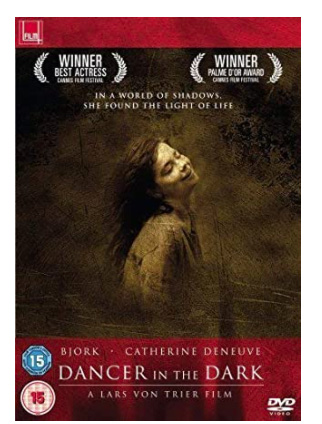
Dancer in the Dark
Synopsis
Selma Ježková is a Czech immigrant working in a factory in rural Washington State, where she lives with her young son Gene. She is slowly going blind from a hereditary condition and secretly saving every penny to pay for an operation that will spare her son the same fate. To escape the harshness of her life she retreats into daydreams in which everyday noises become musical numbers. When her neighbour Bill steals her savings, her desperate attempt to recover them leads to a tragedy that threatens everything she has fought for.
The Making of the Film
Dancer in the Dark was directed by the Danish filmmaker Lars von Trier and completes his so-called Golden Heart trilogy, following Breaking the Waves and The Idiots. These films share a central figure of an innocent woman who sacrifices herself for others. Von Trier conceived the film as a melodrama that borrows from the classical Hollywood musical, a genre he wanted to explore in a harsh and realistic way. He also wanted to reflect his own ambivalent fascination with America, a country he had never visited and which he portrayed from the outside. The Icelandic singer Björk, who composed the songs and took the leading role, became the heart of the project. The film was produced by Zentropa, von Trier's company, and shot in Sweden even though the story is set in the United States. The musical numbers were shot using about a hundred fixed digital cameras to capture the action from many angles at once. The result is a hybrid of social realism and fantasy that remains one of von Trier's most emotional works.
Critical Reception
Dancer in the Dark divided critics sharply. Many hailed it as a bold and moving film, praising Björk's raw and unvarnished performance and von Trier's refusal to follow conventions. Others found it manipulative and punishing, accusing the director of putting his heroine through unbearable suffering. The film's handheld camerawork and the contrast between harsh reality and colourful fantasy were widely discussed. Whatever their verdict, most reviewers agreed that it was a film that could not be ignored.
With audiences, the film has remained a polarising work. Some viewers describe it as one of the most devastating experiences they have had in a cinema, while others find it too bleak to rewatch. It reached a wide international audience thanks to the attention surrounding its Cannes success and Björk's participation. Over time it has built a loyal following and is often cited as a landmark of early twenty-first-century European cinema.
The film won the Palme d'Or at the 2000 Cannes Film Festival, and Björk was awarded the prize for Best Actress. Her song I've Seen It All, written with Lars von Trier and Sjón, received an Academy Award nomination for Best Original Song. The film also earned other nominations and honours in Europe. Its success at Cannes helped to make Lars von Trier one of the most discussed directors of his generation.
Filming anecdotes
Lars von Trier is reported to have written the part of Selma with Björk in mind, and the film is indelibly linked to her. The shoot was famously demanding, and Björk has spoken of it as an exhausting and emotionally draining experience, with reports of tensions between her and the director. For the musical numbers, the crew used around one hundred fixed digital cameras, placed around each set so that the action could be filmed in a single continuous take from many angles. The rest of the film was shot with handheld cameras in a rough, documentary style, in deliberate contrast to the polished look of the musical sequences. Catherine Deneuve, who plays Selma's friend and colleague Kathy, gave the film a touch of European star power and acted as a counterpoint to Björk's intensity.
Themes explored
At its heart, Dancer in the Dark is a story of sacrificial maternal love, in which a mother is prepared to give up everything for her child's future. Blindness is a literal and symbolic theme, as Selma's loss of sight parallels society's inability to see her suffering. The musical sequences are an expression of escape, since Selma retreats into music whenever reality becomes too painful. The film also offers a harsh critique of the American justice system and the death penalty, depicting a legal process that fails to understand its victim. Trust and betrayal drive the plot, with Bill's betrayal setting off the tragic chain of events. The immigrant's dream of a better life and its brutal limits give the film a social dimension. Von Trier explores the cruelty that can be inflicted on innocence, a recurring theme in his work. The story also asks how much a person can endure before the imagination is the only refuge left.
Ending explained
After Selma kills Bill in a desperate attempt to recover her savings, she is arrested and put on trial. She refuses to defend herself in a way that would reveal her secret, since she wants to protect the money she has set aside for her son's operation. Condemned to death, she refuses to use that money to pay for a lawyer, as the operation is the whole point of her sacrifice. In the final scenes she learns that Gene's operation has been paid for and that her son will keep his sight. Walking toward the gallows, she sings her last song, as the musical fantasy and the grim reality meet one last time. She is hanged before the song is finished, and the film cuts to its closing credits. The ending is deliberately devastating, offering no consolation beyond the knowledge that her sacrifice has worked. It is also a statement on the cruelty of a system that cannot see the person it is punishing.
Meaning of the title
The title Dancer in the Dark has several layers of meaning. Literally, it refers to Selma, a woman who loves musicals and is losing her sight, so that she dances in the dark of her own failing vision. It also refers to the way she escapes reality through imagination, turning ordinary sounds into music and finding joy where there is none. Metaphorically, darkness is the world she lives in, a world of poverty, injustice and cruelty. The image of dancing suggests resilience and an almost stubborn optimism, which contrasts with the grim circumstances. The title also evokes the classic musicals that Selma loves, with their dancers, stages and glamour. In the context of her tragic end, it takes on an additional meaning, as her last song is sung in the dark of the hood placed over her face. The phrase is both poetic and sad, which makes it ideal for the film. It sums up von Trier's meeting of fantasy and tragedy.
Original Soundtrack
Björk wrote and performed the songs that form the heart of the film, and the soundtrack was released as the album Selmasongs. The music draws its rhythms from everyday sounds such as factory machines and trains, a device that links the musical numbers to Selma's working-class reality. Songs such as I've Seen It All, which Björk sings with Thom Yorke of Radiohead, 107 Steps and Cvalda became favourites with fans. I've Seen It All earned an Academy Award nomination for Best Original Song. The music allows Selma's inner life to emerge in vivid colour, in contrast with the grey look of the rest of the film. Björk's voice, full of fragility and defiance, is the emotional engine of the story. Many viewers consider the soundtrack one of the great achievements of her career.
Similar Films
If you were moved by Dancer in the Dark, start with Breaking the Waves, the first film in von Trier's Golden Heart trilogy, which also features a woman who sacrifices herself for love. The Idiots, the second film in the trilogy, explores a more provocative form of innocence. Dogville, also by von Trier, offers another bleak look at American society, this time on a theatrical stage. The Umbrellas of Cherbourg is a French musical in which all the dialogue is sung, but it shows a gentler face of the genre. Moulin Rouge! offers a very different take on the modern musical, more colourful and romantic. Cabaret mixes song and darkness against the backdrop of a society heading toward catastrophe. Once is a small-scale musical drama in which music expresses emotions that dialogue cannot. Together they show the range of what the musical can do.