

 Français
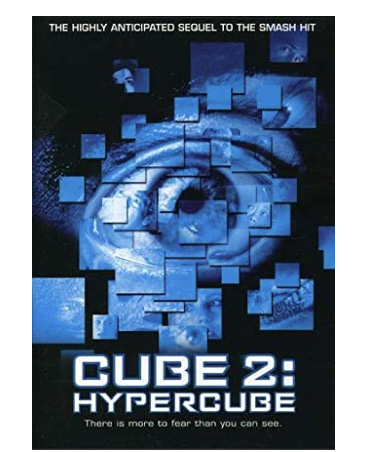
Cube 2: Hypercube
Synopsis
Trapped in a mysterious four-dimensional hypercube, a group of strangers must navigate shifting rooms and deadly traps to escape. As reality begins to warp around them, they realize that time and space behave differently in this terrifying architectural nightmare. Trust quickly erodes among the captives as they uncover the sinister government conspiracy behind the experiment. Only a few will fight for survival until the bitter, mind-bending end.
The Making of the Film
Following the unexpected cult success of the original indie thriller Cube in 1997, producers wanted to expand the concept into a larger, more scientifically complex universe. The creative team was inspired by higher-dimensional geometry, theoretical physics, and the mathematical concept of a tesseract or hypercube. Rather than repeating the exact same minimalist trap formula, they decided to elevate the stakes by incorporating quantum mechanics and corporate conspiracy theories. The idea was to push the characters not just to their physical limits, but into psychological territory where laws of physics no longer apply.
Critical Reception
Professional critics praised the film for its ambitious expansion of the original concept, highlighting its bold dive into abstract mathematical and scientific theories. Many reviews noted that while it lacked the raw, claustrophobic novelty of the first movie, it successfully modernized the franchise with sleek visual effects. Reviewers frequently debated whether the narrative complexity overshadowed the simple character dynamics that made the predecessor work so well. Overall, it was received as a worthy and inventive sci-fi sequel that catered strongly to genre enthusiasts.
Public reception was generally favorable among science fiction and horror fans who appreciated the mind-bending puzzles and surreal atmosphere. Audiences enjoyed trying to decode the complex spatial puzzles alongside the characters while debating the ultimate fate of the participants. The film quickly found a dedicated following on home video, establishing itself as a staple of early 2000s psychological science fiction. Viewers often cited the bewildering twists and philosophical undertones as memorable highlights of the viewing experience.
While the film did not receive major mainstream cinematic awards, it earned recognition within genre-specific festivals and circles for its creative use of limited settings and digital effects. The special effects team received praise for visualizing higher-dimensional spaces on a modest independent budget. Its cult status has since been cemented through retrospective reviews and fan discussions centered around its intricate lore.
Filming Anecdotes
The director drew heavy visual and atmospheric inspiration from surrealist art, minimalist architecture, and classic psychological thrillers that toy with perception. He wanted the lighting and set design to reflect the mental deterioration of the characters as they journeyed deeper into the structure. Cinematic influences ranged from avant-garde science fiction to classic twilight zone episodes focusing on isolation and paranoia. These artistic choices helped create a distinct visual identity separate from the gritty, industrial look of the first film.
Production presented unique technical challenges, particularly because the crew had to simulate a four-dimensional space within standard studio sets. Actors often had to react to invisible or digitally added hazards, requiring immense imagination and physical coordination during tense sequences. Budgetary constraints meant that practical effects and clever camera angles had to be utilized alongside early digital imagery to create the illusion of infinite shifting rooms. Despite these hurdles, the cast and crew maintained high energy throughout the tight shooting schedule.
One particularly memorable scene involved characters navigating a room where gravity shifted unpredictably, forcing the actors to perform complex choreography while harnessed to hidden cables. This sequence required dozens of takes to ensure the movements looked fluid and terrifyingly realistic on screen. The physical toll on the actors was significant, but it added a genuine sense of exhaustion to their performances that translated well on film. Crew members often recalled this specific sequence as the most demanding yet rewarding part of the entire production process.
The initial casting process looked at a diverse pool of rising international talent to represent the eclectic mix of scientists, soldiers, and civilians trapped in the structure. Producers wanted characters with distinct backgrounds to contrast sharply against the sterile, mathematical environment of the hypercube. Several well-known character actors were considered for the lead roles before the final ensemble was selected to maximize interpersonal tension. This careful selection ensured that the psychological clashes felt authentic and drove the narrative forward.
Themes Explored
- The intersection of quantum physics, human consciousness, and spatial geometry.
- Corporate ethics and the dangerous consequences of unchecked technological experimentation.
- Paranoia, isolation, and the gradual breakdown of human morality under extreme pressure.
- Reality versus perception in artificial environments.
Ending Explained
The final moments reveal that the hypercube is the result of a massive military-industrial conspiracy spearheaded by the Izon corporation to develop quantum teleportation weapons. Kate, the sole survivor, manages to escape into the real world carrying crucial data about the facility. However, government agents immediately detain her, and she realizes that the experiment was part of a much larger, inescapable web. The film concludes on a chilling note, implying that the cycle of experimentation and corporate exploitation will continue indefinitely.
Title Significance
The title directly references the original cult classic while introducing the concept of a hypercube, which is a four-dimensional analogue of a cube. It highlights the escalation of scale, danger, and scientific complexity from the first movie into a much larger, more abstract dimension.
Similar Films
- Cube (1997)
- Cube Zero (2004)
- Fermat's Room (2007)
- Exam (2009)
- Coherence (2013)