

 Français
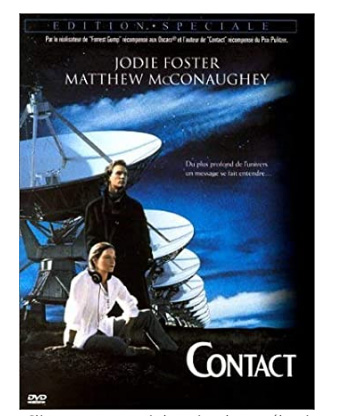
Contact
Synopsis
Ellie Arroway is a dedicated scientist who has spent her life searching for signs of intelligent life in the universe. One night, her team at the Very Large Array detects a mysterious signal from the star Vega, apparently sent by an alien civilization. The signal contains blueprints for a machine of unknown purpose, and the world must decide whether to build it. As governments, scientists and religious leaders clash, Ellie finds herself at the center of the most important discovery in human history.
The Making of the Film
Contact is based on the 1985 novel by Carl Sagan, the famed astronomer and science communicator, who developed the original treatment together with Ann Druyan. The project spent many years in development, with director George Miller attached for a time before Robert Zemeckis took over. Jodie Foster plays Ellie Arroway, with Matthew McConaughey, Tom Skerritt, James Woods and John Hurt in supporting roles. Sagan died in December 1996, before the film was released, and the film is dedicated to him. The production used real locations, including the Very Large Array in New Mexico and the Arecibo Observatory in Puerto Rico. The film was released in the summer of 1997.
Reviews and Reception
Summary of Professional Reviews
Critics praised the film for its intelligence, its emotional depth and Jodie Foster's commanding performance. Many noted that it was rare for a blockbuster to explore the relationship between science and faith so thoughtfully. Some reviewers found the final act somewhat sentimental or ambiguous. Overall, it was considered one of the best science-fiction films of its decade.
Audience Reception
The film was a major commercial success, earning over 170 million dollars worldwide. Audiences were drawn to its sense of wonder and the human story at its center. It has become a favorite among science-fiction fans and scientists alike. The film is often cited as an inspiring portrait of scientific curiosity.
Awards Received
The film won the Hugo Award for Best Dramatic Presentation. It also received an Academy Award nomination for Best Sound. Jodie Foster's performance was widely recognized by critics' groups and award bodies. These honors confirmed its status as a respected piece of science fiction.
Themes Explored
The film is a meditation on the relationship between science and religion. It portrays two ways of seeking truth, one based on evidence and the other on faith, and suggests that neither is complete on its own. The search for meaning and connection is central, as Ellie's personal grief drives her scientific quest. Politics and media are shown as forces that complicate the pursuit of knowledge. The story also reflects on humanity's place in the cosmos and the importance of curiosity. Ultimately, it celebrates wonder and the courage to ask big questions.
Ending Explained
After traveling through the machine, Ellie experiences a profound encounter with an alien intelligence, which takes the form of her late father. She returns to Earth only to be told that the machine never left the platform, and that her journey lasted a fraction of a second. Her only evidence is eighteen hours of static recorded on her camera. The ending forces Ellie, and the audience, to confront the question of belief without proof, mirroring the film's central debate between faith and science.
Meaning of the Title
The title refers to the moment of first contact between humanity and an extraterrestrial civilization. It also hints at the deeper idea of human connection, since the story is as much about reaching out to other people as to other worlds. The simple word captures both the scientific and emotional themes of the film.
Soundtrack
The score was composed by Alan Silvestri, a frequent collaborator of Robert Zemeckis. His music alternates between quiet awe and soaring emotion, supporting the film's sense of wonder. The score plays a major role in making the final journey feel both epic and intimate.
Similar Films
- Close Encounters of the Third Kind (1977): a classic story of first contact.
- Arrival (2016): a thoughtful film about communicating with aliens.
- Interstellar (2014): a space epic about love and survival.
- 2001: A Space Odyssey (1968): a landmark film about evolution and discovery.