

 Français
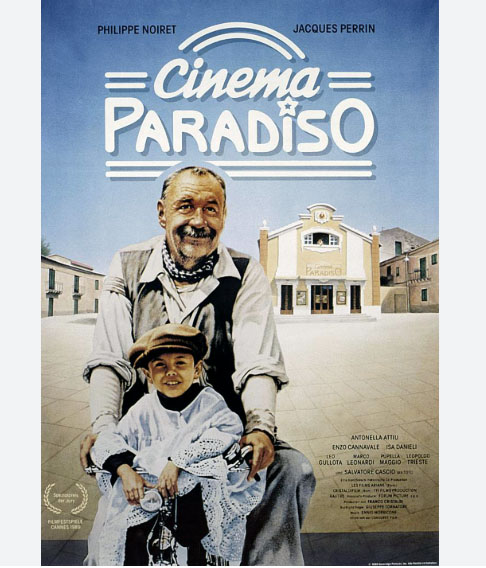
Cinema Paradiso
Synopsis
In a small Sicilian village after the Second World War, a young boy named Salvatore, nicknamed Totò, falls in love with the movies. He befriends Alfredo, the village projectionist at the Cinema Paradiso, who becomes a father figure and teaches him the secrets of the booth. Years later, Salvatore has become a successful film director in Rome, but he has never returned home. A phone call announcing Alfredo's death brings him back to the village and to the memories he has tried to forget.
The Making of the Film
Cinema Paradiso was written and directed by Giuseppe Tornatore, who drew on his own childhood love of cinema in Sicily. The film is a tribute to the golden age of movie theaters, when a whole village gathered in the same room to laugh and cry together. Philippe Noiret played Alfredo, Salvatore Cascio played the young Totò, and Jacques Perrin played the adult Salvatore. The film was shot in Sicily, in the village of Cefalù and in Palazzo Adriano, whose main square became the heart of the story. The original Italian version, which ran over two and a half hours, was not a success, so Tornatore shortened it for international release. It was released in Italy in 1988 and in France in 1989.
Critical Reception
Summary of Professional Reviews
Critics greeted the shorter international version with warmth and admiration. They praised its nostalgic charm, Philippe Noiret's tender performance and the unforgettable relationship between the boy and the projectionist. Some reviewers found it too sentimental, but most felt that its emotion was earned. The longer director's cut, released years later, was seen as a deeper and more melancholic version of the story.
Audience Reception
The film became a worldwide favorite, loved by generations of viewers for its tenderness and its love of cinema. It was a hit in Europe and the United States after its shortened release. Its final sequence is frequently cited as one of the most moving in film history. It remains a favorite among cinephiles.
Awards Received
The film won the Academy Award for Best Foreign Language Film and the Special Jury Prize at the Cannes Film Festival in 1989. It also won the BAFTA Award for Best Foreign Language Film, and Philippe Noiret received a BAFTA for his supporting role. These awards made it one of the best-known Italian films of its decade.
Themes Explored
The film is a love letter to cinema and to the magic of shared storytelling. It explores nostalgia and the pain of leaving home in pursuit of a dream. The relationship between Salvatore and Alfredo shows how mentors can shape a life. Love and loss run through the story, particularly in Salvatore's first romance, which he cannot forget. The film also touches on censorship, as the village priest orders kisses to be cut from the films. Above all, it is a meditation on memory and on what we sacrifice to become who we are.
Ending Explained
When Salvatore returns for Alfredo's funeral, he finds that the old cinema has been abandoned and is about to be demolished. Alfredo has left him a reel of film as a final gift. Back in Rome, Salvatore watches it alone in a screening room and discovers that it is a montage of all the kisses that the priest had ordered cut from the films of his childhood. He smiles through his tears, finally reconciled with his past. The ending is a tribute to the power of cinema to preserve love and memory.
Meaning of the Title
The Cinema Paradiso is the name of the village movie theater where Salvatore spends his childhood. The word "paradiso" suggests a paradise, which reflects how the place feels to a young boy fascinated by films. The title also evokes the idea of a lost paradise that can only be revisited through memory.
Original Soundtrack
The score was composed by Ennio Morricone together with his son Andrea Morricone, and it is one of the most beloved film scores of all time. The tender love theme, written by Andrea, is closely linked to the film's emotional ending. The music evokes nostalgia, innocence and the passage of time. It is regularly performed in concerts and has become a classic of film music.
Similar Films
- Malèna (2000): another Tornatore film about adolescence in Sicily.
- Amarcord (1973): Fellini's nostalgic portrait of a small Italian town.
- Hugo (2011): a tribute to the magic of early cinema.
- The Artist (2011): a modern homage to the silent film era.