

 Français
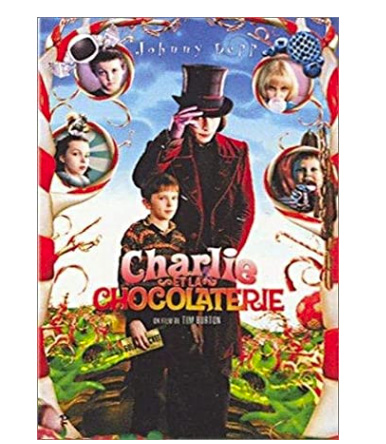
Charlie and the Chocolate Factory
Synopsis
Young Charlie Bucket, who lives in poverty with his family, finds one of five Golden Tickets hidden in chocolate bars. The prize is a tour of the legendary factory of the reclusive confectioner Willy Wonka. Alongside four far less well-behaved children, Charlie discovers a candy-coated world where every sin is punished in spectacular fashion. At the end of the tour, Wonka's real offer turns out to be far bigger than a lifetime supply of sweets.
The Making of the Film
The film is adapted from Roald Dahl's 1964 children's novel, already brought to the screen in 1971 with Gene Wilder in Willy Wonka & the Chocolate Factory. Warner Bros. wanted a version closer to the book's darker, more eccentric spirit, and Tim Burton, a natural fit for the material, signed on to direct. John August wrote the screenplay and added a backstory about Wonka's strained relationship with his father, a dentist, which is not in the novel. Johnny Depp, a regular Burton collaborator, was cast as Wonka, while Freddie Highmore played Charlie.
Reviews and reception
Summary of professional reviews: Critics were generally positive, praising the lavish production design and Johnny Depp's eccentric, unsettling take on Wonka. Some reviewers found the added father-son subplot a little forced and felt the film lacked the warmth of the 1971 version. Danny Elfman's score and the visual inventiveness were widely highlighted.
Audience reception: Audiences embraced the film, which grossed more than $470 million worldwide. Families enjoyed the colourful spectacle, even if opinions remained divided on Depp's performance compared with Gene Wilder's. The Oompa-Loompa musical numbers became a talking point in their own right.
Awards won: The film received an Oscar nomination for Best Costume Design and Golden Globe nominations, including one for Johnny Depp. It also collected a number of nominations at genre and costume awards.
Behind-the-scenes anecdotes
Director's inspirations: Tim Burton wanted to stay closer to Roald Dahl's original text, with its mischievous and slightly macabre tone. He drew on the novel's illustrations and on his own taste for gothic fairy tales to shape the look of the factory.
Production difficulties: The Oompa-Loompas were all played by a single actor, Deep Roy, whose performance was duplicated digitally. This required him to film an enormous number of takes, including many choreographed musical numbers.
Anecdote about a particular scene: For the nut-sorting room, the production relied on real squirrels, which had been trained over several months. Sets were built on a huge scale at Pinewood Studios to give the factory its mixture of theatrical and storybook look.
Themes explored
The film explores greed, gluttony and spoiled behaviour, with each child punished for a different vice. It also celebrates humility and family, embodied by Charlie, who values his loved ones above any prize. A more personal theme appears in Wonka's difficult relationship with his father and his struggle to accept the idea of family. Imagination and the child's perspective on the world run throughout.
Ending explained
Charlie turns down Wonka's offer to take over the factory when he learns he would have to leave his family behind. This pushes Wonka to reconcile with his own father, and he finally accepts the idea of family. In the end, the whole Bucket family moves into the factory with him, and Charlie inherits the world of chocolate while keeping the people who matter.
Meaning of the title
The title simply refers to the central character and the magical place that gives the story its name. Chocolate is both the source of Wonka's fantasy empire and the symbol of the temptations that trip up the children.
Soundtrack
The score by Danny Elfman is a highlight, notably the Oompa-Loompa songs, which set Roald Dahl's original lyrics to a range of musical styles, from funk to psychedelic rock and Broadway.
Similar films
Fans of this film might enjoy Willy Wonka & the Chocolate Factory (1971), Edward Scissorhands, Alice in Wonderland (2010) or Matilda.