

 Français
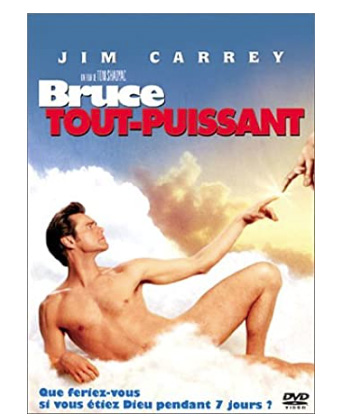
Bruce Almighty
Synopsis
Bruce Nolan is a television reporter who believes that God has unfairly prevented him from achieving professional success. After a particularly disastrous day, Bruce angrily blames God for everything that has gone wrong in his life. God then appears to him and temporarily gives him divine powers to prove that being God is not as simple as Bruce imagines. Bruce initially uses his powers for personal advantages before learning that true responsibility requires understanding the needs of other people.
The Making of the Film
The idea behind Bruce Almighty was developed by screenwriters Steve Koren and Mark O Keefe. Their concept imagined an ordinary man receiving divine powers and discovering that unlimited power does not automatically produce happiness. Tom Shadyac became attached to the project as director and worked closely with Jim Carrey, who also served as a producer. The filmmakers wanted to create a broad comedy while still exploring philosophical questions about free will, responsibility and human limitations. Morgan Freeman was cast as God, giving the character a calm and authoritative presence that contrasted with Carrey energetic performance. Jennifer Aniston played Grace, Bruce emotional connection to ordinary life. Universal Pictures and Spyglass Entertainment developed the project as a large-scale fantasy comedy. The production combined visual effects, practical comedy and a more sentimental storyline about personal responsibility.
Reviews and reception
Professional critics were divided about the film. Rotten Tomatoes recorded a 48% approval rating, with some critics praising Jim Carrey comic energy while others considered the religious premise too simplistic. The chemistry between Carrey and Jennifer Aniston received positive attention from many viewers. Morgan Freeman performance as God was also widely appreciated for its calm humor. Despite mixed reviews, the film was a major commercial success. It earned more than 242 million dollars in the United States alone. Audiences responded particularly well to the fantasy elements and Carrey physical comedy. The film received several awards, including a Peoples Choice Award for Favorite Comedy Motion Picture and an NAACP Image Award for Morgan Freeman.
Filming anecdotes
The production required extensive visual effects to create the illusion that Bruce could manipulate reality. Jim Carrey performed many scenes in which his reactions had to be synchronized with effects that would be added later. Morgan Freeman approached God with a deliberately understated performance rather than playing the character as an exaggerated supernatural figure. The famous scene involving Bruce controlling a news broadcast required careful editing and visual manipulation. Several sequences also involved large crowd scenes and complex environmental effects. The production combined physical comedy with digital effects to make supernatural events appear believable. Jim Carrey physical performance remained central even when the surrounding events were created digitally. The filmmakers deliberately kept the emotional relationship between Bruce and Grace at the center of the story.
Themes addressed
The film explores faith, free will, responsibility, humility, love and the limits of human control. Bruce initially believes that having power will solve every problem. He gradually discovers that millions of individual needs cannot simply be satisfied through personal decisions. The film also questions the difference between wanting something and genuinely understanding what is best for another person. Bruce transformation ultimately requires humility and empathy. The story presents personal responsibility as more important than unlimited power.
Explanation of the ending
Bruce eventually understands that he cannot solve every human problem by controlling events himself. When he becomes overwhelmed by the prayers of millions of people, he realizes that his powers have not made him happier. He asks God to take the responsibility away from him. Bruce then chooses to accept life rather than trying to control every outcome. His relationship with Grace is restored after he recognizes the importance of genuine love and sacrifice. God returns Bruce to his ordinary life, but Bruce is no longer the same selfish and frustrated man. The ending suggests that personal growth comes from accepting human limitations rather than escaping them.
Meaning of the title
The title Bruce Almighty is a humorous reference to the biblical idea of divine omnipotence. Bruce temporarily possesses powers normally associated with God. The word Almighty therefore exaggerates his transformation from ordinary television reporter to supernatural being. The title also contains an ironic element because Bruce quickly discovers that possessing enormous power does not make him capable of managing the world. It summarizes the films central comic premise while preparing the audience for its moral lesson.
Original soundtrack
John Debney composed the original score for the film. His music combines orchestral comedy with more emotional themes for Bruce relationship with Grace. The score was commercially and professionally successful enough for Debney to receive an ASCAP Film and Television Music Award for Top Box Office Films. The soundtrack also incorporates contemporary songs that reinforce the films lighter and romantic moments. The music helps move the film between broad comedy, fantasy and emotional drama.
News
There has been no confirmed direct sequel centered on Bruce Nolan. The character remains one of Jim Carrey most recognizable comedy roles from the early 2000s. The film continues to be revisited in discussions about Hollywood comedies using religious or supernatural premises. Morgan Freeman performance as God is also frequently cited as one of the films most memorable elements.
Similar films
Evan Almighty is the most direct companion because it takes place in the same fictional universe and focuses on another ordinary man receiving divine intervention. Liar Liar is another Jim Carrey comedy centered on an extraordinary rule that forces its protagonist to change. The Truman Show also examines personal awakening and the discovery that life cannot be controlled completely. Click explores similar ideas about power, time and personal priorities. Oh, God! offers an older and gentler comedy about an ordinary person interacting directly with God.