

 Français
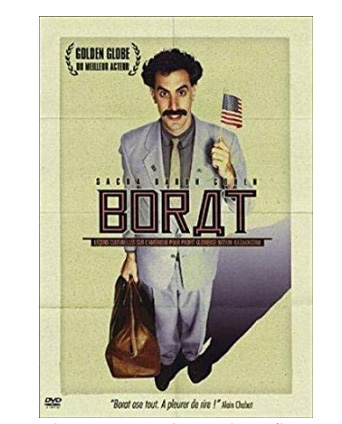
Borat: Cultural Learnings of America for Make Benefit Glorious Nation of Kazakhstan
Synopsis
Borat Sagdiyev, a fictional journalist from Kazakhstan, travels across the United States to make a documentary about American society. Accompanied by his producer Azamat, he encounters ordinary people whose reactions to his outrageous behavior become the basis of the comedy. Borat misunderstands social conventions and deliberately exposes prejudices, contradictions and uncomfortable attitudes. His journey is also driven by an increasingly absurd romantic obsession with actress Pamela Anderson. Presented as a documentary, the film combines improvised encounters, satire and deliberately provocative humor.
Film Origins
The character of Borat was created and developed by British comedian Sacha Baron Cohen, who had previously appeared as the character on television. Cohen became known for portraying fictional personalities who interact with real people without immediately revealing the full nature of the performance. The idea was to use comedy as a way of exposing social attitudes that might remain hidden in ordinary conversations. Director Larry Charles joined the project after working in television comedy and collaborating with performers interested in unconventional humor. The filmmakers developed a road-movie structure that would allow Borat to travel through different parts of the United States. Many of the encounters were based on improvisation rather than conventional scripted dialogue. The fictional journalist's exaggerated behavior was designed to provoke reactions from people who believed they were participating in a documentary. The film also satirizes stereotypes about Kazakhstan, although its portrayal of the country is deliberately fictional and should not be treated as a realistic depiction of Kazakh culture. The project became a controversial experiment in combining character comedy, social observation and documentary techniques.
Critical Reception
Professional critics were strongly divided but generally recognized the film's originality and its provocative comic approach. Many praised Sacha Baron Cohen for creating a character capable of exposing prejudice through apparently spontaneous encounters. The film's willingness to challenge social conventions was considered both its greatest strength and its most controversial feature. Some reviewers criticized its deliberately offensive humor and questioned the ethics of filming people who were unaware of the full satirical context. Others argued that the discomfort created by these encounters was essential to the film's purpose. Its unusual combination of improvisation and social satire made it one of the most discussed comedies of its year.
Audiences responded enthusiastically, making the film a major commercial success despite its controversial content. Borat became a widely recognized comic character, and several of his expressions entered popular culture. The film attracted viewers through word of mouth, particularly because audiences wanted to discover how real people would react to his behavior. Its popularity also generated debate about the boundaries between comedy, documentary and practical jokes. Some viewers considered it a fearless satire, while others found its humor offensive or uncomfortable. Its influence on subsequent comedy and online video culture was substantial.
The film received important awards recognition. Sacha Baron Cohen won the Golden Globe for Best Actor in a Motion Picture Musical or Comedy in 2007. The film was also nominated for the Golden Globe for Best Motion Picture Musical or Comedy. It received an Academy Award nomination for Best Adapted Screenplay, shared by Sacha Baron Cohen and his collaborators. These honors confirmed that the film was more than a commercial comedy success and recognized its unusual contribution to contemporary satire.
Behind the Scenes
Sacha Baron Cohen developed Borat through years of performances in which the character interacted with people who did not know they were part of a comedy project. His approach was influenced by observational comedy and by the possibility of revealing prejudices through apparently innocent questions. Larry Charles helped shape these encounters into a coherent feature film. The filmmakers wanted the audience to experience the same uncertainty and discomfort that the people on screen often displayed.
The production relied heavily on improvisation and presented considerable practical and legal challenges. Filming in public places required the crew to work discreetly and adapt quickly to unpredictable situations. The filmmakers also had to deal with the consequences of encounters that could become confrontational. Several participants later objected to the way their appearances were used, leading to legal disputes and public controversy. The production therefore became almost as debated as the film itself.
Many of the film's most memorable moments were built around encounters with real people rather than conventional actors. The humor often comes from the contrast between Borat's absurd statements and the reactions of those around him. This method gave the film an unpredictable energy that would have been difficult to reproduce with a traditional screenplay. It also created ethical questions about consent, representation and the responsibilities of documentary-style comedy.
Sacha Baron Cohen was central to the casting concept because the entire film depended on his ability to maintain the character in real-world situations. Ken Davitian plays Azamat, Borat's companion and producer, providing a more grounded comic counterpoint. Pamela Anderson appears as a fictionalized version of herself and becomes part of Borat's increasingly ridiculous romantic quest. The combination of a central comic performance and unsuspecting participants gives the film its distinctive format.
Themes
The film uses satire to examine prejudice, xenophobia and the contradictions of social behavior. Borat's exaggerated ignorance encourages people to reveal attitudes they might otherwise conceal. His interactions expose tensions involving gender, religion, ethnicity and national identity. The comedy frequently works by reversing expectations, making the supposedly ignorant visitor appear to understand more about social hypocrisy than the people he encounters.
Another major theme is the construction of national identity. Borat presents a deliberately absurd version of Kazakhstan, reflecting the way countries and cultures can be reduced to simplistic stereotypes. The film also turns its satirical attention toward American self-image, asking whether a society that celebrates freedom and tolerance always lives up to those ideals. The contrast between Borat's fictional background and the real people he meets creates much of the film's discomfort.
The film also questions the relationship between entertainment and ethics. Its documentary-like format makes viewers wonder how much of what they see is spontaneous and how much has been shaped by editing and performance. The participants' reactions become part of the comedy, but their lack of awareness raises questions about consent and exploitation. The film deliberately leaves audiences to confront these contradictions.
Ending Explained
Borat's journey eventually leads him toward Pamela Anderson, whom he has come to regard as his ideal romantic partner. His increasingly absurd pursuit culminates in a public encounter that reveals the distance between his fantasy and reality. The conclusion also returns to the broader purpose of his supposed documentary mission. By traveling through the United States, Borat has collected a series of encounters that expose different aspects of American social behavior. The ending does not offer a conventional moral resolution because the film is designed as a collection of satirical situations rather than a traditional dramatic narrative. Borat remains committed to his fictional worldview, even as the audience has seen the contradictions behind it. The final effect is deliberately uncomfortable: viewers are invited to laugh while considering what the encounters reveal about themselves and society. The film's conclusion therefore reinforces its central method of using absurdity to provoke reflection.
Meaning of the Title
The title combines the name of the fictional journalist with a deliberately exaggerated description of his supposed educational mission. Borat claims to be learning about American culture for the benefit of Kazakhstan, presenting himself as an official observer. The awkward wording is part of the character's comic identity and reinforces the film's parody of cultural misunderstanding. It also suggests that the journey is not simply about discovering America but about exposing the assumptions and prejudices of those who live there.
Similar Films
- Brüno (2009), another Sacha Baron Cohen character comedy built around provocative encounters.
- This Is Spinal Tap (1984), a mockumentary using fictional characters to satirize a real cultural world.
- The Dictator (2012), a political comedy starring Sacha Baron Cohen.
- Man Bites Dog (1992), a dark mockumentary that explores the uncomfortable relationship between cameras, entertainment and real-world behavior.