

 Français
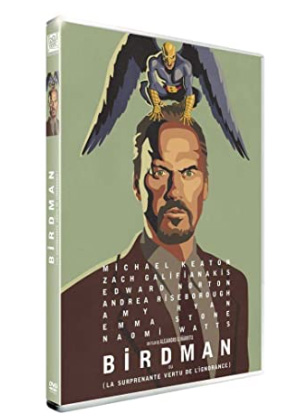
Birdman or (The Unexpected Virtue of Ignorance)
Synopsis
Riggan Thomson is a former Hollywood star best known for playing a famous superhero called Birdman. Hoping to revive his career and prove that he is more than a forgotten blockbuster actor, he writes, directs and stars in a Broadway adaptation of a literary short story. The production is threatened by financial pressure, difficult actors and Riggan's increasingly unstable personal life. His daughter, his former wife and a demanding new cast member all challenge his sense of identity. As opening night approaches, the boundaries between theatrical reality, imagination and psychological crisis begin to blur.
Film Origins
Alejandro González Iñárritu developed Birdman with screenwriters Nicolás Giacobone, Alexander Dinelaris Jr. and Armando Bo. The filmmakers wanted to explore the fragile relationship between artistic ambition, celebrity culture and the desire to be admired. Iñárritu was particularly interested in the pressure experienced by actors whose public identities become inseparable from their most famous roles. Michael Keaton's casting brought an additional layer of meaning because he had himself become internationally famous through his portrayal of Batman in the late 1980s and early 1990s. The fictional Riggan Thomson is not a direct portrait of Keaton, but the parallels give the character an unusual authenticity. The theatrical production within the film is based on a story by Raymond Carver, What We Talk About When We Talk About Love. The filmmakers also wanted the movie to feel like one continuous performance, reflecting the intensity and instability of backstage theater life. Cinematographer Emmanuel Lubezki helped transform this idea into a visual style built around apparently uninterrupted camera movements. The project became an ambitious experiment combining psychological drama, black comedy and technical innovation.
Critical Reception
Professional critics responded enthusiastically to the film's originality, performances and technical ambition. Michael Keaton received particular praise for portraying an actor struggling with insecurity, regret and the need for recognition. Edward Norton and Emma Stone were also widely appreciated for their performances, which add tension and emotional complexity to the story. Emmanuel Lubezki's cinematography attracted exceptional attention for creating the illusion of a continuous shot. Some critics found the film self-conscious or excessively concerned with its own artistic importance, but its overall reception was strongly positive.
The film attracted considerable interest from audiences, partly because of its recognizable cast and unusual visual presentation. Viewers were drawn to its mixture of comedy, psychological tension and backstage drama. The apparent single-take technique became a major talking point and encouraged audiences to examine how the camera moves through the theater and its surrounding streets. Michael Keaton's performance also generated renewed interest in his career. The film became a widely discussed cultural event during the 2014-2015 awards season.
Birdman received major international awards recognition. At the Academy Awards, it won four Oscars, including Best Picture, Best Director, Best Original Screenplay and Best Cinematography. It also received numerous nominations in acting and technical categories. The film won the Golden Globe for Best Screenplay, while Keaton received the Golden Globe for Best Actor in a Musical or Comedy. These achievements established it as one of the most celebrated films of 2014.
Behind the Scenes
Iñárritu wanted to examine the conflict between genuine artistic expression and the pursuit of fame. He was interested in actors who become trapped by a famous character and struggle to establish a separate identity. The choice of Michael Keaton was therefore especially meaningful because of the actor's own association with the Batman films. The story also draws on the director's interest in theater, ego and the contradictions of creative ambition.
The most demanding production challenge was the illusion that the entire film unfolds in a single continuous shot. In reality, the movie was assembled from carefully planned takes and hidden transitions, but the camera movements had to be coordinated with exceptional precision. Actors, camera operators, lighting technicians and stage crews rehearsed extensively to ensure that every movement connected smoothly. The production required a detailed understanding of the theater's corridors, dressing rooms, backstage areas and performance spaces. Emmanuel Lubezki's work was central to achieving the film's distinctive visual rhythm.
The theatrical production of What We Talk About When We Talk About Love provides the film with an important artistic parallel. Riggan wants to prove that he can create serious theater, but the production repeatedly exposes his insecurities and need for approval. The rehearsals and performances blur the distinction between the characters' fictional roles and their private lives. This theatrical structure allows the film to move naturally between comedy, conflict and psychological uncertainty.
Michael Keaton was selected because his career gave him a particular connection to the film's central subject. Edward Norton was cast as Mike Shiner, a talented but difficult stage actor whose methods challenge Riggan. Emma Stone plays Riggan's daughter Sam, while Naomi Watts portrays actress Lesley. The ensemble was carefully assembled to create a convincing theatrical company whose personal tensions become part of the drama.
Themes
The film examines the need for recognition and the danger of allowing public approval to define personal identity. Riggan has achieved enormous fame, but he feels that his superhero role has prevented others from taking him seriously as an artist. His Broadway production becomes an attempt to reclaim control over his reputation. The film questions whether artistic ambition can ever be separated from vanity and the desire to be admired.
The relationship between reality and illusion is another central theme. Riggan experiences moments in which his imagination appears to alter the physical world, leaving the audience uncertain about what is actually happening. This ambiguity reflects his psychological instability and his difficulty distinguishing genuine achievement from fantasy. Theater itself becomes a metaphor for the roles people perform in everyday life.
The story also explores family relationships, aging and the fear of becoming irrelevant. Riggan struggles to reconnect with his daughter and to accept the consequences of his past decisions. His colleagues expose different forms of insecurity, from the need for professional respect to the fear of personal failure. The film ultimately questions whether freedom can be found by abandoning the identities imposed by others.
Ending Explained
The ending deliberately leaves the audience uncertain about what has happened to Riggan. After a disastrous theatrical performance, he achieves a form of public attention that he had spent much of the film seeking. In the hospital, he appears to experience a new sense of freedom and looks out of the window. His daughter Sam enters the room and discovers that he is no longer in his bed. When she looks outside, her reaction suggests that she may have seen something extraordinary. One interpretation is that Riggan has finally achieved the supernatural flight he has imagined throughout the story. Another is that the scene represents his daughter's emotional acceptance of him or the final expression of his fantasy. Iñárritu intentionally avoids confirming a single explanation. The ambiguity reflects the film's central concern with the difference between reality, performance and personal belief. The ending leaves viewers to decide whether Riggan has escaped his former identity or disappeared into it completely.
Meaning of the Title
The title refers to Birdman, the superhero character who made Riggan Thomson famous. The name represents both his greatest professional success and the identity from which he desperately wants to escape. The subtitle, The Unexpected Virtue of Ignorance, suggests that freedom may come from refusing to accept the judgments and expectations imposed by others. It also questions the distinction between artistic seriousness and public recognition. Together, the two parts of the title capture the conflict between a famous past and the desire to create something meaningful in the present.
Soundtrack
The soundtrack is distinctive because it relies heavily on improvised jazz drumming by Antonio Sánchez. The percussion creates a restless, almost nervous atmosphere that follows the movements of the camera and the emotional state of the characters. Instead of functioning as conventional background music, the drums often become part of the film's rhythm and dramatic structure. Classical music excerpts also appear throughout the film, creating a contrast between spontaneous performance and established artistic tradition. Sánchez's work became one of the film's most recognizable creative elements.
Similar Films
- Black Swan (2010), a psychological drama about artistic ambition and the loss of control.
- Synecdoche, New York (2008), a surreal exploration of theater, identity and artistic obsession.
- The Wrestler (2008), a portrait of a former star struggling with aging and the need for recognition.
- All That Jazz (1979), a theatrical drama examining creativity, ego and personal destruction.