

 Français
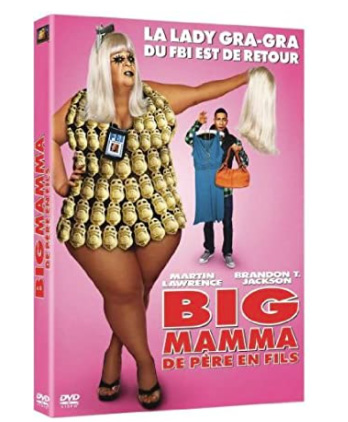
Big Mommas: Like Father, Like Son
Synopsis
FBI agent Malcolm Turner and his stepson Trent, who has witnessed a murder, go undercover at an all-girls performing arts school in Georgia to flush out the killer. To protect their identities, Malcolm once again slips into the disguise of the formidable grandmother Big Momma, while Trent becomes her teenage granddaughter Charmaine. As they navigate the school's rules and rivalries, the pair must find the culprit before he finds them. Complicating matters, Trent develops a crush on one of the students, and the line between his mission and his feelings gets blurry.
The Making of the Film
Big Mommas: Like Father, Like Son is the third film in the franchise that began with Big Momma's House in 2000 and continued with Big Momma's House 2 in 2006. John Whitesell, who had directed the second film, returned to the director's chair, with Martin Lawrence reprising his role as Malcolm Turner. The idea this time was to widen the formula by adding a second disguised character, with Lawrence's stepson becoming a partner in the masquerade. The character of Trent Pierce, who was a young child in the first film, was recast, with Brandon T. Jackson taking the role of the now teenage stepson. Principal photography began in April 2010. The story moves the action from a Southern family home to an all-girls performing arts school, giving the film a new comic setting and room for musical numbers. The film was released by 20th Century Fox in February 2011. It was conceived as a lighthearted family-friendly comedy that would reuse the franchise's most popular gimmick, the elaborate prosthetic disguise.
Critical Reception
Critics were extremely harsh on the film. It has a Rotten Tomatoes approval rating of just 5 percent, and Metacritic gave it a very low score. Reviewers described it as unnecessary and unfunny and accused it of recycling the franchise's formula without adding anything new. A few observers acknowledged Martin Lawrence's physical comedy, but most felt that the story and the jokes were stale. The film is commonly cited as one of the weaker entries of the franchise.
The film opened in third place at the American box office in February 2011 and went on to gross about 82 million dollars worldwide against a budget of 32 million. That made it a modest earner, lower than the first two films in the series. Audiences polled by CinemaScore gave it a B, the lowest grade of the three films. It nevertheless found its audience on home video, where the extended edition added a few minutes of footage, including a musical number.
Filming anecdotes
Martin Lawrence's transformation into Big Momma relies on an elaborate prosthetic suit and makeup, which reportedly takes hours to apply and became one of the franchise's trademarks. In this film the disguise is doubled, with Brandon T. Jackson also playing a girl, which required its own makeup and wardrobe. The recasting of Trent, who was a child in the first film, gave the production a chance to change the stepfather and stepson relationship into a buddy comedy. A cover of the song Ain't Nobody, performed by Jackson and Jessica Lucas, was used in the film's musical moments. The extended DVD version of the film included about five minutes of additional footage, with a new song-and-dance number.
Themes explored
At its core, the film is a comedy of disguise, and its central joke is the contrast between Malcolm Turner's tough FBI persona and the matronly figure of Big Momma. It plays with gender expectations by putting two male characters in a world of teenage girls and observing their awkward adjustments. The relationship between stepfather and stepson is the emotional centre, as the two must learn to trust each other. The film also touches on the idea of finding one's talent, since Trent's artistic ambitions in music clash with his stepfather's more cautious view of his future. Family responsibility and the desire to protect loved ones motivate the plot. A crime story runs in the background, but it serves mainly as an excuse for comic situations. The school setting adds a light reflection on adolescence, rivalry and friendship. Overall the film remains a broad, family-friendly farce that prioritises gags over depth.
Ending explained
In the film's climax, the hidden killer is exposed and the two undercover agents manage to protect the students and bring the criminal to justice. Their disguises are revealed, which leads to a comic confrontation and a final chase through the school. The case is solved thanks to a mixture of improvisation and teamwork, which finally brings Malcolm and Trent closer together. Trent's musical talent is recognised, and the school's performance numbers become a way to resolve the story's emotional threads. The relationship with the student he likes ends on a gentle note, as the truth about his identity creates a few awkward moments. By the end, Malcolm accepts that Trent is growing up and deserves to choose his own path. The ending sticks to the lighthearted tone of the franchise, leaving no major surprise or moral dilemma. It closes with the sense that the pair, for all their misadventures, have become a real family.
Meaning of the title
The title plays on two familiar elements. Big Mommas is a plural version of the franchise's name, since this time there are two disguised characters, both dressed as women, instead of one. Like Father, Like Son is a well-known English proverb which says that a son resembles his father, and here it applies to stepfather and stepson, who follow the same path of disguise. The proverb also underlines the central relationship, in which one man teaches another how to be a responsible adult. The word House, which appeared in the earlier titles, disappears here because the story takes place in a school rather than a family home. The punctuation and structure make the title a mini-joke that tells viewers exactly what to expect. In French the film was released under a title that emphasises the family bond as well. Altogether, the title announces a comic story about two generations sharing a ridiculous disguise.
Similar Films
If you enjoyed Big Mommas: Like Father, Like Son, the first stop is naturally Big Momma's House, the 2000 original that launched the franchise. Its sequel, Big Momma's House 2, takes the same disguise gag to a new setting. Mrs. Doubtfire, with Robin Williams, is the classic example of a man who dresses as a woman to be close to his family. Tootsie, with Dustin Hoffman, handles the same idea with more wit and emotional depth. White Chicks puts two FBI agents in disguise as women to protect heiresses. The Nutty Professor, with Eddie Murphy, is another comedy built around extraordinary makeup and multiple characters. Some Like It Hot remains the great classical comedy of male characters in female disguise. Together these films form a small but lively genre of cross-dressing comedies.