

 Français
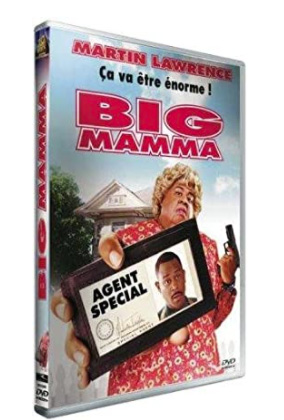
Big Momma's House
Synopsis
FBI agent Malcolm Turner, a master of disguise, is sent to a small town in Georgia to find an escaped bank robber who is expected to turn up at the home of his former girlfriend, Sherry. When the owner of the house, her grandmother Big Momma, is called away, Malcolm takes her place by transforming himself with prosthetics into the formidable matriarch. As he tries to watch Sherry and her young son, he finds himself drawn into their lives. His double life becomes more complicated as he begins to fall for the woman he is supposed to be protecting.
The Making of the Film
Big Momma's House was directed by Raja Gosnell, who would later direct family comedies such as Scooby-Doo, and written by Darryl Quarles. The idea combines the classic cross-dressing comedy with the structure of an undercover police story. Martin Lawrence, already a major comedy star thanks to his television series and his films with Will Smith, took the lead role of Malcolm Turner. The film was designed as a vehicle for Lawrence's physical comedy and gave him the chance to play a character who is half action hero and half grandmother. Nia Long played Sherry, the woman Malcolm is supposed to protect, while Paul Giamatti played his partner, and Terrence Howard appeared as the escaped criminal Lester Vesco. The film was released in June 2000 by 20th Century Fox. Its mix of broad comedy, romance and crime became the template for two later sequels. It remains one of Lawrence's most popular films.
Critical Reception
Critics gave the film a lukewarm to negative reception. Reviewers often found the plot predictable and the humour broad, though many acknowledged Martin Lawrence's talent for physical comedy. The film was seen as a competent but formulaic vehicle for its star, with a premise borrowed from earlier cross-dressing comedies. Some reviewers praised the chemistry between Lawrence and Nia Long, while others thought the supporting characters were underwritten.
The film was a clear audience hit. It earned about 117 million dollars in the United States and about 173 million worldwide. Those figures made it one of the bigger comedy successes of the year and the strongest performer in the franchise. Its popularity led to two sequels, in 2006 and in 2011. The film has remained a television staple and a favourite of audiences who enjoy its warm, silly humour.
Filming anecdotes
Martin Lawrence's transformation into Big Momma relied on an elaborate prosthetic suit and makeup, which reportedly took several hours to apply each day. The disguise became the film's signature gimmick and the heart of its marketing. The role required Lawrence to play the same character in two guises, as an FBI agent and as a grandmother, which gave him a chance to show off his range. The film's success led to a franchise, with Lawrence returning to the role in Big Momma's House 2 in 2006 and Big Mommas: Like Father, Like Son in 2011.
Themes explored
At its core, Big Momma's House is a comedy of disguise and identity, built around the idea that a man can become someone else with the help of makeup and a good performance. It plays with gender stereotypes by showing a tough male agent forced to take on the habits of an older Southern woman. Love and trust are also important themes, since Malcolm's growing feelings for Sherry depend on a lie he cannot easily explain. The story shows that a person's character can be revealed more clearly when they pretend to be someone else. Family appears through Sherry's relationship with her son and the warmth of her home. The film also contrasts the life of a professional crime fighter with the quiet routine of a small-town household. The crime plot supplies a series of chases and complications, but the emotional centre is the bond that Malcolm builds with the people he is deceiving. In the end, the film turns on the question of whether love can survive a deception.
Ending explained
In the final act, Malcolm's disguise is exposed at the worst possible moment and he must reveal the truth to Sherry. At the same time, the escaped criminal Lester Vesco reappears and threatens Sherry and her son. Malcolm uses his skills to confront him, and the FBI arrives to arrest the robber. The case is closed, but the personal consequences are less clear, since Sherry has to decide whether she can forgive the man who deceived her. The film ends on a romantic note, with the couple reconciled and the comedy winding down. The real Big Momma returns to her house, which gives the story a last comic twist. The tone remains light throughout, and the ending reinforces the idea that Malcolm's best qualities came through in his disguise. It leaves room for the sequels that followed.
Meaning of the title
The title Big Momma's House refers to the house of the grandmother whose identity Malcolm borrows. The word Momma gives the film a warm, Southern colour, since it evokes a large and comforting matriarch. The title also functions as a joke, because the viewer knows that the person who occupies the house is not the person the neighbours think she is. By focusing on the house, the title suggests a domestic comedy, with the home as the stage on which the disguise is performed. The slightly unusual spelling of Momma is typical of the characters' Southern voice. The French title, Big Mamma, uses a similar construction. The simplicity of the title made it easy to turn into a franchise brand. It is a good example of a title that tells the audience exactly what to expect from the movie.
Similar Films
If you enjoyed Big Momma's House, the most obvious companion is Mrs. Doubtfire, with Robin Williams as a father who disguises himself as a nanny to be close to his children. Tootsie is the classic comedy about an actor who pretends to be a woman to get a part. Some Like It Hot, from 1959, is the great ancestor of the genre. The Nutty Professor, with Eddie Murphy, relies on similarly spectacular prosthetics and multiple roles. White Chicks, with the Wayans brothers, follows two FBI agents in disguise. Bringing Down the House mixes culture-clash humour with a comedic romance. Tyler Perry's Madea films revolve around another formidable matriarch played by a man. Finally, the sequels Big Momma's House 2 and Big Mommas: Like Father, Like Son continue the story of Malcolm Turner.