

 Français
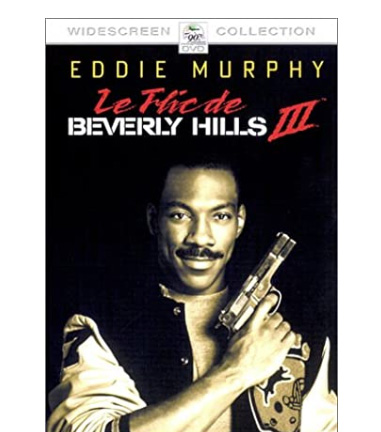
Beverly Hills Cop III
Synopsis
When his boss is killed in a shootout in Detroit, Axel Foley follows a trail of stolen cars to Los Angeles. There he discovers that a counterfeit-money ring is operating out of the Wonder World amusement park. Teaming up with his old friend Billy Rosewood, Axel goes undercover in the park to expose the criminals. The investigation turns into a chase through rollercoasters and fantasy attractions.
The Making of the Film
Beverly Hills Cop III arrived six years after the second film, and Eddie Murphy returned as Axel Foley. The screenplay was written by Steven E. de Souza, who had worked on 48 Hrs. and Die Hard. The idea was to set the action in a theme park, a bold and colorful environment inspired by Disneyland. John Landis, the director of Trading Places and Coming to America, was chosen to direct, reuniting with Murphy. Judge Reinhold returned as Billy Rosewood, and Hector Elizondo played a security chief. The film aimed to combine comedy and action in a lighter tone than the earlier entries.
Reviews and reception
Summary of professional reviews
Critics were harsh, saying that the film lacked the energy and freshness of the original. Many found the plot weak and the humor forced, and Murphy's performance was considered less sharp. It is often cited as the weakest of the trilogy.
Audience reception
The film earned about 119 million dollars worldwide, a decline from its predecessors. Audiences were disappointed, and the film has been remembered as a low point in Murphy's career. Some viewers have grown fond of its silly charm over the years.
Awards and nominations
The film did not win significant awards. It was nominated for several negative awards, which reflected its poor reception. Its main legacy is as an example of a franchise that lost its way.
Filming anecdotes
Director's inspirations
Landis wanted to create an action comedy in which the amusement park became a character in itself. He used the bright colors and fantasy sets for contrast with the more serious plot. The film is also filled with nods to his earlier work.
Production difficulties
Shooting in a working amusement park created logistical problems, since the production had to work around visitors and ride schedules. Large action sequences on moving attractions needed careful coordination. The script was reportedly revised several times during production.
Anecdote about a particular scene
Landis, known for his love of cinema, filled the film with cameos by fellow directors, including George Lucas and Joe Dante. The scenes on the amusement park rides, including a chase through a fake space attraction, are among the film's most memorable. Murphy's comic improvisation also gives some moments a lively spark.
Themes explored
The film is a buddy comedy about loyalty and old friendships. It explores the clash between the glossy world of entertainment and the criminal activities hidden behind it. Axel's determination to avenge his boss gives the story an emotional core. The film also pokes fun at corporate culture and the illusions of theme parks. It remains an action comedy first and foremost, with humor as its main tool.
Ending explained
Axel and Billy confront the leader of the counterfeiting ring in the park's control center. After a shootout and a chase through the attractions, the criminals are defeated. Axel avenges his boss and proves his loyalty to his friends. The film ends with Axel returning to Detroit, satisfied. It is a conventional ending that wraps up the story simply.
Meaning of the title
The title simply tells us that this is the third entry in the Beverly Hills Cop series. It refers to Axel Foley, the Detroit cop who visits Beverly Hills. The number three signals the continuation of a familiar formula. The setting this time moves away from the wealthy city to an amusement park, but the title remains the same.
Original Soundtrack
Nile Rodgers composed the score, keeping the familiar Axel F theme by Harold Faltermeyer. The music retains the series' trademark mix of funky synthesizers and upbeat rhythms. The theme remains one of the most recognizable pieces of 1980s film music.
News
Axel Foley returned in 2024 with Beverly Hills Cop: Axel F, released on Netflix, with Eddie Murphy reprising his role. The film brought back several familiar characters from the original series.
Similar Films
- Beverly Hills Cop (1984): the original film that started the series.
- 48 Hrs. (1982): an action comedy with Eddie Murphy.
- Lethal Weapon 2 (1989): another buddy cop sequel.
- Rush Hour (1998): an action comedy with a mismatched pair.
- Bad Boys (1995): two cops in a high-energy action comedy.