

 Français
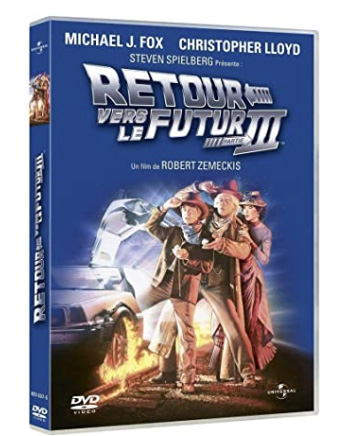
Back to the Future Part III
Synopsis
Marty McFly is stranded in 1955, but Doc Brown has sent him a letter from 1885, revealing where he has hidden the DeLorean. When Marty discovers that Doc will be shot in the Old West by the outlaw Buford Tannen, he travels back to 1885 to save him. There, he meets his ancestors and the gunslinging Tannen, while Doc falls for the new schoolteacher Clara Clayton. To return to 1985, they must find a way to get the time machine up to eighty-eight miles per hour without gasoline.
The Making of the Film
Back to the Future Part III was written and shot together with Part II, since Robert Zemeckis and Bob Gale wanted to complete the story in a continuous production. The idea of sending the characters to the Old West came from the filmmakers' love of classic Westerns. After the cliffhanger at the end of the second film, they wanted to give Doc a romantic arc and finally a happy ending. The script was designed as a gentler and more emotional adventure, after the twisting plot of the second film. Gale and Zemeckis took inspiration from John Ford's films and the Spaghetti Westerns of Sergio Leone. The concept of the DeLorean being stuck in the past with a broken fuel line created a nice problem for the heroes to solve. They also decided that the story would explore Marty's own pride and recklessness. In the end, the film closes the trilogy with humour, heart and a loving nod to the Western genre.
Reviews and reception
Professional critics' summary
Critics gave the film generally positive reviews, praising it as a charming and entertaining end to the trilogy. They enjoyed the Western setting, the chemistry between Christopher Lloyd and Mary Steenburgen, and the warm tone. Some felt that it was less ambitious than the previous film and relied too much on formula. Nevertheless, most agreed that it provided a satisfying conclusion to the story.
Audience reception
The film was a hit, earning more than 240 million dollars worldwide, though less than its predecessors. Fans appreciate the emotional resolution for Doc and the clever ways in which the film echoes the earlier instalments. Over time, many viewers have come to regard it as an underrated gem of the trilogy. The final train sequence is often cited as one of the best action scenes in the series.
Awards
The film earned a number of nominations at genre awards and the Saturn Awards. The film's costume and production design were praised by critics. Its strongest reward was the affection of audiences.
Filming anecdotes
Director's inspirations
Zemeckis was inspired by classic Westerns, with their wide landscapes, saloon fights and train chases. He also wanted to honour the work of Sergio Leone, which led to Marty adopting the false name of Clint Eastwood. The film pays tribute to the adventure serials that Zemeckis loved as a child. The love story between Doc and Clara adds a gentle and romantic side to the film.
Production difficulties
The production built an entire Old West town in California for the shoot, and the crew filmed on a real historic railway. Shooting the train sequence was complicated, as it involved a locomotive pushing the DeLorean at high speed. The team also had to deal with the heat, dust and long hours of the location shoot. Because the second and third films were shot back to back, the cast and crew worked for many months without a break.
Anecdote about a particular scene
The final chase, in which the train pushes the DeLorean toward a ravine, is a masterpiece of timing and tension. The film also includes a funny scene in which ZZ Top appears as a band at the town dance. Another highlight is the shoot-out between Marty and Buford Tannen, which echoes the first film's confrontation with Biff. The film's showdown shows how much Marty has grown.
Originally planned casting
Michael J. Fox and Christopher Lloyd returned in their roles, and Thomas F. Wilson played both Biff and his ancestor, the outlaw Buford Tannen. Mary Steenburgen was cast as Clara Clayton, bringing warmth and grace to the role. Lea Thompson and Elisabeth Shue also appear in smaller parts. The cast also includes many members of the previous film.
Themes explored
The film explores the theme of fate, as Marty is horrified to see his friend's gravestone and tries to change the past. It also looks at the clash between progress and tradition, with Doc as a futuristic inventor in the Old West. Another central theme is courage, as Marty must overcome his pride and his fear of being called a coward. Love is also a key element, with Doc experiencing true romance for the first time. The film talks about the importance of family and heritage, as Marty meets his ancestors. It also reflects on the idea that the future is not written and can be shaped by our actions. The film shows that mistakes can be corrected with wisdom and humility. Ultimately, it is a story about friendship and the freedom to choose one's own path.
Ending explained
Marty rescues Doc from Buford Tannen's gang, and the two work together to repair the DeLorean. They decide to use a steam locomotive to push the car up to eighty-eight miles per hour, but Clara is dragged into danger when she tries to catch up with Doc. Doc manages to save her by climbing aboard the speeding train, while Marty takes off in the DeLorean toward a ravine that was not yet built in 1985. He returns to the present just before a modern train smashes into the car, destroying it for good. Moments later, Doc reappears in a time-travelling locomotive, with Clara and their two sons. He tells Marty that the future is not written and that it is what you make it, echoing the film's main message. Marty then rejoins Jennifer and moves forward with a new confidence in his own choices. The trilogy ends on an optimistic and heartfelt farewell
Meaning of the title
The title continues the series by marking this film as the third and final chapter of the story. It follows the same pattern as the previous instalments, reinforcing the sense of a complete trilogy. The words Back to the Future take on yet another twist here, as the characters go backward in time to the Old West. This amusing contradiction is part of the series' identity, which constantly plays with the idea of time. The number III signals that this is the last chapter of the adventure. The title also suggests the circle closing after three journeys. It reflects the humour and charm that made the saga so memorable.
Original Soundtrack
Alan Silvestri composed a rousing score with Western influences, mixing orchestral drama with the signature themes of the trilogy. The film also includes the song Doubleback by ZZ Top, which was written for the movie and features in the end credits. The music beautifully supports the emotional moments, especially the love story between Doc and Clara.
News
The trilogy remains hugely popular, and its legacy continues through merchandise, anniversary re-releases and a stage musical. Back to the Future: The Musical has played in London and on Broadway. Fans still celebrate the trilogy every year on October 21, the date to which Marty travels in the second film.
Similar Films
Back to the Future and Part II complete the trilogy. Young Guns and Silverado are fun Westerns from the same era. Wild Wild West and Cowboys and Aliens mix the Old West with fantasy and science fiction. Bill and Ted's Bogus Journey is another comical time-travel adventure.