

 Français
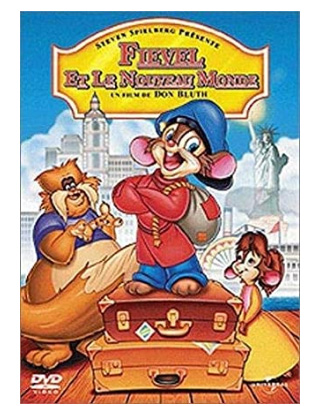
An American Tail
Synopsis
In 1885, the Mousekewitz family flees the cats of Russia and sets sail for America, hoping to find a land where there are no cats. During the voyage, young Fievel is swept overboard and separated from his family. Arriving alone in New York, he discovers that life in the New World is not as easy as the stories promised. With the help of new friends, he searches the city for his loved ones, while the family searches for him.
The Making of the Film
An American Tail is an animated film directed by Don Bluth, who had left Disney in 1979 and made a name for himself with "The Secret of NIMH". The film was produced with Steven Spielberg's company Amblin Entertainment, and was inspired in part by the story of Jewish emigration from Eastern Europe, including Spielberg's own family history. The story uses mice as stand-ins for immigrants, with cats as symbols of persecution. The voice cast included Phillip Glasser as Fievel, Dom DeLuise as Tiger and Madeline Kahn as Gussie. The film was released in the United States in late 1986 and in France in 1987.
Reviews and Reception
Summary of Professional Reviews
Critics gave the film a generally positive reception. Many praised its sweet story, its emotional power and the richness of its hand-drawn animation. Some reviewers found it a bit sentimental or dark for very young children. Overall, it was seen as one of the strongest alternatives to Disney's animated films at the time.
Audience Reception
The film was a significant commercial success, earning more than 80 million dollars worldwide and breaking records for a non-Disney animated feature. Its song "Somewhere Out There" became a major hit. Families embraced its message of hope, and it launched a franchise with sequels, a television series and merchandise. It remains a nostalgic favorite for the generation that grew up with it.
Awards Received
The song "Somewhere Out There" earned an Academy Award nomination for Best Original Song and won the Grammy Award for Song of the Year. The film also received several other nominations and honors, including recognition for its music. These awards helped boost the film's reputation.
Themes Explored
The film is a story about immigration and the hope for a better life. It portrays the dreams and disappointments of newcomers who discover that the promised land has its own dangers. Family is at the heart of the story, as the separation of Fievel from his loved ones drives the plot. Friendship and solidarity emerge among the immigrants, who band together to resist exploitation. The film also touches on persecution, since the mice flee from the cats of their homeland. Courage and perseverance are celebrated as the keys to survival.
Ending Explained
In the climax, the mice unite to defeat the cats who have been exploiting them, using a giant mechanical mouse to scare them out of the harbor. Fievel is finally reunited with his family in a moving final scene. The film ends on a note of joy and hope, suggesting that the immigrants have found a true home. It closes the story with a message of resilience and family love.
Meaning of the Title
The title is a pun on the words "tale" and "tail", combining the idea of a story with the tail of a mouse. It presents the film as the story of a small immigrant mouse in America. The play on words also gives the film a touch of humor.
Soundtrack
The score was composed by James Horner, and the film features the song "Somewhere Out There", written by Barry Mann, Cynthia Weil and Horner. The song, performed as a duet by Linda Ronstadt and James Ingram, became a major hit. It is widely regarded as one of the most memorable songs from an animated film of its era.
News
The film was followed by a sequel, "An American Tail: Fievel Goes West", in 1991, along with several direct-to-video follow-ups and a television series.
Similar Films
- The Secret of NIMH (1982): Don Bluth's earlier animated adventure.
- The Land Before Time (1988): another Bluth film about family and survival.
- All Dogs Go to Heaven (1989): a Bluth film about loyalty and redemption.
- Oliver & Company (1988): a Disney film about an orphan in New York.