

 Français
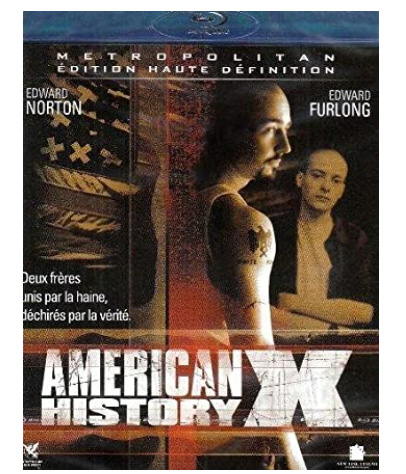
American History X
Synopsis
Derek Vinyard is a charismatic young man who becomes a prominent figure in a violent white supremacist movement in Los Angeles. After killing two Black men during an attempted robbery of his car, he is sentenced to prison. During his incarceration, an unexpected friendship forces him to reconsider his beliefs and the hatred that has shaped his life. Following his release, Derek attempts to prevent his younger brother Danny from following the same destructive path. Their family history reveals how racism, violence and resentment can spread from one generation to another.
The Making of the Film
American History X was developed around a screenplay by David McKenna exploring racism, extremism and the consequences of hatred in contemporary American society. The project attracted attention because of its willingness to examine the psychological and social mechanisms behind white supremacist movements. Director Tony Kaye approached the material with a visually striking style, using black-and-white cinematography to distinguish important periods in Derek's life. Edward Norton was cast as Derek Vinyard and became deeply involved in shaping the character. The production aimed to avoid presenting racism as an abstract social problem, instead showing how it can become embedded in family relationships and personal identity. The film also explores the possibility of personal transformation without suggesting that change can erase past actions. Its narrative structure moves between Derek's earlier life and the consequences of his imprisonment. This approach creates a dramatic portrait of radicalization, regret and the difficulty of breaking a cycle of violence.
Reviews and Reception
Professional reviews: Critics widely praised Edward Norton's intense performance and the film's willingness to confront racism directly. The visual contrast between color and black-and-white sequences was also frequently discussed. Several reviewers appreciated the emotional force of the story and its examination of ideological radicalization. Some critics nevertheless questioned the film's dramatic simplifications and its treatment of complex social issues.
Audience reception: The film developed a strong reputation among audiences interested in serious social dramas. Its portrayal of racism, prison violence and family conflict made a lasting impression on many viewers. Edward Norton's performance became one of the most frequently discussed aspects of the production. The film has continued to generate debate about prejudice, personal responsibility and the possibility of redemption.
Awards: Edward Norton received an Academy Award nomination for Best Actor. He also received significant recognition from professional critics and awards organizations. The film's performance was considered one of the most powerful dramatic achievements of his early career. Its reputation has endured beyond its original theatrical release.
Behind-the-Scenes Stories
Director's inspirations: Tony Kaye wanted to create a visually distinctive film that would communicate the emotional and ideological transformation of its protagonist. The contrast between black-and-white and color imagery became a central narrative device. David McKenna's screenplay provided the foundation for examining the influence of family, social environment and personal choices. The filmmakers sought to show how hatred can become an identity that individuals struggle to abandon.
Production challenges: The relationship between director Tony Kaye and Edward Norton became particularly difficult during the final stages of production. Disagreements arose over the editing process and the film's final version. The production underwent substantial editorial changes, creating one of the most publicized creative disputes associated with the film. The black-and-white cinematography and complex chronological structure also required careful coordination.
Notable scene: The infamous curb-stomp sequence is one of the film's most disturbing moments. Its graphic presentation makes the consequences of Derek's hatred impossible to ignore. The scene also establishes the event that transforms his life and leads to his imprisonment. Its brutality becomes essential to understanding the psychological consequences of violence.
Original casting: Edward Norton was selected to play Derek Vinyard and underwent a significant physical transformation for the role. Edward Furlong portrayed his younger brother Danny, providing the emotional link between Derek's past and present. The supporting cast includes Beverly D'Angelo, Jennifer Lien and Avery Brooks. Their performances help establish the family and social environment in which Derek's radicalization develops.
Themes Explored
Racism and hatred are the central themes of American History X. The film examines how extremist beliefs can develop through family influence, social frustration and exposure to organized movements. It shows that prejudice is not simply an opinion but can become a destructive ideology that shapes every aspect of a person's life. Violence is presented as a consequence of this ideology and as a mechanism that perpetuates suffering. The relationship between Derek and Danny illustrates how beliefs are transmitted from one generation to another. Redemption is another important theme, although the film refuses to portray personal transformation as an easy process. Education, friendship and direct human contact challenge the assumptions that sustain hatred. Ultimately, the story argues that individuals must take responsibility for their beliefs and actions if they hope to break the cycle of violence.
Ending Explained
The ending of American History X deliberately avoids offering a comforting conclusion. Derek has succeeded in distancing himself from the racist ideology that once dominated his life, and he has tried to guide Danny toward a different future. However, the violence that shaped their family history has not disappeared. Danny is murdered in the school bathroom by a fellow student, revealing the devastating consequences of the hatred that Derek once helped spread. The tragedy demonstrates that personal transformation cannot automatically undo the harm caused by previous actions. Derek's attempt to protect his brother comes too late, despite the sincerity of his change. The final narration reflects on the destructive nature of hatred and the need to reject ideological violence. The ending suggests that understanding and forgiveness are important, but they cannot guarantee that the past will not return. Danny's death leaves Derek facing the consequences of a cycle he helped create.
Meaning of the Title
The title American History X suggests an alternative and uncomfortable examination of the history of the United States. The expression evokes the idea of a missing chapter or an erased part of the national narrative. The letter X can symbolize an unknown identity, an excluded history or a social reality that is deliberately ignored. It also recalls the use of the letter X within certain radical movements and extremist identities. By placing American alongside History, the title connects individual prejudice to broader historical and political structures. The film suggests that racism cannot be understood without examining the social conditions that allow it to survive. It also challenges the idea that national history should be presented only through reassuring or heroic narratives. The title therefore announces a confrontation with the darker aspects of American society.
Similar Films
The Believer explores the psychological contradictions of a young man involved in extremist ideology. This Is England examines racism, identity and the influence of violent subcultures on young people. Romper Stomper portrays the destructive world of neo-Nazi skinhead groups. Skin examines radicalization and the consequences of belonging to an extremist movement. La Haine explores social exclusion, police violence and the tensions surrounding urban identity. Fruitvale Station examines racism and the human consequences of systemic injustice. The Wave explores how authoritarian ideas can spread within a seemingly ordinary social environment. These films share American History X's interest in prejudice, radicalization, violence and the possibility of social change.