

 Français
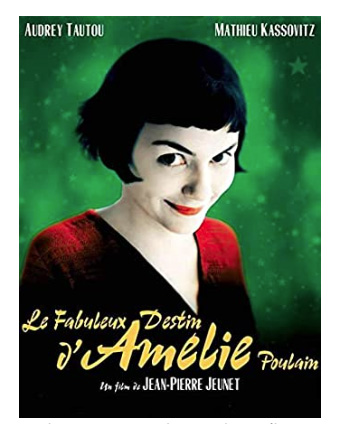
Amélie
Synopsis
Amélie Poulain is a shy young woman living in Montmartre, Paris, where she works as a waitress in a small café. After discovering a hidden box of childhood treasures in her apartment, she decides to find its former owner and return it to him. The emotional reaction to this unexpected gesture inspires her to devote herself to making other people happy through small, secret acts of kindness. As she becomes increasingly involved in the lives of those around her, Amélie gradually realizes that she must also find the courage to pursue her own happiness. Her attention eventually turns to Nino, an equally unusual young man who collects discarded photographs from photo booths.
The film's origins
Jean-Pierre Jeunet developed the idea for Amélie after imagining a character who observes the world from a very personal and unconventional perspective. He wanted to create a romantic comedy that celebrated the small pleasures of everyday life rather than relying on traditional dramatic conflicts. The screenplay was written by Jeunet and Guillaume Laurant, who built an imaginary version of Paris populated by eccentric but deeply human characters. The director was particularly interested in the contrast between the heroine's rich inner world and her difficulty expressing her emotions openly. Audrey Tautou was eventually selected to embody Amélie, bringing an expressive face and a natural sense of mystery to the character. The production was not adapted from a novel or a true story, although it incorporates observations about ordinary people and their private desires. Jeunet also wanted the film to have a distinctive visual identity, with saturated colors, carefully composed images and a nostalgic atmosphere. The result became an affectionate portrait of Paris and a celebration of imagination, kindness and romantic possibility.
Reviews and reception
Critical reception:
Amélie received exceptionally positive reviews from many international critics. Jean-Pierre Jeunet was praised for creating a visually distinctive and imaginative world filled with charming details and memorable characters. Audrey Tautou received particular acclaim for her delicate and expressive performance, which made the heroine both mysterious and emotionally accessible. Bruno Delbonnel's cinematography and the film's carefully constructed production design were also widely admired. Some critics considered its vision of Paris overly romanticized, but its originality and emotional warmth made it one of the most recognizable French films of the early 2000s.
Audience reception:
The film became an international box-office success, attracting audiences far beyond France. Its charming portrayal of Montmartre, unusual characters and gentle humor appealed to viewers looking for an optimistic alternative to conventional romantic comedies. Amélie became particularly popular in Europe and North America, introducing many international viewers to contemporary French cinema. Its success also transformed Audrey Tautou into an internationally recognized actress. The film has since acquired a lasting cultural presence, with its visual style and musical themes remaining instantly recognizable.
Awards and recognition:
Amélie received five Academy Award nominations in 2002, including Best Foreign Language Film, Best Original Screenplay and Best Cinematography. At the César Awards, it won four prizes, including Best Film and Best Director for Jean-Pierre Jeunet. It also received the BAFTA Award for Best Film Not in the English Language and several European Film Awards. The film won the Audience Award at the 2001 Toronto International Film Festival. These achievements confirmed its international importance and helped establish it as one of the most successful French films of its generation.
Behind-the-scenes stories
Director's inspirations:
Jeunet drew inspiration from his affection for unusual personalities, nostalgic objects and the hidden stories of ordinary people. His intention was to create a Paris that felt both recognizable and slightly dreamlike, where seemingly insignificant events could have extraordinary emotional consequences. The director also wanted to celebrate the pleasure of observing small details, such as the sound of a spoon breaking a crème brûlée or stones skipping across a canal. The character of Amélie reflects this fascination with everyday poetry and the private imagination of individuals. The film's visual approach was influenced by French photographic traditions and the director's desire to construct a coherent, almost illustrated world.
Production challenges:
Creating the film's distinctive color palette required extensive work in cinematography and digital image processing. The filmmakers used carefully selected locations in Paris, particularly around Montmartre, to give the story an authentic geographical foundation. Some real locations were digitally modified to remove unwanted visual elements and reinforce the film's stylized atmosphere. The production also involved coordinating numerous supporting characters whose small stories needed to fit naturally into the central narrative. Maintaining the balance between realism and fantasy was one of the most important artistic challenges.
A memorable scene:
The sequence in which Amélie discovers the hidden metal box behind a loose tile in her apartment establishes the emotional direction of the entire film. Inside, she finds childhood treasures belonging to a previous resident and decides to return them anonymously. When she witnesses the former owner reacting emotionally to the discovery, she realizes that a simple gesture can profoundly affect another person. This moment transforms her understanding of happiness and gives her a new purpose. The scene perfectly introduces the film's central belief that small acts of kindness can have extraordinary consequences.
Originally considered casting:
The leading role was initially developed with actress Emily Watson in mind, and the character was originally conceived as an Englishwoman living in Paris. After Watson became unavailable, Jeunet reconsidered the character and adapted the project for a French actress. Audrey Tautou eventually became the definitive choice following her audition. Her performance transformed the character into one of the most memorable heroines of modern French cinema.
Themes explored
Kindness and generosity: Amélie demonstrates that seemingly insignificant gestures can bring happiness to people whose lives have become routine or lonely.
Loneliness and human connection: Many characters live isolated lives, but their encounters reveal a common desire for affection and understanding.
Imagination and childhood: The film celebrates the ability to preserve curiosity and wonder even after entering adulthood.
Love and emotional vulnerability: Amélie must learn that protecting herself from disappointment also prevents her from experiencing genuine happiness.
The beauty of everyday life: Ordinary objects, familiar streets and simple pleasures become sources of extraordinary emotional experiences.
Personal courage: The heroine eventually understands that helping others is not enough if she refuses to take risks for her own future.
Ending explained
At the end of the film, Amélie finally decides to stop observing Nino from a distance and take a chance on a genuine relationship. After several playful encounters and mysterious messages, she allows him to enter her apartment and discover the person behind the unusual clues. Nino gradually understands that the woman he has been searching for is the same person who has repeatedly crossed his path. Their meeting represents a turning point because Amélie finally accepts that happiness cannot always be experienced indirectly through other people. Her fear of rejection gives way to a willingness to be emotionally vulnerable. The final moments show the couple riding together through the streets of Paris, suggesting that Amélie has begun a new chapter in her life. The film does not present love as a magical solution to every difficulty, but as a possibility that becomes real when people dare to reach out to one another.
Meaning of the title
The title Amélie refers to the film's central character, Amélie Poulain. Although her full name appears in the original French title, the international release uses the shorter form Amélie. The simplicity of the title reflects the intimate and personal nature of the story, which is built around one woman's imagination and emotional development. Amélie is not presented as a conventional heroine performing extraordinary actions, but as an ordinary person whose sensitivity transforms the lives of others. The title therefore places the emphasis on her unique personality and her gradual discovery of happiness.
Original soundtrack
The soundtrack, composed primarily by Yann Tiersen, is one of the film's most celebrated artistic elements. Its combination of piano, accordion, strings and delicate instrumental arrangements creates a nostalgic and dreamlike atmosphere perfectly suited to the story. Jeunet discovered Tiersen's music before production and was so impressed that he commissioned additional compositions while incorporating existing pieces from the composer's earlier albums. Tracks such as Comptine d'un autre été: L'après-midi and La Valse d'Amélie became internationally recognizable. Tiersen received the César Award for Best Music Written for a Film in 2002. His compositions have become inseparable from the film's identity.
Similar films
Delicatessen (1991): Another Jean-Pierre Jeunet film combining eccentric characters, unusual visual compositions and darkly poetic humor.
The Science of Sleep (2006): A romantic fantasy exploring imagination, dreams and the difficulty of expressing genuine emotions.
Midnight in Paris (2011): A nostalgic celebration of Paris, artistic inspiration and the fascination with another era.
Chocolat (2000): A warm story about kindness, personal freedom and the transformative influence of small gestures.
Little Miss Sunshine (2006): A charming ensemble comedy about unconventional people discovering the importance of human connection.