

 Français
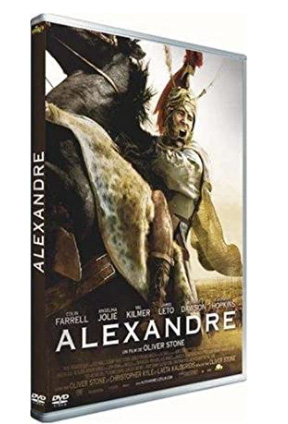
Alexander
Synopsis
Born the son of King Philip of Macedon and the ambitious Olympias, Alexander grows up in a court torn by intrigue and rivalry. After his father's assassination, the young king sets out to conquer the known world, leading his army through Persia, Egypt and as far as India. His charisma and daring win him the loyalty of his men, but his dreams of glory gradually isolate him. The film follows the rise and fall of one of history's most legendary figures, as told by his old companion Ptolemy.
The Making of the Film
Alexander is a historical epic directed by Oliver Stone, who had dreamed of making a film about Alexander the Great since his youth. Stone co-wrote the screenplay and drew on historical sources, including the work of the historian Robin Lane Fox, who served as a consultant. Colin Farrell played the title role, supported by Angelina Jolie as his mother Olympias, Val Kilmer as King Philip and Anthony Hopkins as the older Ptolemy. The production was a vast international undertaking, with filming in Morocco, Thailand and the United Kingdom. Stone later released several re-edited versions of the film, including a Director's Cut and a Final Cut. The original theatrical version was released in late 2004.
Reviews and Reception
Summary of Professional Reviews
Critics were largely negative about the film. Many found the narrative confusing and overloaded with dialogue and exposition, and felt that the central character lacked depth. Some reviewers praised the ambition of the battle scenes and the lavish production design. Colin Farrell's performance was divisive, while Angelina Jolie's exaggerated accent drew particular comment.
Audience Reception
The film was a disappointment in North America, but performed far better in international markets, earning well over 150 million dollars worldwide. In several countries, it found a more receptive audience than in the United States. Over time, some viewers have re-evaluated it as a flawed but fascinating epic. It remains a much-debated entry in Stone's career.
Filming Anecdotes
Production Challenges
The shoot was enormous and logistically complex, involving thousands of extras, trained war elephants and sprawling sets. The production moved between several continents, which made scheduling and weather difficult. Stone was so dissatisfied with the reception of the theatrical cut that he re-edited the film several times, producing a longer and more detailed version.
Anecdote About a Particular Scene
The battle of Gaugamela, one of the film's major set pieces, was shot in the Moroccan desert with a huge army of extras and hundreds of horses. The sequence was designed to convey the chaos and scale of ancient warfare. It is often cited as the most striking and ambitious sequence in the film.
Themes Explored
The film is a portrait of ambition, glory and the burden of leadership. It shows how a young man's dream of uniting the world can become an obsession that costs him his closest relationships. The influence of family, particularly the complicated bond with his mother, shapes his personality. Love and loyalty, especially in his relationship with his friend Hephaestion, play a central role. The story also deals with the clash between East and West, as Alexander tries to blend Greek and Persian cultures. Behind the spectacle, it is a meditation on the price of greatness.
Ending Explained
The film closes with the death of Alexander in Babylon, leaving his empire without a clear successor. His generals divide the territory among themselves, and the dream of a united world quickly collapses. The story is told in flashback by Ptolemy, who reflects on his friend as an extraordinary man whose ambition outran his time. The ending underlines the idea that glory is fleeting, even for a conqueror.
Meaning of the Title
The title is the name of its subject, Alexander the Great, the Macedonian king who created one of the largest empires in ancient history. By using only his first name, the film emphasizes the legendary status of the figure. It also suggests that the story is a personal portrait rather than a purely historical account.
Soundtrack
The score was composed by Vangelis, who had previously won an Academy Award for "Chariots of Fire". His music blends orchestral grandeur, choral passages and ethnic instruments to evoke the ancient world. It is considered one of the most distinctive and memorable elements of the film.
News
Oliver Stone released several alternative versions of the film, including "Alexander Revisited: The Final Cut" in 2007, which presents a substantially re-edited and longer version of the story.
Similar Films
- Gladiator (2000): a sweeping epic set in ancient Rome.
- Troy (2004): a mythological war film released the same year.
- Braveheart (1995): a historical epic about a legendary leader.
- Kingdom of Heaven (2005): a large-scale historical drama with a director's cut.