

 Français
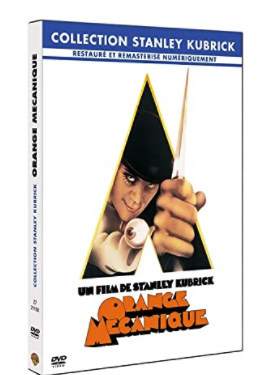
A Clockwork Orange
Synopsis
In a near-future England, Alex DeLarge leads a gang of young thugs who spend their nights on "ultra-violence", rape and theft. Betrayed by his friends and arrested for murder, he volunteers for an experimental government treatment that conditions him to feel sick at the thought of violence. Released back into society as a harmless shell, he becomes a victim of those he once terrorized. The film asks whether a man forced to be good is still a man at all.
The Making of the Film
The film is adapted from Anthony Burgess's 1962 novel of the same name, a short and fiercely inventive book written in a made-up teenage slang called Nadsat. Stanley Kubrick came across the novel in the late 1960s and was fascinated by its mix of dark satire, philosophy and violence. He wrote the screenplay himself, working from the American edition of the book, which omits the final chapter in which Alex begins to outgrow his violent urges. That choice gives the film a more cynical and ambiguous ending than Burgess had intended. Kubrick saw the story as a bitter reflection on free will and state control.
Reviews and Reception
Summary of Professional Reviews
Critics were deeply divided. Some hailed the film as a daring masterpiece of satire and visual style, while others condemned it for what they saw as a glorification of violence. Over time, its reputation has grown enormously, and it is now regarded as one of Kubrick's defining works and a landmark of 1970s cinema.
Audience Reception
The film provoked intense reactions on release, with heated debate about its brutality and its supposed influence on real crimes. In the UK, Kubrick himself pulled it from distribution in 1973 after receiving threats, and it remained unavailable there until after his death. Today it is a cult classic, endlessly quoted and referenced in pop culture.
Awards Won
The film received four Academy Award nominations, for Best Picture, Best Director, Best Adapted Screenplay and Best Film Editing, though it did not win. It also won major prizes from the New York Film Critics Circle, including Best Film and Best Director.
Filming Anecdotes
Director's Inspirations
Kubrick wanted a deliberately artificial, stylized world, mixing futuristic design with a retro-pop aesthetic. He leaned on classical music and a cold, symmetrical visual style to create a disturbing contrast with the brutality on screen.
Production Difficulties
The shoot was physically demanding for Malcolm McDowell, who cracked ribs during the filming of the beating scenes and suffered a scratched cornea during the Ludovico treatment sequence. Kubrick also worked fast and on a modest budget, using real locations, modern architecture and unusual props to build his future.
Anecdote About a Particular Scene
The infamous rendition of "Singin' in the Rain" during the home-invasion scene was reportedly improvised by Malcolm McDowell. Kubrick liked it so much that he had the rights to the song secured. The chilling contrast between cheerful music and brutal violence became one of the most notorious moments in film history.
Themes Explored
A Clockwork Orange is a provocative examination of free will versus conditioning, asking whether goodness has any value if it is not chosen. It questions the role of the state in controlling its citizens and the moral cost of curing violence by stripping away someone's humanity. The film is also a biting satire of institutions, from the prison system to politicians and psychiatrists. Youth rebellion, class and the seductive pull of violence are woven throughout. By making Alex both repulsive and strangely charismatic, it forces the viewer to confront their own reactions.
Ending Explained
After the government's treatment is reversed, Alex wakes in a hospital as his old self, and a smiling minister feeds him as photographers record the scene. His narration declares that he is cured, meaning his violent fantasies have returned, now protected by political convenience. The final image suggests that society is just as manipulative as Alex, only more respectable. Burgess's original ending, in which Alex matures, was omitted in the American edition that Kubrick used, which makes the film's conclusion considerably bleaker.
Meaning of the Title
Burgess took the title from a Cockney expression, "as queer as a clockwork orange", which describes something strangely unnatural. In the story, it describes a human being, an organic and living thing, who has been turned into a machine that obeys mechanical rules. The title is therefore a compact image of the book's central idea: a person stripped of choice is no longer fully alive.
Original Soundtrack
The film's music is among the most celebrated in cinema. Wendy Carlos created eerie, pioneering synthesizer arrangements of classical pieces, while Beethoven's Ninth Symphony becomes a recurring, unsettling presence tied to Alex's psyche. The choice of classical music over typical film scores is central to the movie's disturbing, ironic tone.
Similar Films
- Trainspotting: youth, excess and moral chaos with a dark sense of humor.
- Natural Born Killers: a satirical take on violence and media.
- The Shining: another cold, meticulous work by Kubrick.
- Taxi Driver: a disturbing portrait of alienation and violence.