

 Français
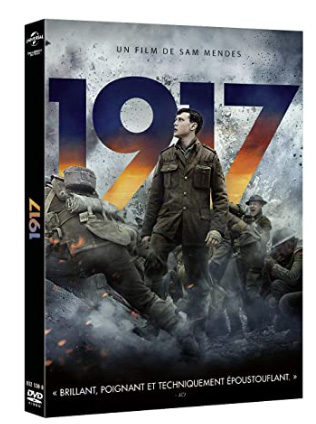
1917
Synopsis
During the First World War, two young British soldiers, Lance Corporals Schofield and Blake, receive an urgent mission. They must cross enemy territory to deliver a message that could prevent a British battalion from walking into a German trap. Blake has an additional personal reason to complete the mission because his brother is among the soldiers at risk. With time running out, the two men face devastated landscapes, enemy positions and unpredictable dangers. Their journey becomes a desperate race against time through the horrors of war.
The Making of the Film
Sam Mendes developed 1917 from stories told by his grandfather, Alfred Mendes, who served in the British Army during the First World War. His grandfather had described experiences as a messenger, carrying information across dangerous territory under extremely difficult conditions. Mendes wanted to transform the emotional impression of those stories into a film about an ordinary soldier facing an extraordinary responsibility. He worked with screenwriter Krysty Wilson-Cairns to create a fictional mission inspired by the realities of wartime communication. The story was not intended as a direct account of one historical operation, but it draws on the conditions and dangers experienced by soldiers on the Western Front. Mendes also wanted the audience to experience the passage of time with the two protagonists rather than observe the war through a conventional sequence of scenes. This led to the decision to present the film as an apparently continuous journey. The project combined historical research, carefully planned choreography and an ambitious technical approach. Its central idea was to make the audience feel physically present beside the soldiers.
Critical Reception
Professional Reviews
1917 received widespread critical acclaim, particularly for its cinematography, technical ambition and immersive presentation of combat. Reviewers praised Roger Deakins' work, which creates the impression that the camera follows the soldiers through one continuous movement. The performances of George MacKay and Dean-Charles Chapman were also widely appreciated for their emotional restraint and physical intensity. Critics frequently highlighted the film's sound design, production design and carefully coordinated action sequences. Some reviewers felt that its emphasis on spectacle occasionally simplified the wider political and historical context of the war. Nevertheless, the film was widely regarded as one of the most technically accomplished war films of its period.
Audience Reception
The film achieved strong audience interest and considerable commercial success. Its immersive visual style made it particularly effective on large cinema screens. Many viewers responded to the tension created by the mission's deadline and the apparent continuity of the journey. The emotional relationship between the two soldiers also helped audiences connect with the wider historical setting. Its popularity extended beyond traditional war-film audiences, attracting viewers interested in ambitious cinematic experiences.
Awards
1917 received ten Academy Award nominations and won three Oscars, including Best Cinematography, Best Sound Mixing and Best Visual Effects. It also won major honours at the Golden Globes, including Best Motion Picture – Drama and Best Director for Sam Mendes. The film received recognition from the BAFTA Awards, where it won several prizes, including Best Film and Outstanding British Film. Roger Deakins' cinematography was especially celebrated throughout the awards season. These distinctions confirmed the film's position as one of the most acclaimed productions of 2019.
Behind the Scenes
Director Inspirations
Sam Mendes was inspired by the wartime experiences of his grandfather, who served as a messenger during the First World War. The director wanted to communicate the vulnerability of soldiers who had to cross dangerous territory without knowing what awaited them. The film also draws on the tradition of war cinema, but its structure was designed to create an unusually immediate experience. Mendes and cinematographer Roger Deakins studied how camera movement could follow characters through complex environments without making the technique feel artificial.
Production Challenges
The apparent continuous shot required extremely precise coordination between the camera department, actors, stunt performers and set construction teams. Although the film appears to unfold in one uninterrupted take, it was assembled from numerous carefully choreographed long takes connected through concealed transitions. The crew had to plan the movement of the camera through trenches, ruined villages, open fields and underground spaces. Large sets were built to accommodate the camera's movement and the timing of the performers. The production also relied on detailed rehearsal so that explosions, background action and changes in lighting would happen at precisely the right moment. These technical demands made the shoot unusually complex.
A Particular Scene
The nighttime sequence in the ruined town is among the film's most visually striking passages. Schofield moves through streets illuminated by flares while German soldiers and explosions create a constantly changing landscape of danger. The camera follows him through the darkness, allowing the audience to experience the confusion and disorientation of the environment. The sequence required careful coordination between lighting, pyrotechnics, camera movement and the actor's performance. Its visual design demonstrates how the continuous-shot approach can create suspense without relying on conventional editing.
Casting
George MacKay and Dean-Charles Chapman were selected to carry the story as Schofield and Blake. Their performances needed to communicate fear, exhaustion and determination while maintaining the physical continuity of the journey. The supporting cast includes Colin Firth, Benedict Cumberbatch, Mark Strong, Andrew Scott and Richard Madden. Their appearances are relatively brief, reflecting the protagonists' limited encounters with other people during the mission.
Themes
Duty and sacrifice are central to 1917. The two soldiers are asked to risk their lives to save men they may never meet, showing how individual actions can have consequences for hundreds of others. The film also examines friendship and the emotional bond that develops between soldiers under extreme pressure. Blake's personal motivation gives the mission an intimate dimension, while Schofield's determination becomes increasingly important as the journey continues. The landscape of the Western Front is presented as a place where destruction has transformed ordinary geography into a hostile environment. Communication is another major theme: a written message can determine whether thousands of men advance or survive. The film explores the psychological effects of combat, including fear, exhaustion and the difficulty of continuing after traumatic experiences. Its continuous visual structure reinforces the feeling that war offers no convenient pause or escape. Ultimately, the story honours the courage of ordinary people caught in extraordinary circumstances.
Ending Explained
Schofield eventually reaches the British forces and delivers the message that prevents the planned attack from continuing. His mission succeeds, but the personal cost is considerable because Blake has been killed during their journey. Schofield finds Blake's brother and tells him what happened, completing the emotional purpose that had motivated the younger soldier. The final scene shows Schofield sitting beneath a tree, exhausted after the events of the mission. This image recalls the film's opening, in which he was also resting beneath a tree before receiving his orders. The repetition suggests that the experience has transformed him even though the physical setting appears familiar. He has survived, but the memories of the journey and the loss of his companion will remain with him. The ending does not present victory as a simple triumph; it emphasises the human cost behind every successful military operation.
Meaning of the Title
The title 1917 refers to the year in which the story takes place, during the First World War. It situates the fictional mission within a specific historical moment on the Western Front. The simplicity of the title contrasts with the enormous scale of the conflict and the complexity of the soldiers' experiences. By using a year rather than a descriptive phrase, the film presents itself as a window into a particular period of history. The title also reminds viewers that the events belong to a real war that affected millions of people. It gives the story a documentary-like directness while leaving room for its fictional characters and mission.
Original Soundtrack
Thomas Newman composed the original score for 1917, creating music that supports the film's tension and emotional progression. The score moves between restrained passages and more intense orchestral sequences as the soldiers encounter danger. Its use is carefully coordinated with the camera movement, helping the journey feel continuous. The music does not constantly dominate the soundscape; it works alongside the effects of explosions, gunfire, footsteps and silence. This balance contributes significantly to the film's immersive atmosphere. Newman's work received major awards-season recognition, including an Academy Award nomination for Best Original Score.
Similar Films
- Saving Private Ryan (1998), another major war film centred on a dangerous mission behind enemy lines.
- Dunkirk (2017), which uses an innovative structure to create an immersive portrait of wartime survival.
- Paths of Glory (1957), a powerful examination of military authority and the human cost of war.
- All Quiet on the Western Front (2022), a visceral depiction of the experiences of soldiers during the First World War.