

 Français
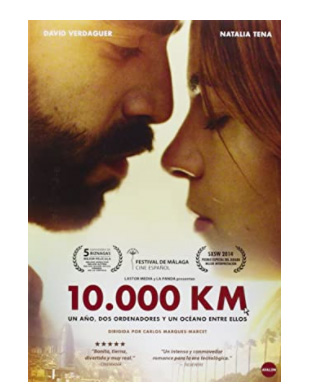
10,000 km
Synopsis
Set in Barcelona and Los Angeles, the film follows Sergi and Alex, a devoted long-term Spanish couple living in Barcelona who are on the verge of finally trying to have a baby and buy a permanent home. Their plans are suddenly upended when Alex, a talented photographer, accepts a prestigious one-year artist residency in Los Angeles. Separated by ten thousand kilometers and a nine-hour time difference, the couple attempts to maintain their intimate bond exclusively through video calls, instant messaging, and webcams. As months drag on, the physical distance, screen delays, and unspoken resentments slowly strain their relationship to its absolute breaking point. The intimate indie drama explores modern love mediated entirely through technology.
The Making of the Film
Catalan director Carlos Marques-Marcet co-wrote and directed the micro-budget indie drama to explore how modern long-distance relationships are mediated and distorted by digital communication technology. Marques-Marcet wanted to capture the hyper-realistic experience of modern expatriate life and Skype-dependent romance. Producers secured Spanish film funding to mount the minimalist two-character production. The script focused heavily on real-time emotional degradation across computer screens.
Critical Reception
Résumé des critiques professionnelles : Critics offered widespread critical acclaim, praising Natalia Tena and David Verdaguer's astonishingly naturalistic, fearless lead performances and the brilliant conceptual framing of setting an entire romance across computer monitors. Reviewers commended Carlos Marques-Marcet for capturing the agonizing intimacy and isolation of digital communication. The film was celebrated as a remarkably modern and emotionally resonant indie triumph.
Réception du public : Audiences responded with deep emotional connection, especially expatriates and young couples familiar with long-distance separation via video calls. Viewers praised the raw honesty of the script and the palpable chemistry between the leads. Word-of-mouth sustained strong festival and streaming success.
Récompenses obtenues : The film swept the Spanish Goya Awards and Malaga Film Festival, winning multiple major prizes including Best New Director, Best Screenplay, and Best Actress for Natalia Tena.
Behind-the-Scenes Stories
Inspirations du réalisateur : Carlos Marques-Marcet drew inspiration from real-life millennial migration experiences, contemporary long-distance relationships, and minimalist theatrical two-handers. He wanted the computer screens and webcams to feel like genuine architectural spaces within the apartments. Visual styling favored continuous long takes to preserve uninterrupted emotional realism.
Difficulties de production : Filming extended sequences where actors interacted purely through laptop webcams required meticulous technical coordination of live video feeds and split-screen audio timing. Natalia Tena and David Verdaguer lived in separate physical apartments during parts of the shoot to generate authentic feelings of real-world geographical separation. Managing the intimate, vulnerable emotional scenes required deep trust between the director and the two lead actors.
Anecdote sur une scène particulière : The grueling twenty-minute continuous-shot Skype argument sequence was filmed in a single unbroken take, capturing raw, unscripted emotional exhaustion from both actors. Natalia Tena and David Verdaguer improvised subtle technological glitches and awkward internet freezes to maintain hyper-realistic immersion. The apartment sets were specially wired with camera rigs to mimic real laptop webcams.
Casting initialement prévu : Natalia Tena and David Verdaguer were cast early after the director recognized their electric real-life chemistry and improvisational theatrical training.
Themes Explored
The film explores modern long-distance romance, technological mediation of intimacy, geographical dislocation, career ambition versus relationship sacrifice, and emotional erosion. It examines how digital screens both connect and isolate lovers. Another core theme is the fragility of trust. Ultimately, it is a deeply modern portrait of a relationship under digital siege.
Ending Explained
The narrative concludes after Alex returns to Barcelona following her year in Los Angeles, leading to an initially joyful reunion that quickly curdles into painful awkwardness as they realize the insurmountable emotional chasm created by their year apart. During a quiet morning in their apartment, they share a bittersweet, silent glance, acknowledging that their relationship has fundamentally fractured beyond repair. The final lingering shot captures their quiet heartbreak. It signifies a realistic, melancholic end to a digital romance.
Meaning of the Title
The title '10,000 km' refers directly to the literal geographical distance separating Barcelona and Los Angeles, symbolizing the immense physical chasm that tests the limits of digital intimacy. It grounds the modern romance in physical displacement.
Original Soundtrack
Carlos Falanga composed a minimalist, ambient acoustic score that accented the quiet apartment spaces and digital silence between video calls.
["Her", "Blue Valentine", "Before Sunset"]